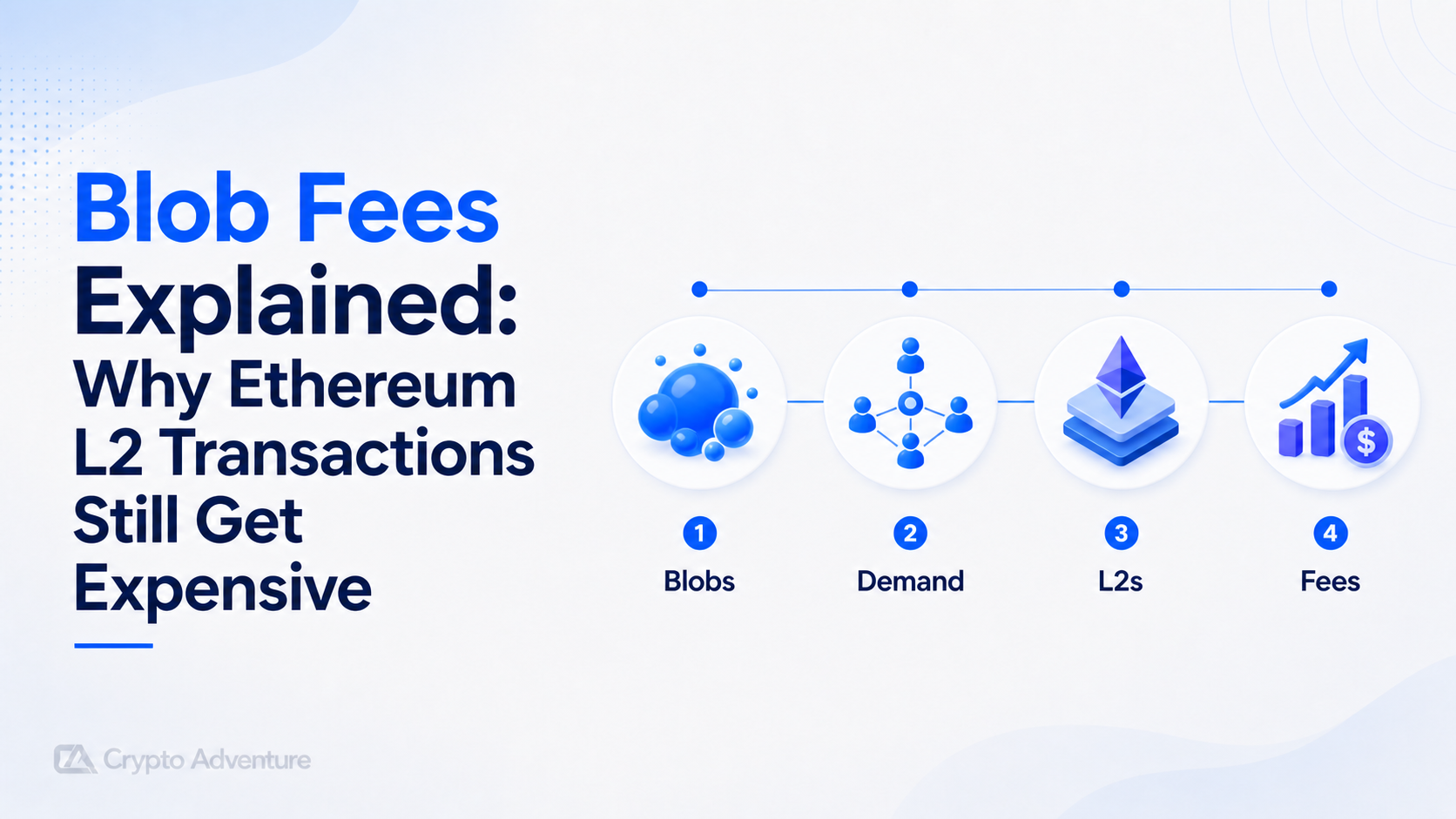
Blob fees are the cost paid for a special kind of Ethereum data space used by rollups. They were introduced through EIP-4844, also known as proto-danksharding, as part of Ethereum’s Dencun upgrade. The goal was to make rollup data much cheaper than old calldata.
Before blobs, rollups often posted transaction data to Ethereum as calldata. That was expensive because the data was processed by Ethereum nodes and stored permanently. Blobs changed the model. Rollups can now attach large data blobs to Ethereum blocks, while the blob data stays available for a shorter period instead of living on Ethereum forever.
Rollups need temporary data availability so anyone can verify and reconstruct the L2 state, but they do not need every byte stored permanently inside Ethereum execution history. Blobs give rollups cheaper temporary space for that data.
Blobs reduced one of the biggest rollup cost inputs. A rollup still executes transactions offchain, but it must publish enough data to Ethereum so the system stays verifiable. That published data lets users, nodes, and challengers check the rollup state.
With blobs, rollups no longer need to push all that data into the same expensive execution gas market. Blob data uses a separate fee market. That separate market can be much cheaper when blob demand is low.
This is why many Ethereum L2 transactions became much cheaper after Dencun. The base layer did not become cheap for normal Ethereum L1 users in the same way. The biggest benefit went to rollups because blobs directly lowered their data publishing cost.
Blob fees reduce costs, but they do not remove congestion. Ethereum did not make blob space unlimited. Blob space has a target and a fee market. When more rollups compete for the same blob capacity, the blob base fee can rise.
This is similar to how Ethereum gas works. If demand is low, fees stay cheap. If demand rises above target, fees increase. Blob fees can stay low for long periods, then spike when many rollups, apps, airdrops, mints, trading bursts, or chain events create heavy demand at the same time.
An L2 transaction also has more than one cost component. Users may pay for L2 execution, L1 data posting, priority fees, operator margins, congestion inside the rollup, bridge fees, or app-level routing costs. Blob fees are one piece of the full price.
EIP-4844 created a separate blob gas market. Blob-carrying transactions pay for blob gas, and the blob base fee adjusts based on blob demand. This keeps blob pricing separate from normal Ethereum execution gas.
That separation is powerful because L2 data does not need to fight every DeFi swap, NFT mint, and contract call in the same fee market. It also means blob prices can move independently. Ethereum gas can be high while blobs stay cheap, or blobs can spike when rollup demand becomes crowded.
This is the key point for users: cheap blobs are not a permanent guarantee. They are a market. If blob demand rises, L2 fees can rise even when the technology is working exactly as designed.
Rollups need data availability. A rollup cannot simply process transactions privately and ask users to trust the operator. It needs to publish enough information so others can verify state, build proofs, challenge invalid claims, or reconstruct balances if something breaks.
Ethereum’s data availability materials explain why this matters. Rollups and light nodes need strong assurances that data exists and can be checked without every participant downloading everything forever.
Blobs make that data availability cheaper. They do not remove the requirement. If a rollup wants Ethereum security, it still has to pay Ethereum for data availability.
The first reason is rollup demand. More L2 transactions mean more batches, more data, and more blob pressure.
The second reason is chain events. Airdrops, token launches, inscriptions, liquidations, meme coin trading, NFT mints, and bridge rushes can all push transaction volume higher.
The third reason is competition between rollups. Ethereum has many L2s. When several rollups need blobs at the same time, they compete for the same data space.
The fourth reason is compression quality. Rollups that compress data well can use blob space more efficiently. Rollups that publish more data per user transaction can face higher costs.
The fifth reason is fee pass-through. Some rollups pass changing data costs to users quickly, while others smooth fees, subsidize activity, or change pricing through their own fee models.
Two L2s can use the same Ethereum blob market and still charge different user fees. That happens because each rollup has its own execution engine, batching cadence, compression design, sequencer policy, profit margin, fee token, and congestion model.
A high-volume rollup can spread blob costs across many transactions, but it can also hit internal congestion. A smaller rollup may have lower demand but less batching efficiency. A rollup with better compression may post less data per transaction. A rollup with higher margins may keep fees higher even when blobs are cheap.
Users should not assume all L2s become cheap at the same time. Blob fees are shared infrastructure, but each L2 turns blob cost into user fees differently.
Users can reduce fee pain by checking transaction costs before signing, especially during airdrops, NFT mints, volatile markets, or major L2 launches. Fees can change quickly when many users move at once.
Stable timing matters. Sending transactions during calmer periods can reduce both L2 execution fees and blob-driven data costs. Bridges and swaps should be checked carefully because routed transactions may include extra costs beyond a simple transfer.
Users should also compare L2s. A transaction that is expensive on one rollup may be cheaper on another because of batching, demand, execution cost, or fee policy. This is especially important for smaller transfers where fees can eat a larger share of value.
Blobs are not the final scaling step. Proto-danksharding is an intermediate stage before fuller Ethereum data scaling. Future upgrades aim to expand data availability capacity and make rollups cheaper and more scalable over time.
Even then, fees will not disappear. Better capacity usually lowers costs at the same demand level, but successful scaling also attracts more usage. More apps, users, rollups, and AI agents can fill new capacity again. Ethereum scaling is a moving target because demand grows with better infrastructure.
Blob fees made Ethereum L2s much cheaper by giving rollups temporary data space outside the normal execution gas market. They solved a major cost problem, but they did not make L2 transactions permanently cheap.
L2 fees can still rise when blob demand increases, rollups compete for data space, app activity spikes, or a specific rollup passes costs through aggressively. Users should treat blobs as a cheaper data market, not free bandwidth. The better habit is to check fees before signing, avoid crowded moments when possible, compare L2s, and understand that every rollup still pays Ethereum for the data that keeps it secure.
The post Blob Fees Explained: Why Ethereum L2 Transactions Still Get Expensive appeared first on Crypto Adventure.





