Bloomberg Law reported that the Washington office of the Deputy Attorney General ordered the US Attorney’s Office in New Jersey to dismiss the case with prejudice, a designation that permanently bars prosecutors from refiling the charges. A court filing shows the defense reached an agreement in principle to resolve the pending wire fraud and unregistered securities counts, with authorities preserving only civil avenues to recover money for victims.
BitClub Network sold itself as a passive-yield Bitcoin mining operation: investors bought shares in mining pools and were promised a cut of the output. According to the 2019 indictment, the output figures were invented. Prosecutors alleged Goettsche directed staff to manipulate the displayed mining earnings while describing his target audience in private messages as “idiots” and “sheep,” language that made the case a fixture in crypto-fraud coverage for years.
The strength of the government’s position was never seriously in doubt on the record. Three of Goettsche’s associates, Silviu Balaci, Joseph Abel, and Gordon Beckstead, pleaded guilty to their roles in the scheme, an unusual foundation on which to abandon the prosecution of the alleged principal. Dropping charges against the accused mastermind after securing convictions against his subordinates inverts the standard prosecutorial sequence, where cooperators plead in order to build the case upward.
The reversal aligns with the April 2025 memo from Deputy Attorney General Todd Blanche instructing the department to end its “regulation by prosecution” approach to digital assets, disband its crypto enforcement infrastructure, and narrow charging decisions in token-related cases. The BitClub dismissal extends that doctrine further than most observers expected: BitClub was never a case about regulatory ambiguity or token classification, but a straight fraud allegation involving fabricated numbers and identifiable victims.
The Block reported that Goettsche retained a legal team with direct lines into the administration, including Brett Tolman, a conservative criminal-justice advocate, and Bradford Cohen, a lawyer and former contestant on The Apprentice, both known for their proximity to Donald Trump. The combination of a policy shift written broadly and advocacy aimed at the officials applying it leaves open the question of where the new enforcement line actually sits, and the answer matters for every pending crypto fraud docket in the country.
Measured strictly against other crypto Ponzi schemes, the pyramid-style operations that pay early investors with new deposits rather than collapses like FTX or exchange hacks, BitClub sits fifth on the all-time list, and it remains the biggest ever built specifically around mining. The four schemes above it took heavier losses but met a very different enforcement response:
OneCoin doubles as the benchmark for what a full criminal pursuit looks like. The Justice Department worked that case across a decade and multiple continents: Greenwood received a 20-year sentence in September 2023, the scheme’s head of legal and compliance received four years, and Ignatova remains on the FBI’s Ten Most Wanted list with a $5 million reward attached.
The OneCoin file also shows the two enforcement tracks diverging in real time. In April 2026, the department opened a compensation process for OneCoin victims from more than $40 million in forfeited assets. Asset recovery and remission continue; what has changed is the appetite for putting alleged crypto fraudsters in front of juries. BitClub victims may yet see civil recoveries, but the deterrence function of a criminal conviction, the element that produced 20-year sentences in the OneCoin cases, is what the dismissal removes.
The timing gives the policy question its edge. TRM Labs recorded 207 crypto hacks and exploits in the first half of 2026, more than double the 83 incidents in the same period of 2025 and the highest count in any six-month span the firm has tracked. Total losses of roughly $972 million came in at less than half of last year’s $2.3 billion, but the drop reflects the absence of a single mega-theft on the scale of 2025’s $1.5 billion Bybit hack rather than a safer environment.
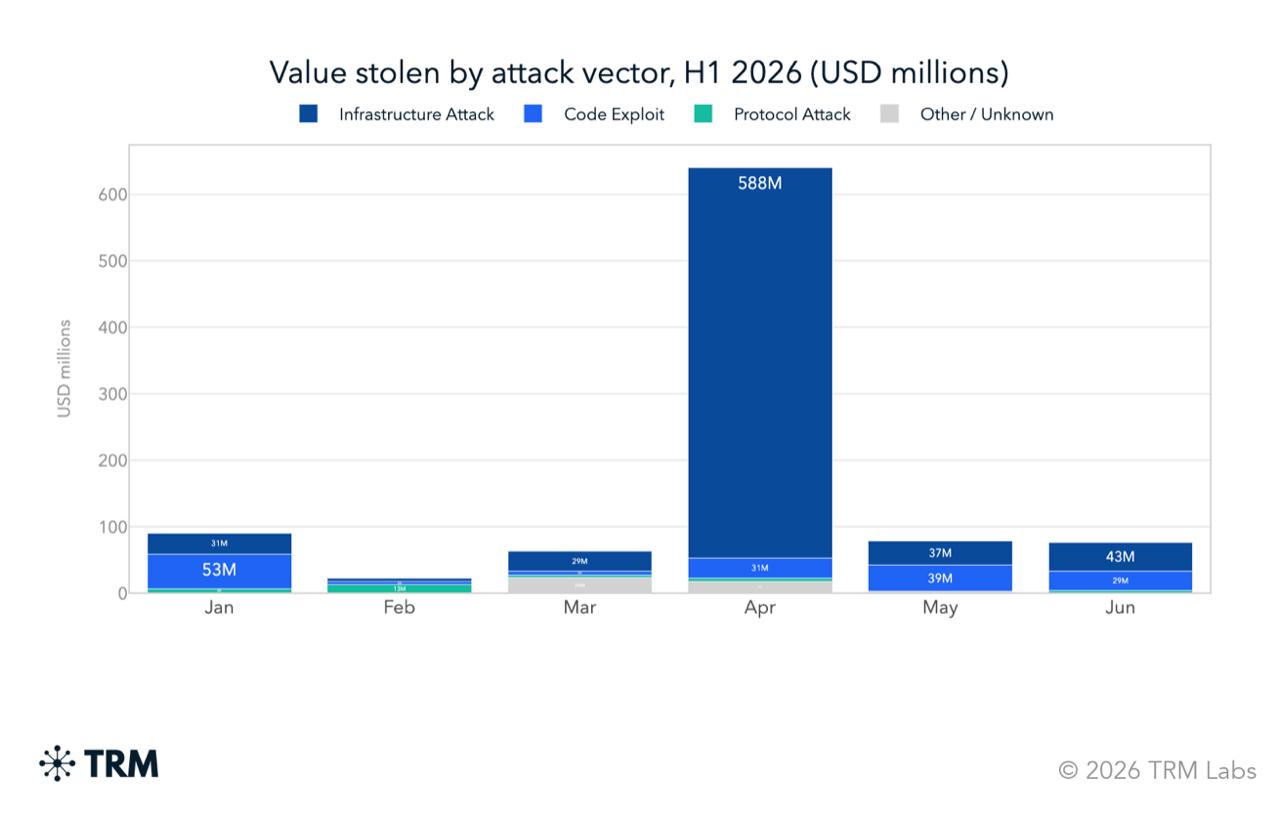
North Korea-linked groups accounted for approximately $643 million, about 66% of everything stolen, driven almost entirely by the April attacks on Drift Protocol ($285 million) and KelpDAO ($292 million). The composition of the losses is the more durable warning: infrastructure and key compromises made up only 15% of incidents but 76% of stolen value. Ari Redbord, global head of policy and government affairs at TRM Labs, said the industry’s “operational security has not kept pace with our on-chain complexity.”
Set the two developments side by side and the asymmetry is hard to miss. Attack volume against crypto users and protocols is at an all-time high, dominated by a state actor beyond the reach of US courts, while the criminal-enforcement track for domestic crypto fraud is being wound down case by case. Civil recovery can return money; it cannot replace the deterrent that the OneCoin sentences were designed to project.
The BitClub dismissal is one data point, but a dismissal with prejudice in a $722 million fraud case with cooperating co-defendants is a loud one. For now the crypto industry can keep an eye on whether the formal dismissal filing lands in New Jersey federal court and on what stated grounds, whether civil actions or forfeiture proceedings against Goettsche follow, and whether other defendants in pending crypto fraud cases begin citing the BitClub outcome in their own motions. If they succeed, the doctrine written in the April 2025 memo could reshape the risk calculus for fraud in a market that just posted its busiest six months of attacks on record.
The information provided in this article is for informational purposes only and does not constitute financial, investment, or legal advice.
The post The End of a Landmark Crypto Ponzi Case: Why DOJ Could Drop It appeared first on Coindoo.





