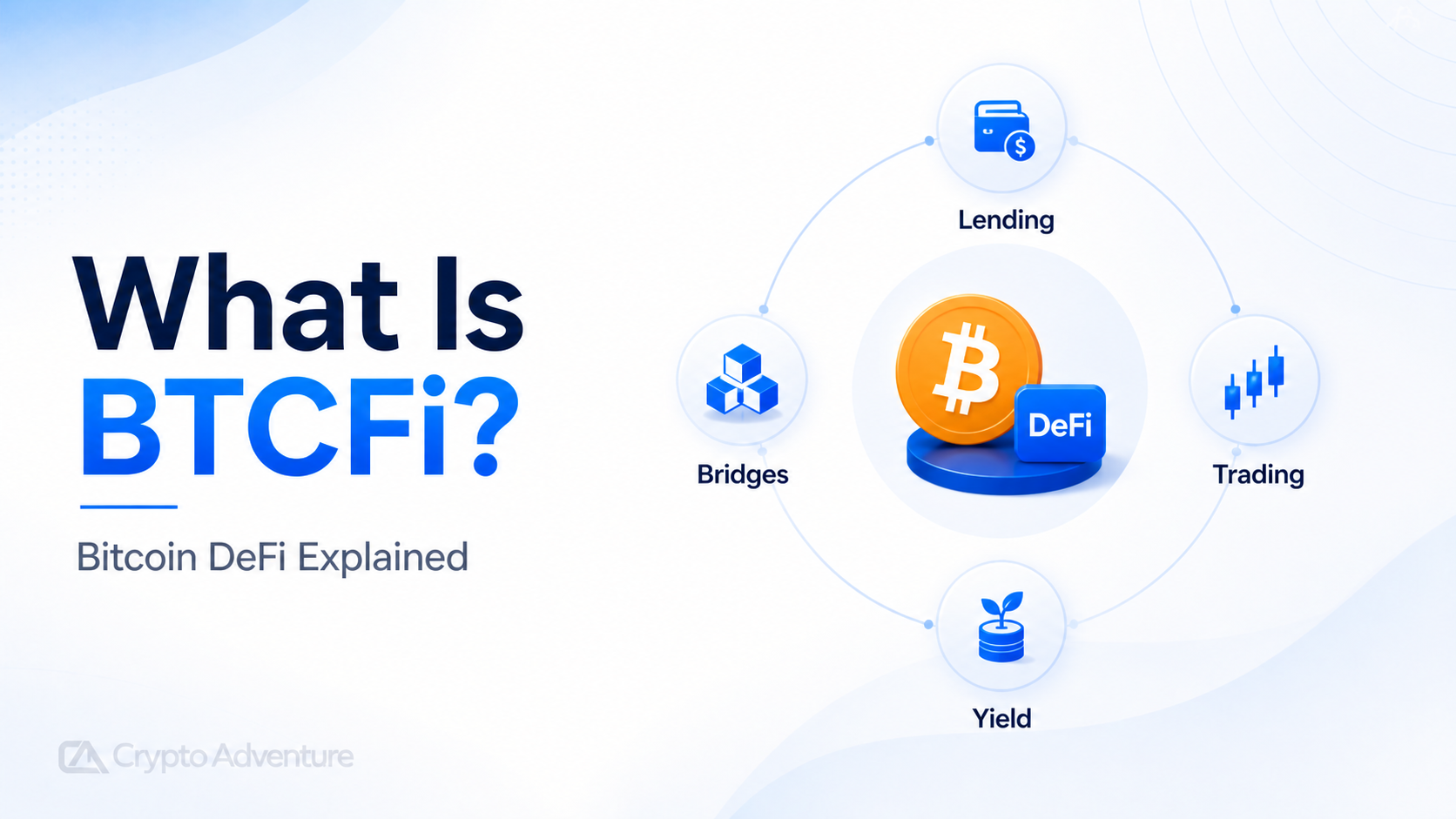
BTCFi means Bitcoin DeFi. It refers to financial applications that use Bitcoin as collateral, settlement asset, yield source, or security layer. The goal is to make BTC productive without changing Bitcoin’s base chain into a general-purpose smart contract platform.
Bitcoin was built first as sound money and censorship-resistant settlement. It does not have Ethereum-style smart contracts at the base layer, and that restraint is part of its security culture. BTCFi tries to bring lending, borrowing, stablecoins, staking, swaps, liquidity, and yield to Bitcoin through sidechains, Layer 2 networks, bridges, wrappers, restaking protocols, and Bitcoin-secured systems.
The category is growing because Bitcoin holds the deepest store-of-value liquidity in crypto. If even a small share of idle BTC moves into financial applications, the market opportunity is large. The hard part is doing that without introducing weak custody, fragile bridges, or yield products that turn Bitcoin’s low-risk monetary role into high-risk leverage.
Bitcoin DeFi took longer because Bitcoin’s base layer is deliberately limited. That is not a weakness by itself. It protects the monetary layer from frequent changes, complex contract bugs, and application-level chaos. It also means developers need other ways to build financial apps around BTC.
Ethereum DeFi grew quickly because smart contracts, ERC-20 tokens, and composability were native to the chain. Bitcoin builders had to rely on sidechains, wrapped BTC, federated bridges, Lightning, DLCs, Taproot-era scripting, and newer approaches such as BitVM and Bitcoin staking.
That creates a different risk profile. Ethereum DeFi often starts with contract risk. BTCFi often starts with bridge, custody, peg, validator, or settlement risk. The most important user question is not only what the yield is. It is what happened to the BTC.
BTCFi has several building blocks. The first is wrapped or pegged BTC, where native Bitcoin is represented on another chain. The second is Bitcoin Layer 2s or sidechains, where smart contracts can run closer to Bitcoin. The third is Bitcoin staking, where BTC secures external systems without leaving the Bitcoin chain. The fourth is Bitcoin-backed lending, where users borrow stablecoins or other assets against BTC exposure.
Stacks brings smart contracts and Bitcoin-linked settlement through its own chain, with sBTC representing BTC 1:1 on Stacks. Rootstock uses rBTC as smart Bitcoin inside an EVM-compatible sidechain secured through merged mining. Babylon focuses on Bitcoin staking, letting BTC holders secure decentralized networks while maintaining self-custody.
These systems are not identical. sBTC, rBTC, wrapped BTC, and Babylon-staked BTC all create different trust assumptions. A BTCFi user should never treat every BTC representation as the same asset.
Bitcoin-backed lending is one of the clearest BTCFi use cases. A user deposits BTC or a BTC representation, then borrows a stablecoin or another asset against it. This lets the user access liquidity without selling Bitcoin.
The benefit is capital efficiency. A long-term Bitcoin holder can keep BTC exposure while using borrowed liquidity elsewhere. The risk is liquidation. If BTC price falls or the collateral ratio becomes unsafe, the position can be liquidated.
The other risk is wrapper quality. Borrowing against BTC on a sidechain or smart contract platform depends on the peg, bridge, oracle, and liquidation engine. The BTC may be valuable, but the position is only as safe as the system holding or representing it.
Bitcoin staking is another BTCFi path. Babylon lets BTC holders lock BTC through Bitcoin transactions and use that stake to secure Bitcoin Supercharged Networks through finality providers. The BTC does not need to be bridged or wrapped into another chain for the staking mechanism.
This is a major design shift because it turns Bitcoin into a security asset for other networks. BTC holders can potentially earn rewards while keeping custody closer to Bitcoin’s base chain.
The risk is slashing and operator selection. A finality provider can create risk if it fails protocol duties, signs conflicting messages, or mishandles operational security. Bitcoin staking is not the same as passive holding. It adds a new layer of technical and economic exposure.
Stablecoins are essential for BTCFi because they give users a way to borrow, trade, settle, and manage risk without leaving the Bitcoin-oriented ecosystem. A BTC holder may not want to sell BTC, but may still want dollar liquidity.
Stablecoins can support lending markets, liquidity pools, payments, and yield strategies. They also introduce issuer, bridge, chain, and depeg risk. A BTCFi system using USDC, USDT, or another stablecoin depends on the stablecoin’s reserves, redemption path, supported networks, and liquidity.
The strongest BTCFi products will pair Bitcoin collateral with stablecoin liquidity in ways that make liquidation, custody, and redemption easy to understand.
BTCFi fits Bitcoin holders who want more utility from BTC and understand the added risk. It can be useful for borrowers, yield seekers, traders, and institutions that want Bitcoin-backed financial products.
It is less suitable for users whose priority is pure long-term self-custody. Moving BTC into financial systems changes the risk profile. The user may keep Bitcoin price exposure, but they add contract, bridge, operator, slashing, or liquidation risk.
The best approach is to separate savings BTC from active BTC. Cold storage can remain the low-risk core, while only a smaller portion enters BTCFi strategies.
BTCFi brings DeFi-style lending, yield, staking, swaps, and stablecoin liquidity to Bitcoin. It expands what BTC can do without forcing Bitcoin’s base layer to become an application chain.
The opportunity is large because Bitcoin has unmatched liquidity and monetary credibility. The risk is equally important because BTCFi can introduce bridges, wrappers, smart contracts, operators, liquidations, and slashing into an asset many users hold for safety. The strongest BTCFi products will make Bitcoin more productive while keeping custody, settlement, and risk assumptions clear.
The post What Is BTCFi? Bitcoin DeFi Explained appeared first on Crypto Adventure.





