
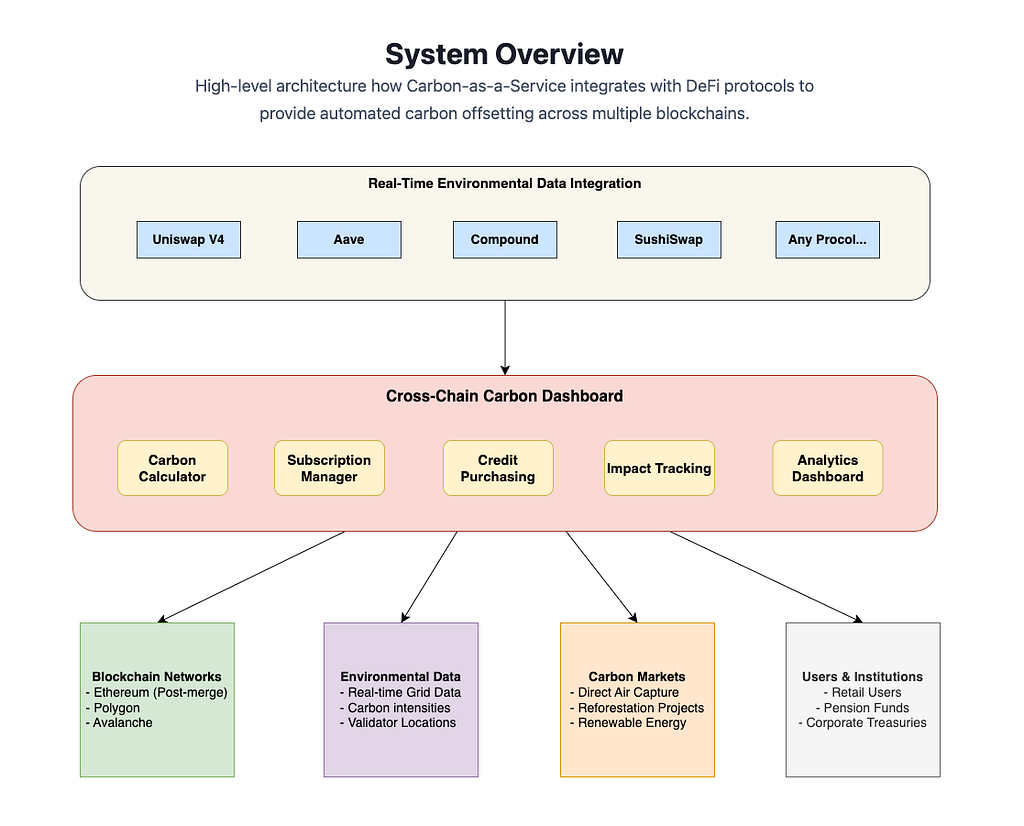
Building climate-positive DeFi isn’t just about good intentions — it requires sophisticated infrastructure that can handle millions of transactions across multiple blockchains while maintaining accuracy, transparency, and cost-effectiveness. The technical architecture behind Carbon-as-a-Service represents a new category of blockchain infrastructure: environmental middleware that operates across the entire DeFi ecosystem.
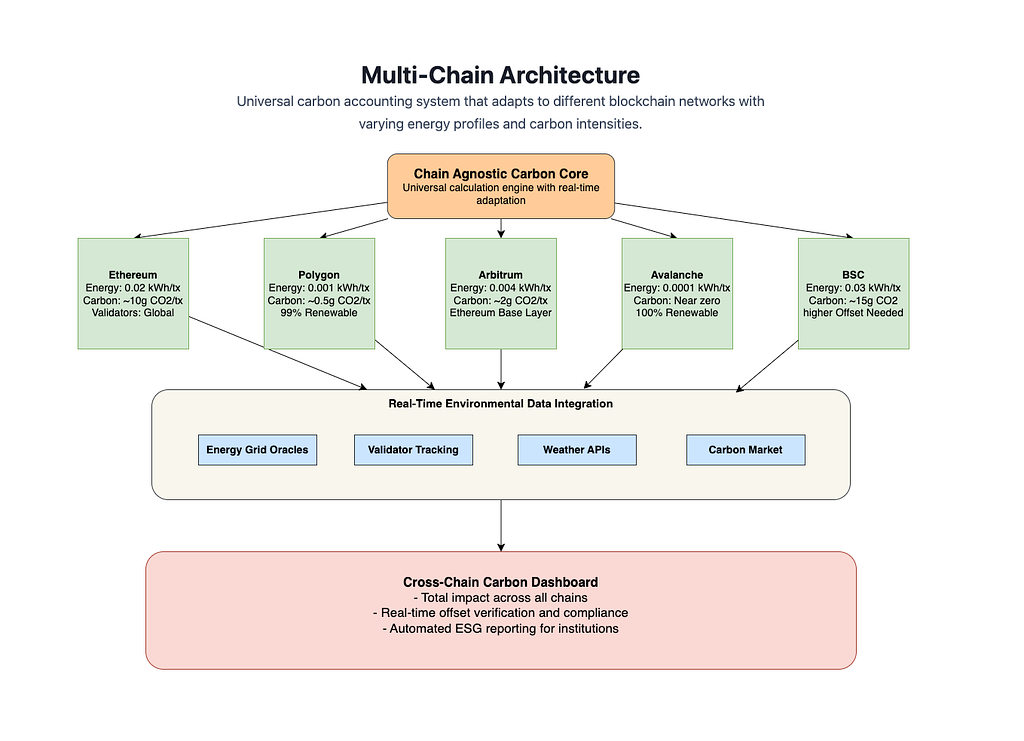
The modern DeFi landscape spans dozens of blockchains, each with unique characteristics, energy profiles, and user bases. Ethereum processes millions of transactions daily with its post-merge energy efficiency, while Polygon offers ultra-low carbon intensity through renewable energy partnerships. Avalanche runs almost entirely on renewable energy, creating near-zero carbon transactions, while BSC operates with mixed energy sources requiring different offset calculations.
A truly universal carbon solution must work across all major networks without requiring separate implementations for each chain. This challenge led to the development of a multi-chain architecture that features a chain-agnostic core logic system capable of adapting to any blockchain’s specific energy characteristics. The system employs network-specific adapters that understand each blockchain’s unique properties including gas mechanics, average block times, validator energy consumption, and regional energy grid composition.
Consider the complexity: a single user might swap tokens on Ethereum in the morning, provide liquidity on Polygon at lunch, and participate in yield farming on Avalanche in the evening. Each transaction has a different carbon footprint based on the underlying blockchain’s energy consumption patterns, but the user expects a unified view of their environmental impact across all activities.
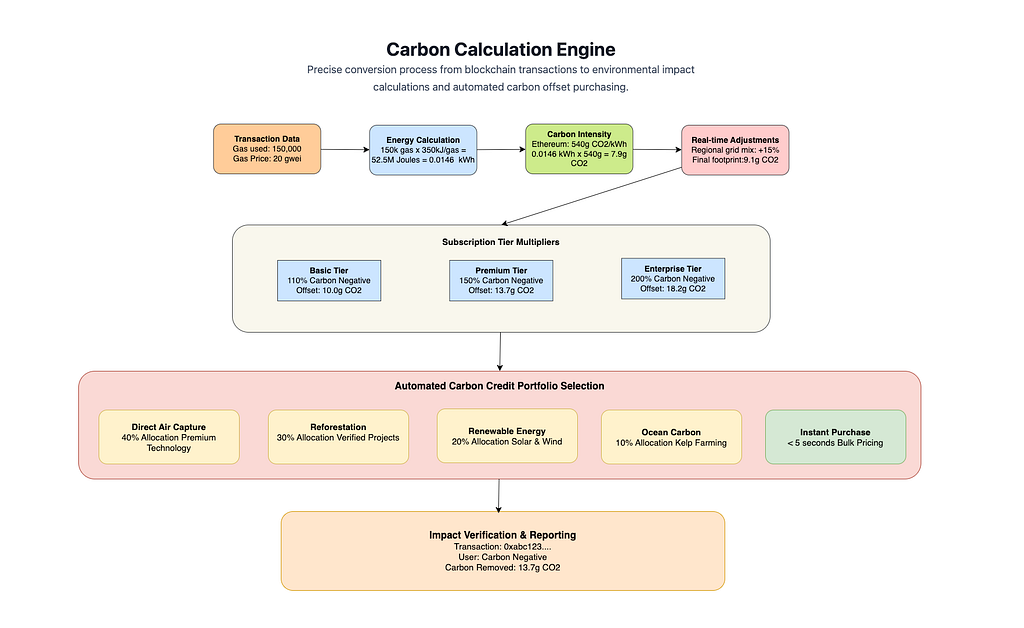
At the heart of the system lies our real-time carbon calculation engine, which processes environmental impact data with precision previously impossible in blockchain applications. This isn’t just simple math — it’s a sophisticated system that accounts for the complex relationship between blockchain transactions and real-world energy consumption.
Gas-to-Energy Conversion Models The engine utilizes sophisticated algorithms that convert gas consumption into actual energy usage, accounting for validator efficiency, network load, and hardware specifications across different blockchain networks. A transaction consuming 150,000 gas on Ethereum during high network congestion has a different energy impact than the same gas consumption during low-traffic periods, because validator efficiency changes based on network load.
Regional Energy Grid Integration Real-time data feeds from energy grids worldwide ensure carbon calculations reflect the actual energy sources powering blockchain validators in different geographic regions. When Ethereum validators in Texas run on wind power during peak generation hours, the carbon intensity differs significantly from the same validators running on natural gas during calm weather periods.
Dynamic Coefficient Updates Carbon intensity calculations adjust based on seasonal renewable energy availability, grid modernization efforts, and validator migration patterns. These updates happen automatically, ensuring accuracy that adapts to the rapidly changing energy landscape without requiring manual intervention from protocols or users.
The result is unprecedented precision in blockchain carbon accounting. Where traditional estimates might use static numbers like “X grams CO2 per transaction,” our system provides real-time calculations that reflect actual energy conditions at the moment of transaction execution.
Managing subscriptions for hundreds of protocols requires infrastructure that guarantees uptime, handles payment processing, and scales elastically with demand. This isn’t just about collecting monthly fees — it’s about creating reliable infrastructure that protocols can depend on for their environmental commitments.
The subscription infrastructure operates on a tiered service architecture with different service levels and guaranteed SLAs. Basic tier subscribers receive standard carbon offsetting with 99.5% uptime guarantees, while enterprise clients get dedicated infrastructure, custom integrations, and 99.99% uptime commitments. Auto-scaling payment processing systems handle everything from small protocol monthly fees to large enterprise carbon credit purchases, with automatic currency conversion and compliance reporting.
Smart contract treasury management systems automatically manage carbon credit purchasing, protocol fee distribution, and emergency fund allocation across multiple chains. When a protocol’s subscription expires, the system automatically pauses carbon offsetting to prevent unauthorized charges while maintaining transparency about environmental impact status.
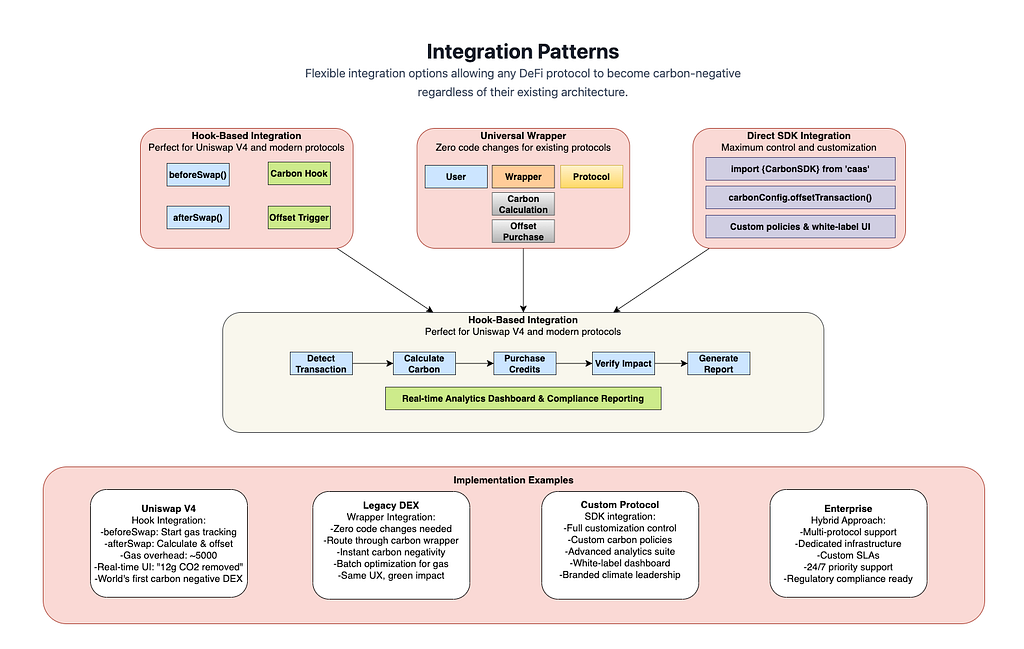
The system supports multiple integration patterns to accommodate different protocol architectures and development preferences, ensuring that any DeFi protocol can become carbon-negative regardless of their existing technical infrastructure.
Hook-Based Integration For protocols with native hook support like Uniswap V4, carbon offsetting integrates as specialized hooks that automatically trigger on relevant transactions. This approach provides the deepest integration with minimal performance overhead, calculating carbon impact and triggering offset purchases seamlessly within the existing transaction flow.
Universal Wrapper Pattern Existing protocols can become carbon-negative through universal wrappers that handle environmental accounting without requiring changes to the original codebase. Users interact with the wrapper, which routes transactions to the underlying protocol while adding carbon offset functionality. This enables rapid adoption without development risk or protocol modifications.
Direct SDK Integration Protocols wanting maximum control can integrate carbon calculation libraries directly, enabling custom environmental policies and specialized reporting features. This approach allows protocols to implement unique carbon strategies, such as user-selectable offset levels or carbon impact-based fee structures.
Every carbon-offset transaction follows a sophisticated data pipeline that ensures accuracy and transparency from transaction detection to impact verification. This pipeline represents one of the most complex aspects of the system, requiring coordination between blockchain monitoring, environmental data sources, and carbon credit markets.
Real-time transaction monitoring systems detect relevant transactions across all monitored protocols using event logs, transaction traces, and smart contract interactions. The system distinguishes between different transaction types — swaps, liquidity provision, yield farming, governance voting — each with different gas consumption patterns and environmental impacts.
Once a transaction is detected, instantaneous carbon footprint calculations begin using network-specific models that account for current network conditions, energy grid composition, and validator efficiency. These calculations happen within seconds of transaction confirmation, enabling real-time environmental impact display in user interfaces.
Automated carbon credit purchasing systems acquire verified credits from vetted suppliers based on calculated environmental impact. The system maintains relationships with multiple carbon credit providers to ensure reliability and competitive pricing. Batch purchasing optimizes costs while maintaining the ability to provide real-time offset confirmation to users.
Third-party verification systems confirm actual carbon removal or avoidance through partnerships with environmental monitoring organizations. This verification happens on a regular basis for all carbon credits purchased, ensuring that environmental claims are backed by measurable real-world impact.
The system architecture is designed to handle the entire DeFi ecosystem through horizontal scaling capabilities that allow individual components to scale based on demand. During high-traffic periods like major token launches or market volatility events, the system automatically provisions additional computational resources to maintain performance.
Microservices architecture ensures that computational bottlenecks in one area don’t affect overall system performance. Carbon calculation services can scale independently from subscription management, which scales independently from carbon credit purchasing systems. This separation allows for targeted optimization and ensures system stability during peak usage.
Efficient batching of carbon credit purchases reduces transaction costs while maintaining real-time offset capabilities. Instead of purchasing individual carbon credits for each transaction, the system batches purchases every few minutes, reducing gas costs and carbon market transaction fees while still providing immediate offset confirmation to users.
Strategic caching of carbon calculations and protocol configurations minimizes computational overhead for frequently accessed data. Common calculation patterns are cached and reused, while protocol-specific configurations are stored locally to avoid repeated blockchain calls.
Performance optimization remains critical as the system processes millions of transactions daily. Carbon calculation functions are optimized for minimal gas consumption, typically adding less than 5,000 gas per transaction while providing environmental accounting. Heavy computational tasks like detailed environmental impact analysis happen off-chain to avoid blocking user transactions, ensuring that climate action never compromises user experience.
Environmental claims require the highest levels of security and reliability, as incorrect calculations or failed offset purchases directly impact real-world environmental outcomes. The system employs multiple layers of security and verification to ensure accurate environmental accounting.
Smart contract architecture utilizes modular design principles with separate contracts for carbon calculation, credit purchasing, and impact tracking. This separation allows independent security audits and reduces the attack surface for any individual component. Multi-signature security controls protect carbon credit purchasing and system parameter updates, preventing manipulation or misuse of environmental funds.
Real-world environmental data integration requires robust oracle networks for reliable data feeds covering energy grid composition, validator locations, and carbon credit pricing. The system uses multiple oracle providers and cross-references data sources to prevent manipulation and ensure accuracy. Environmental claims undergo regular third-party audits to verify that carbon credits purchased actually result in measurable environmental impact.
Monitoring and alerting systems track all aspects of carbon offset operations, from transaction detection through credit purchasing and impact verification. Automated alerts notify operators of any anomalies or failures, enabling rapid response to maintain system reliability and environmental integrity.
This technical infrastructure enables the integration of climate action into DeFi protocols without compromising performance, user experience, or development velocity. The architecture represents a fundamental shift toward environmental-first design principles in blockchain development, proving that sophisticated climate action can enhance rather than hinder blockchain innovation.
Building the infrastructure for climate-positive DeFi. Previously worked on carbon markets, blockchain scalability, and sustainable technology. Passionate about using innovation to solve humanity’s biggest challenges.
#DeFi #Climate #Sustainability #Blockchain #ClimateTech #CarbonNegative #GreenFinance #Innovation
The Technical Architecture Behind Universal Carbon Offsetting: How CaaS Scales Climate Action was originally published in Coinmonks on Medium, where people are continuing the conversation by highlighting and responding to this story.





