New here? Start with: Start Here: Exe Protocol in 5 Minutes
Exe Protocol brings programmable fee sponsorship, policy-governed execution, and a new economic model to Solana. We’re proving it first on our native DEX, Exeswap, then extending it via SDK to Solana apps, wallets, and agents.
Exeswap isn’t just another DEX — it’s a new economic model for onchain trading. Built on Solana and powered by Exe Protocol’s DataMINT™ feature and policy-governed execution layer, Exeswap turns one of DeFi’s oldest assumptions on its head:
Users must always pay directly for execution in order for exchanges and liquidity providers (LPs) to thrive.
We’re changing all that. Instead of extracting value from traders through permanent fee drag, Exeswap uses Exe’s non-tradable, policy-governed execution credit, $XPR, to cover eligible costs under policy, while the protocol captures value from permissioned, anonymized market signal and smarter execution design.
The result is a model that traditional DEXs do not offer:
For traders, LPs, partners, and investors, that matters because Exeswap is not just competing on interface or routing. It is addressing the deeper problem killing app adoption, erodes LP rewards, and stalls growth:
Fee friction at the point of action creates user churn.
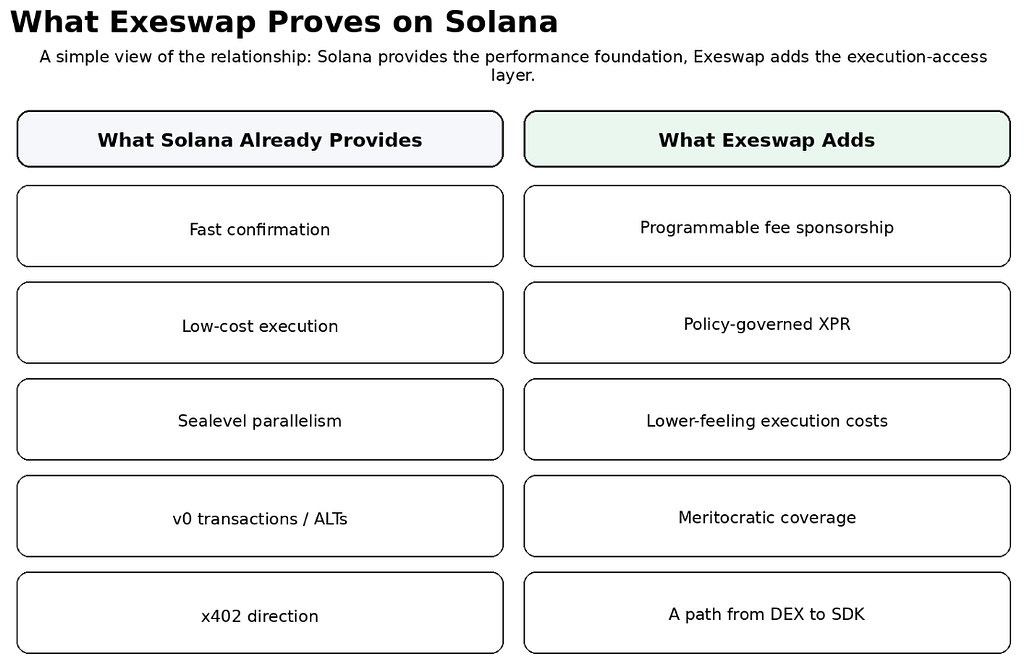
Solana already provides what most chains still struggle to deliver:
That is exactly why we are building on Solana first.
But low fees are not the same as frictionless access.
For a high-value trader, Solana’s low costs are a major advantage. For a new user, a low-balance wallet, an app trying to sponsor onboarding, or an AI agent making repeated small decisions, friction still accumulates through:
Exeswap is designed to solve that layer.

Traditional DEX economics still rely on direct user fees to reward liquidity providers (LPs).
That model works, but it becomes less sustainable as usage scales because it comes with permanent trade-offs:
Exeswap introduces a different economic model.
Instead of treating execution purely as a cost paid directly by the user for every action, Exeswap uses XPR to cover eligible costs under policy.
Because using our DEX and other apps is effectively fee-free over time the app economics — and eventually the shape of execution itself — changes the user experience.
Exeswap brings together three things:
Apps and protocol logic can sponsor specific actions instead of leaving every cost directly on the user.
That turns fee spend into something more strategic:
Exeswap uses XPR as execution credit.
XPR is:
It is not a speculative token. It is not a claim on an external market price. It is execution capacity represented inside the system.
At launch, coverage is already meritocratic.
It is allocated using:
Over time, optional signal participation lets the system classify value more precisely, reduce waste, and allocate fee relief with greater efficiency.
That is the progression:
XPR’s initial function is a non-tradable, chain-local execution credit — not a speculative token and not a claim on external market price.
When users trade on Exeswap, the system evaluates the activity under policy.
That process is designed to:
In simple terms:
That is the real inversion: Instead of every interaction simply extracting value from the user, Exeswap turns execution into something that can be governed, targeted, and improved over time.
This point matters: Exeswap is not built on the idea of warehousing raw user data as the product. We do not treat raw user data as the asset. Exe’s valuation and policy algorithms are designed to operate on permissioned, anonymized signal rather than identifying personal data.
The product is permissioned, anonymized market signal processed through policy.
That means:
This is why Exeswap is not just a “gasless” campaign or rebate trick.
It is a live implementation of a broader execution model:
Activity becomes part of the balance sheet.
Exeswap needs a chain that supports:
Solana provides all four:
Solana’s low costs and fast confirmation make repeated interaction practical for users, apps, and agents. Solana’s x402 work explicitly frames the network as a strong environment for HTTP-native payments and agentic commerce.
Exeswap is not just “submit a trade, pay a fee, done.” It increasingly involves policy checks, account references, and execution-side state. Solana’s Sealevel runtime is built to process non-conflicting work in parallel, which makes it a strong fit for policy-aware execution systems.
Fee abstraction often requires touching more accounts and carrying more state through the transaction path. Solana’s versioned transactions and Address Lookup Tables help make that practical by compressing account references and expanding the number of accounts that can be efficiently loaded in a transaction. Solana’s official docs describe ALTs as increasing that capacity from 32 to 64 addresses per transaction.
One of the biggest reasons to build on Solana now is where the ecosystem is heading. x402 makes it possible for APIs and software services to request payment directly over standard web flows using HTTP 402. That aligns closely with Exe’s longer-term direction: Agentic infrastructure for software acting on behalf of users, not just users clicking buttons themselves.
Solana already has strong trading infrastructure:
Exeswap fits at a different layer.
It is not just another liquidity venue.
It is the first application of Exe’s execution-access layer:
That is what makes Exeswap strategically different.
Exeswap is the proving ground. The SDK is the expansion path.
Once the model is proven on our DEX, the same Exe primitives extend across the Solana ecosystem:
What those apps get is user and market advantage:
That is why Exeswap matters beyond trading.
It proves the model in the clearest possible environment, then opens the door to something larger:
An execution layer for Solana-native applications.
The next challenge for high-performance chains is not more throughput alone.
It is making that throughput easier to access as onchain activity expands into:
The winning UX pattern is not simply lower fees: It is smarter access to execution — where cost is abstracted behind value creation, policy, and intent.
That is the layer Exeswap is helping to build.
Exeswap proves that a DEX does not need to be trapped inside the old economic pattern:
Charge the user, reward the LP, repeat until…fee burn and churn become the limit.
On Solana, Exe makes a different design viable:
That is why Exeswap is more than a DEX launch.
It is not a cosmetic DEX improvement. It is a live demonstration of Exe’s broader goal: Making apps, wallets, and agents effectively fee-free.
The future of DeFi is not lower fees. It is smarter access to execution.
Want to see this in production? Follow for launch updates, pilot announcements, and KPI snapshots as we stress-test Exeswap and expand to partner integrations. We’ll share what’s working, what isn’t, and the metrics behind it.
Together, we’re building infrastructure that scales without subsidies.
Email: tonyexeswap@proton.me
Telegram: [Link]
Telegram Ann: [Link]
X (Twitter): [Link]
Bluesky: [Link]
Exeswap: Making Our Solana-First DEX Effectively Fee-Free was originally published in Coinmonks on Medium, where people are continuing the conversation by highlighting and responding to this story.





