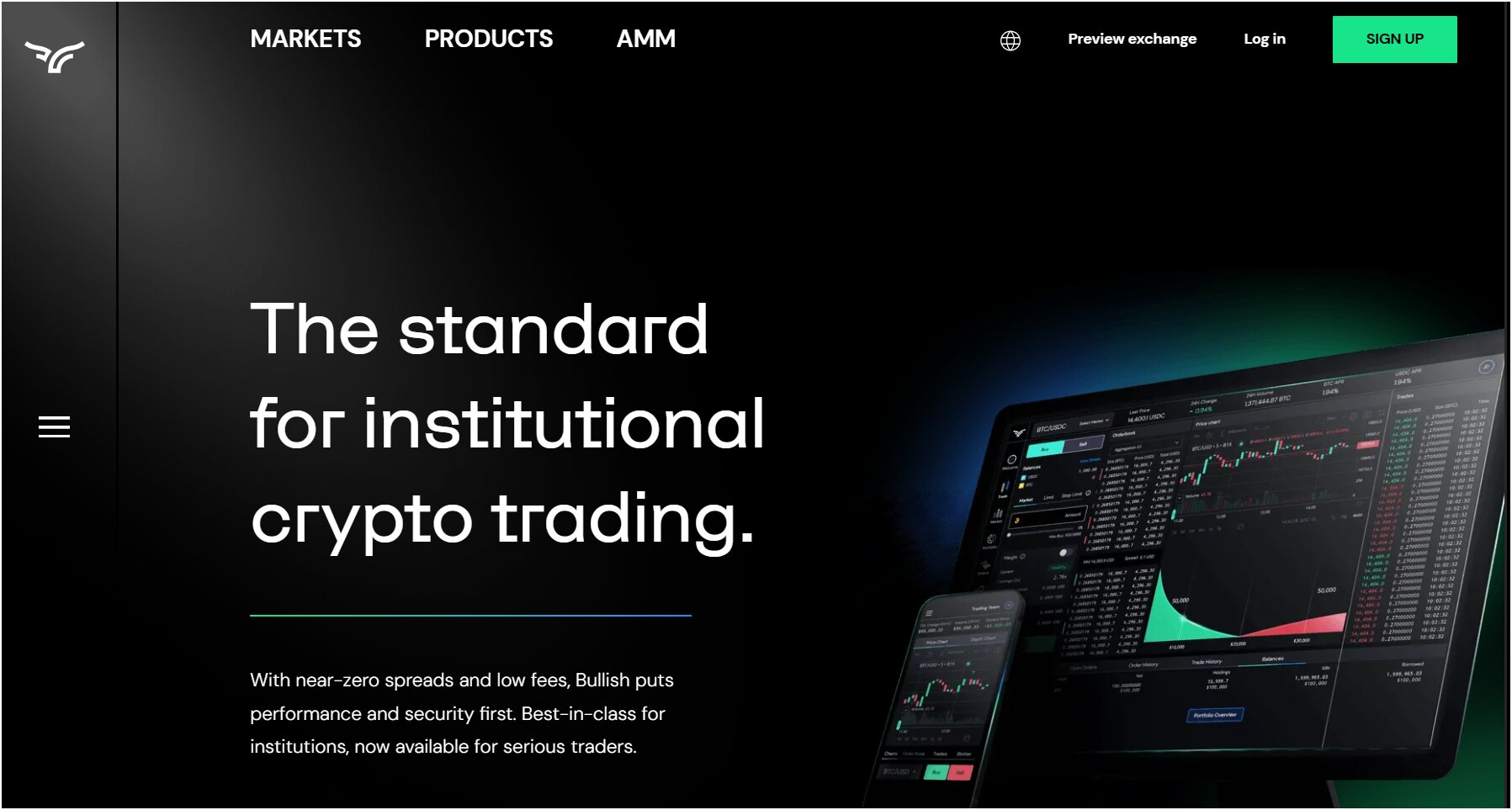
Bullish Exchange is a regulated cryptocurrency trading platform that combines a central limit order book with an automated market maker to offer deep liquidity and low-cost trading.
The top features of the Bullish crypto exchange are zero maker fees, automated market maker (AMM), spot and futures trading, crypto options, cross-asset collateral system, and a fully regulated infrastructure.
In this Bullish Exchange review, you will learn about its fees, features, supported coins, and security setup in detail. You will also understand how it compares with top exchanges like Binance, MEXC, and Bitget, and whether it is the right platform for your trading needs.
 The Bullish Exchange?
Bullish is a centralized crypto exchange built by Bullish Global (a company backed by prominent investors and affiliated with the blockchain firm Block.one). The platform launched publicly in 2021 and went on to list on the New York Stock Exchange (NYSE) under the ticker BLSH in 2025.
It basically aims to provide you with institutional‑grade market infrastructure and offers a high‑performance central limit order book (CLOB) with an AMM. The CLOB matches orders at very high speed, while the AMM actually supplies deterministic liquidity so you can trade large orders with minimal slippage.
The exchange operates as a full‑reserve venue. Well, that means your funds are kept in a 1:1 ratio and segregated from the company’s own assets. Also, it holds licenses or approvals from regulators in the United States (BitLicense and Money Transmission License in New York), Germany (BaFin), Hong Kong (Securities and Futures Commission), and Gibraltar (Gibraltar Financial Services Commission).
The pros of Bullish Exchange are:
The cons of Bullish Exchange are:
You will find that Bullish does not list every single new token that pops up on Twitter, but they support the major assets that actually matter to investors. Currently, the exchange offers around 60 cryptocurrencies. They have a bit of a “quality over quantity” mindset when it comes to their asset list to ensure safety for institutional clients. They also support several stablecoins like USDT, USDC, and even newer ones like Ripple USD (RLUSD).
You can trade these assets across dozens of spot and derivative contracts, including perpetual futures, dated futures, and options. The futures markets are generally settled in USDC, and there are cash‑settled options on BTC/USDC.
The Bullish exchange platform is available in over 50 countries, including a very big recent expansion into the United States. They recently got approval from the NYDFS, which means you can use it in states like New York, California, and Florida.
By the way, they also serve customers in:
Well, you need to just keep in mind that some features might be restricted depending on where you live. So, for example, derivatives like futures and options might not be open to you if your local laws are too strict (like those in the United States).
However, retail traders in the United Kingdom (unless you qualify as a high‑net‑worth individual), Canada, China, Japan, Israel, Iran, North Korea, Myanmar, and Russia are excluded.

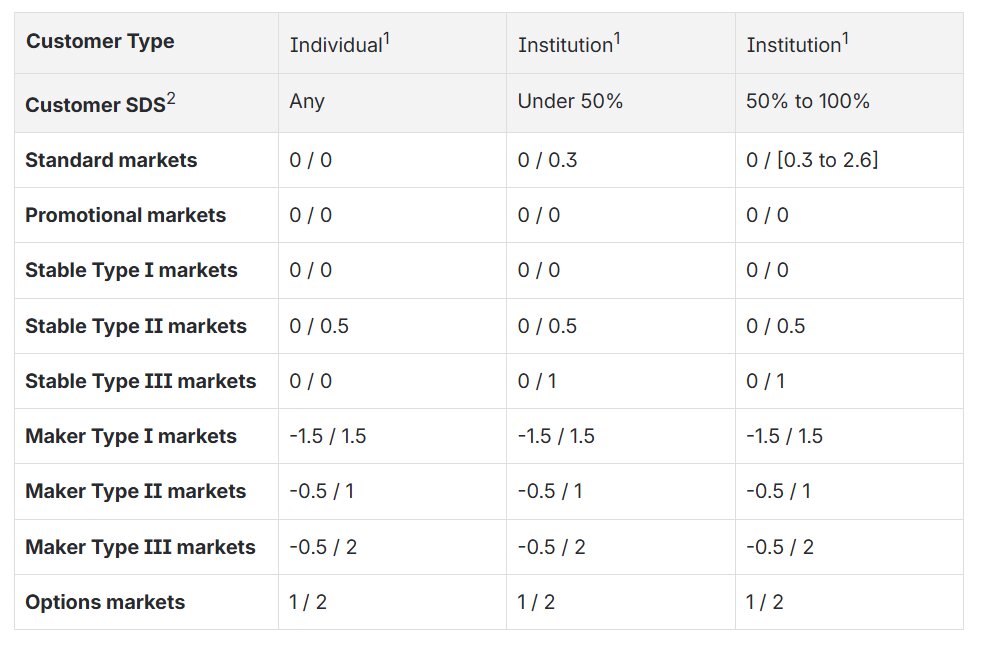
Bullish uses a very aggressive 0% maker fee model for most individual accounts. Well, this means if you place a limit order and wait for someone else to fill it, you pay absolutely nothing to the exchange. Taker fees range between 0%-0.03% dispensing on the account type (check image).
Now, for payments, you can easily deposit crypto for free, and if you want to use cash, they support bank wires in USD and EUR. A USD wire withdrawal usually costs about $30, while SEPA transfers in Europe are only about €2.
The top robust security measures of Bullish exchange are cold storage, custodial partnerships, PoR audits, 2FA, DDoS protection, and independent data security audits.
Yes, Bullish Exchange has a mandatory KYC requirement for all users. You cannot skip it if you want to trade on this platform. You know, Bullish is a regulated exchange, so they follow Know Your Customer rules very strictly to stay legal in places like the US and EU.
So, when you sign up, you will need to provide:
Usually, the verification takes about 24 to 48 hours to get approved, and if you want to stay anonymous, you should definitely look at the alternatives I am about to list (mainly MEXC exchange, which is a no-KYC platform).
The top alternatives to Bullish exchange are Binance, MEXC, and Bitget. Here’s a quick comparison:
| Criteria | Bullish | Binance | MEXC | Bitget |
| Launched Date | 2021 | 2017 | 2018 | 2018 |
| Top Features | AMM + CLOB, zero maker fees, regulated, OTC desk | Spot, futures, staking, Earn, Launchpad, P2P | Massive altcoin listings, 200x leverage, copy trading | Copy trading, futures trading, earn products, Web3 wallet |
| Supported Coins | ~60+ | 500+ | 3,500+ | 1,600+ |
| Trading Fees | 0% maker, up to 0.03% taker | 0.1% (lower with BNB) | 0% maker, 0.05% taker | 0.1% maker/taker |
| Maximum Leverage | Up to 7x | Up to 125x | Up to 200x | Up to 125x |
| KYC Mandatory | Yes | Yes | No (withdraw up to 10 BTC) | Yes |
| U.S. Availability | Limited (selected 20 states) | Binance.US only | Not available | Not available |
Binance offers everything in one place, including spot trading, margin, futures, staking, launchpad projects, NFT marketplace, and even passive income tools like Earn. But Bullish mainly focuses on trading with a clean and regulated structure, but it does not offer staking, farming, or advanced earning tools.
Binance is clearly better when you want variety, as you get access to more than 500 coins, while Bullish keeps things limited to around 60 major assets. You see, that difference is pretty huge, especially if you like exploring new altcoins or meme coins early. Binance also supports higher leverage up to 125x, which is way more flexible compared to Bullish’s 7x limit.
Now, look at fees. Bullish wins here with zero maker fees and very low taker fees. It is one of the cheapest crypto exchanges. Binance still charges around 0.1%, although discounts are available with BNB. So, if your main focus is saving fees and trading large volumes, Bullish actually feels better. But honestly, overall, Binance is better for most users. Generally, you get more features, more coins, better customer support, and more flexibility.
Create your Binance account now using our referral link and unlock your exclusive sign-up rewards
MEXC is built for aggressive traders who want access to new tokens and high-risk opportunities. MEXC is clearly better in terms of supported coins. You get access to more than 3,500 cryptocurrencies. Bullish only lists major coins, so you will not find new or trending tokens there.
MEXC offers up to 200x leverage, but Bullish stays conservative with 7x leverage. Well, that makes Bullish safer, but also less attractive for high-risk traders who want bigger gains.
Here, the main difference is KYC. MEXC is often referred to as an anonymous crypto exchange due to its optional KYC requirements. You can deposit and withdraw up to 10 BTC per day without ID verification. You see, Bullish requires full verification before you can even start. So, if privacy matters to you, MEXC is best for you.
Sign Up on MEXC Now and Claim Up to $8,000 USDT!

Bitget sits somewhere between Binance and MEXC, and you can clearly feel that when you compare it with Bullish. It offers a balanced mix of features, including spot trading, futures trading, copy trading, and even passive income tools.
Bitget is much better in terms of features, as you get copy trading, which is a big deal for beginners who want to follow professional traders. Bullish does not offer anything like that. Plus, there are also earn products and lending features on Bitget, which are completely missing on Bullish. Again, the number of supported coins is higher as well.
So, overall, Bitget is better for features, copy trading, and higher leverage. Bullish is better if you want a clean, regulated platform with extremely low fees.
Sign up on Bitget today and unlock a welcome pack worth 6,200 USDT

The best features of Bullish exchange are margin trading, spot trading, automated market maker tools, options trading, and a user-friendly mobile app.
Margin trading on Bullish is generally offered through perpetual and dated futures settled in USDC. Here, you can long or short around 20 major pairs with up to 7x leverage.
The platform uses cross‑asset collateralization. Basically, all available assets in your portfolio back your positions, and an auto‑borrow/auto‑pay system manages collateral. Both market and limit orders are supported, and if your margin falls below maintenance requirements, the system triggers partial liquidations and draws from a guaranty fund to reduce contagion.

Spot trading here is really fast because of their high-performance matching engine. The interface has two modes: “Simple” for beginners and ‘Pro’ for people who need to see the full order book and depth charts. Also, most pairs have no maker or taker fees, and spreads are tight because the AMM provides deterministic liquidity.
Bullish’s deterministic AMM lets you provide liquidity across multiple spot and derivatives markets. Well, you can select a pair, set upper and lower price bounds, and a spread, and then the algorithm buys low and sells high within that range to capture fees.
You can also decide how much of the gross AMM payment you keep (e.g., 75%, 90%, or 100%), with the rest going to Bullish as a fee. Plus, AMM instructions run alongside the central order book and use your collateral, so in derivatives markets, you need margin; if the price leaves your range, the position can be closed or require more collateral.
Bullish offers USDC-settled options for Bitcoin and Ethereum. You can buy calls or puts to bet on the price moving up or down. It is a bit complex for beginners, but for pros, it is really a great way to hedge a portfolio or make some speculative bets with limited risk. But remember, options trading is not available for U.S. retail traders.
Actually, for a long time, Bullish was web-only, but they eventually realized everyone trades on their phones. Bullish introduced a mobile app for Android and iOS in January 2026. The app serves more than 50 jurisdictions and mirrors the web platform: so, you can view charts, manage your portfolio, and place market or limit orders across over 60 markets.

Bullish’s user interface is polished and easy to navigate, particularly in Advanced mode. You can see that charts load quickly, and the order book updates in real time. Plus, switching between spot, futures, AMM, and options is quite simple, actually, thanks to separate tabs. The platform offers a dark and light mode, and you can customize your workspace with various chart layouts.
Now, customer support, however, is an area where Bullish could improve. There is a help center with articles and guides, but there is still no live chat. So, if you have an issue, you must submit a support request via the portal. There is a presence on social media platforms like X (Twitter) and LinkedIn as well, but I find that those channels are not designed for individual account issues. They rarely help.
Step 1: Sign up and secure your account
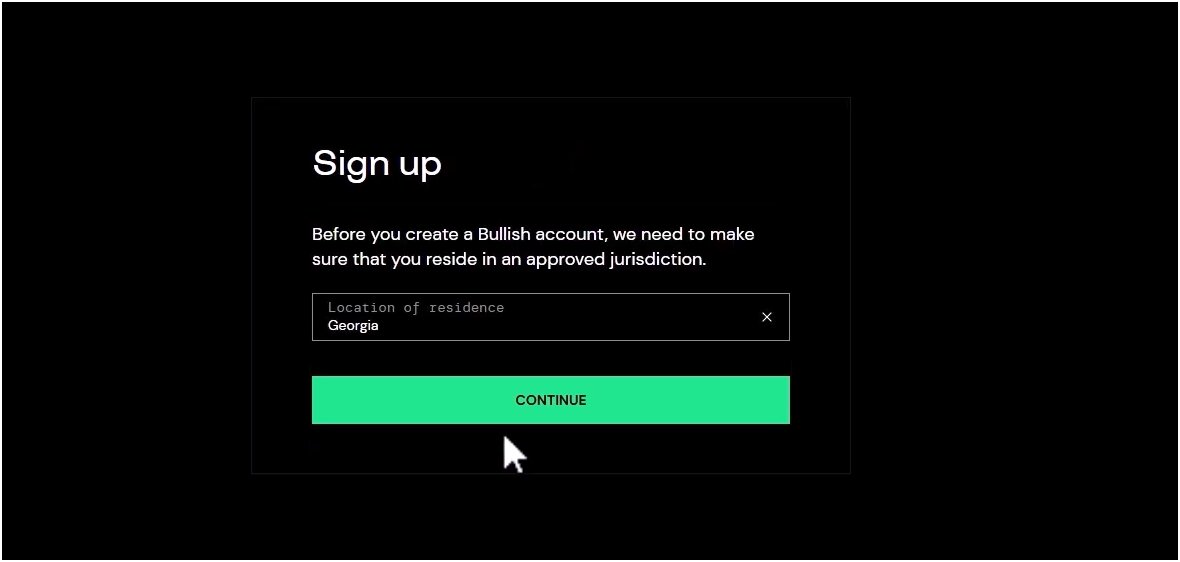
You should visit bullish.com or download the mobile app, create a Bullish account with your email and password, verify your email, and then enable two‑factor authentication. You also need to choose your “country of residence” and the purpose of creating an account.
Step 2: Complete KYC
Now, you must submit your personal information, upload a government ID, proof of address, and a selfie through Bullish’s verification partner. This is mandatory to start trading, and approval usually takes only a few minutes, but can sometimes take longer.
Step 3: Fund your account
You can now deposit USD or EUR via SWIFT or SEPA bank transfer, or transfer supported cryptocurrencies. There is no minimum deposit, but you should deposit a decent amount to start trading, and the minimum trade size is about $1.

Step 4: Trade and manage funds
Finally, you can use “Simple” mode for quick swaps or “Advanced” mode for market and limit orders with full order‑book depth. You can monitor your positions and AMM instructions on the portfolio page and withdraw funds when needed.

Bullish is best suited for advanced traders, institutions, hedge funds, and high‑frequency traders who value regulation, deep liquidity, and ultra‑low fees. Plus, if you prioritize compliance and security, for example, if you manage client funds or require audits, Bullish’s public company status and regulatory licenses provide peace of mind.
But again, on the other hand, Bullish may not be the best choice for beginners or casual investors. You see, the limited number of supported coins means you cannot explore niche tokens. The interface lacks educational prompts for novices, and there are no staking or earn products, no copy trading or algorithmic bots, and no passive income features. Similarly, residents of those restricted countries (we talked about above) will need to look elsewhere.
To sum up our Bullish crypto exchange review, it is a safe and legitimate crypto exchange. It is a publicly traded, well‑regulated platform with some of the lowest fees in the industry. It combines a central limit order book with an automated market maker to deliver deep liquidity and narrow spreads. Your funds are kept in cold storage, segregated from corporate assets, and even audited by a Big Four firm. Plus, the exchange is licensed in multiple jurisdictions, publishes monthly metrics, and has undergone SOC 1 and SOC 2 audits.
However, obviously, the platform is not without limitations. The asset selection is quite small compared with other exchanges like Binance, MEXC, and Bitget. The fee structure, although cheap, is divided into many categories and uses basis points, which can, of course, confuse new users. And, there is still no live chat support. You won’t find staking, copy trading, or yield products as well.
Pay Less, Earn More! Register now for fee discounts, cashback, and exclusive Binance rewards!
The post Bullish Exchange Review 2026: Fees, Features, and Alternatives appeared first on CryptoNinjas.





