Capitalism Meets State Power: Intel’s Future
[Our AI Business Services] — [Advertise with Us!]
Friday is here, and the weekend will bring no shortage of developments. Intel has fallen under state influence — and it may not be the only company facing this challenge. Around the world, governments are racing to build their chips, while new systems are getting closer to decoding human thoughts. As wireless tech advances, the line between mind and machine could blur even further. Enjoy your weekend, and stay curious.
Get 20% off a group subscription
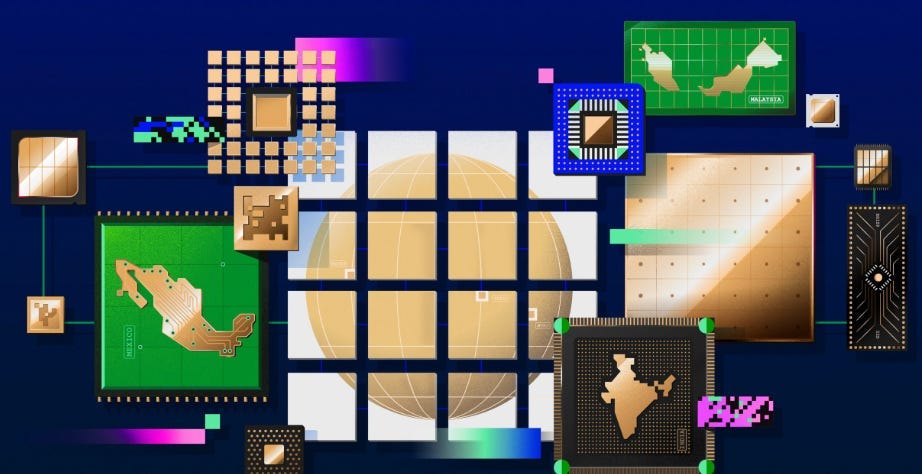
Mexico, Malaysia, and India are pushing to build local semiconductor industries to cut reliance on $24B+ in annual chip imports and move up the supply chain. Instead of competing with giants like TSMC and Nvidia, the focus is on legacy chips for electronics and autos, less advanced, but cheaper to produce.
Globally, 75% of chips are made in Taiwan/China, 12% in the U.S. Experts doubt any single country can build a full supply chain, warning against “policymaker fantasy.” The biggest barrier across all three countries is a shortage of skilled engineers and brain drain to higher-paying markets.
Base44 — An AI‑powered, no‑code development platform that enables anyone to create fully functional web or mobile apps simply by describing them in natural language.
We created an app using Base44 that gives us a daily passive income idea that can be created and executed with AI tools and monetized instantly. Check our Base44 app here.
Download our list of 1000+ Tools for free.

Intel’s stock jumped 5% after reports that the Trump administration is considering taking a stake in the struggling chipmaker to help fund its long-delayed $100B Ohio fab project. While pitched as a move to “reshore” U.S. semiconductor production, this marks a shift from subsidies to partial government ownership, blurring the line between capitalism and state control.
If Intel, once the pride of U.S. tech, becomes partly state-run, it could set a precedent for other “strategic” firms like Micron or GlobalFoundries to face similar interventions. Intel could theoretically go fabless, focusing on design like Nvidia and AMD, but Washington wants domestic fabs for national security. Combined with the White House’s new policy of taking a 15% cut from Nvidia and AMD chip sales to China, this move suggests the U.S. is edging toward state-managed industry, raising questions about market distortion, investor confidence, and whether America is inching closer to a form of industrial socialism.
This is a scenario analysis that most of us do not want to see, but that is not that far fetched if we continue the pattern that we are seeing now:
Mild Intervention (2025–2027)
Deeper State Capitalism (2028–2032)
Full Industrial Socialism (2032 and beyond)
A minority stake in Intel could look harmless today, but if extended across the sector, it risks turning America’s most innovative industry into a state-managed utility, sacrificing agility for control.

Scientists in the BrainGate2 trial have shown they can decode not just spoken attempts but also imagined words.
One ALS patient generated nearly 6,000 words at 97.5% accuracy, while others reached up to 70% accuracy in inner speech. The breakthrough could ease communication for paralyzed patients but raises privacy concerns, computers even picked up numbers people silently counted.
To prevent eavesdropping, researchers tested a mental password (“Chitty Chitty Bang Bang”), recognized with 98.7% accuracy. It’s early-stage, but a major step toward turning thoughts directly into speech.
Capitalism Meets State Power: Intel’s Future was originally published in Coinmonks on Medium, where people are continuing the conversation by highlighting and responding to this story.