Cardano price prediction has become one of the hottest topics among crypto investors as ADA continues to attract attention with its research-driven approach and long-term development strategy. While no forecast can guarantee future results, understanding potential price scenarios can help both beginners and experienced investors make more informed decisions.
At the time of writing, Cardano trades around $0.19, following a volatile month that saw the price drop to a monthly low of $0.15 on June 6 before recovering from that support zone. Earlier, on May 27, ADA reached a monthly high of $0.26, showing that the cryptocurrency can still experience significant price swings within a short period.
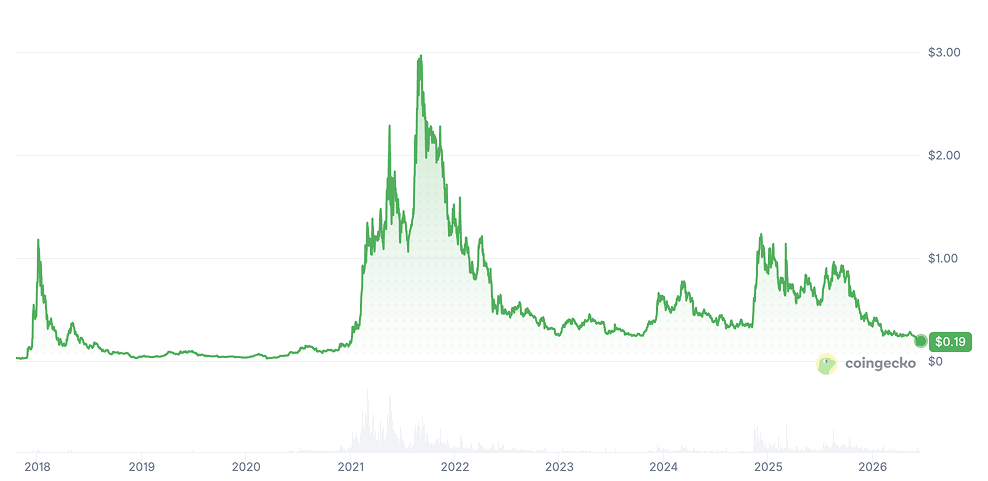
CoinGecko, June 15, 2026
In this guide, you will find detailed ADA price predictions for 2026 and beyond, including monthly forecasts, long-term outlooks extending to 2050, technical analysis, expert opinions, and the key factors that could influence Cardano’s future value. By the end, you will have a clearer understanding of what may drive ADA’s price and what realistic expectations investors should have over the coming years. So, let’s get started!
| Current ADA Price | ADA Price Prediction 2026 | ADA Price Prediction 2030 |
| $0.19 | $0.8 | $2.5 |
Cardano is a decentralized blockchain platform designed to support smart contracts, decentralized applications (dApps), and digital assets. Its native cryptocurrency, ADA, powers the network by enabling transactions, paying fees, and participating in staking. Unlike many blockchain projects that focus on rapid development, Cardano follows a scientific and research-based approach, with many upgrades reviewed by academics before implementation.
The project was launched in 2017 by Charles Hoskinson, one of the co-founders of Ethereum. His goal was to build a blockchain that could solve common problems such as limited scalability, high transaction costs, and energy consumption while maintaining a high level of security.
One of Cardano’s biggest advantages is its Proof-of-Stake consensus mechanism, called Ouroboros. Instead of relying on energy-intensive mining, the network allows ADA holders to stake their coins and help validate transactions while earning rewards. This makes Cardano one of the most energy-efficient major blockchain networks.
The ecosystem has expanded significantly over the past few years. Developers continue to build decentralized finance (DeFi) protocols, NFT marketplaces, gaming projects, and identity solutions on Cardano. At the same time, scalability upgrades such as Hydra aim to increase transaction throughput and support wider adoption.
Cardano has experienced several major market cycles since its launch in 2017, making it one of the most closely watched cryptocurrencies. After trading below $0.03 for much of its early history, ADA entered a powerful bull market in 2021 and climbed to its all-time high of approximately $3.1, delivering gains of more than 10,000% from its lowest levels.
The following bear market pushed ADA below $0.25, wiping out most of its previous gains as investors shifted away from risk assets. Despite the correction, Cardano continued to expand its ecosystem with smart contracts, DeFi applications, and scalability upgrades.
Today, ADA trades around $0.19, remaining well below its record high but still significantly above its launch price.
Let’s take a closer look at short-term Cardano price predictions based on the latest forecasts from DigitalCoinPrice and PricePrediction.net.
For the next month, analysts expect ADA to remain relatively stable around its current $0.19 price level. DigitalCoinPrice projects June 2026 prices near $0.16, suggesting a modest correction from current levels. PricePrediction.net starts its July forecast at $0.1722 and sees the price climbing as high as $0.2388, with an average of $0.2055. This indicates that short-term expectations range from mild consolidation to a gradual recovery.
Looking six months ahead, the outlook becomes more optimistic. DigitalCoinPrice expects Cardano to trade between $0.16 and $0.18 by November and December 2026, signaling a return to today’s valuation after a weaker summer period. In contrast, PricePrediction.net forecasts a much stronger recovery, projecting November prices between $0.2529 and $0.3507, with an average of $0.3018. Under this scenario, ADA would gain more than 65% from its current price.
By the end of 2026, forecast differences become even more apparent. DigitalCoinPrice predicts ADA could close the year around $0.18, essentially remaining flat compared to current levels. Meanwhile, PricePrediction.net estimates a December trading range between $0.2536 and $0.3517, with an average price of $0.3027.
| Year | Minimum Price | Maximum Price | Average Price | Price Change |
| 2026 | $0.11 | $1.43 | $0.8 | +320% |
| 2027 | $0.1 | $2.02 | $1 | +425% |
| 2030 | $0.26 | $5.08 | $2.5 | +1,200% |
| 2040 | $0.68 | $28.31 | $15 | +7,800% |
| 2050 | $1.55 | $1.78 | $1.65 | +770% |
DigitalCoinPrice estimate that in 2026, Cardano could trade between $0.11 (-40%) at the lower end and $0.18 (-5%) at its yearly peak. Their forecast suggests ADA may experience a volatile year, with weakness during the summer followed by a gradual recovery toward the end of the year.
PricePrediction offers a more optimistic outlook for 2026. According to its forecasts, ADA could range from $0.17 (-6%) to $0.35 (+95%), indicating the potential for a strong rebound if market sentiment improves and network activity continues to grow.
Telegaon remains significantly more bullish. Its 2026 projection places Cardano between $0.45 (+150%) and $1.43 (+695%), reflecting expectations of broader blockchain adoption, increased staking participation, and a favorable crypto market cycle.
DigitalCoinPrice forecasts ADA to trade around $0.16 (-11%) during June 2026. PricePrediction expects a considerably stronger range between $0.32 (+75%) and $0.37 (+105%), suggesting that the market could recover faster than conservative estimates indicate.
According to DigitalCoinPrice, Cardano may fluctuate between $0.15 (-166%) and $0.16 (-11%) in July. PricePrediction projects a range from $0.33 (+85%) to $0.39 (+115%), reflecting expectations of gradually strengthening buying pressure.
DigitalCoinPrice expects ADA to trade between $0.11 (-40%) and $0.13 (-30%) during August. Meanwhile, PricePrediction forecasts prices from $0.35 (+90%) to $0.4 (+120%), showing a much more optimistic view of market conditions.
For September 2026, DigitalCoinPrice predicts Cardano near $0.11 (-40%), while PricePrediction estimates a range between $0.36 (+95%) and $0.42 (+130%). The gap highlights the uncertainty surrounding ADA’s medium-term outlook.
DigitalCoinPrice expects ADA to recover toward $0.15 (-17%) in October. PricePrediction projects prices between $0.37 (+100%) and $0.43 (+140%), indicating the potential for stronger momentum if the crypto market enters a bullish phase.
DigitalCoinPrice forecasts a range between $0.16 (-11%) and $0.17 (-5.5%) for November 2026. PricePrediction remains optimistic, expecting ADA to trade between $0.39 (+110%) and $0.45 (+150%) by the end of the month.
DigitalCoinPrice estimates Cardano could finish 2026 around $0.185. PricePrediction expects a range between $0.4 (+120%) and $0.47 (+155%), while Telegaon projects a possible rally toward $1.43 (+690%) under highly bullish market conditions.
DigitalCoinPrice expects Cardano to remain relatively stable in 2027, forecasting a price range between $0.17 (-5.5%) and $0.22 (+22%). The model suggests modest growth as the ecosystem continues to mature.
PricePrediction presents a slightly more cautious scenario. Its estimates place ADA between $0.1 (-45%) and $0.26 (+40%), implying that market conditions could remain challenging while still allowing for periods of recovery.
Telegaon offers a much more bullish forecast for 2027. According to its model, Cardano could trade between $1.48 (+720%) and $2.02 (+1,000%), assuming accelerating adoption of decentralized applications and continued expansion of the Cardano ecosystem.
DigitalCoinPrice analysts estimate that in 2028, Cardano could trade between $0.17 (-5.5%) and $0.24 (+30%). Their projections suggest a relatively stable year, with ADA gradually recovering after previous market volatility.
PricePrediction presents a similar outlook. According to its monthly forecasts, ADA may range from $0.11 (-40%) to $0.29 (+60%), reflecting moderate upside potential if the broader crypto market strengthens.
Telegaon remains considerably more optimistic. Its 2028 forecast places Cardano between $2.06 (+1,000%) and $3.24 (+1,650%), assuming accelerating blockchain adoption and increasing demand for Cardano’s ecosystem.
DigitalCoinPrice expects Cardano to continue its gradual appreciation in 2029, forecasting a price range between $0.2 (+10%) and $0.27 (+50%) as network activity continues to expand.
PricePrediction offers a much stronger outlook, estimating ADA could trade between $0.33 (+80%) and $0.88 (+390%), supported by improving market sentiment and long-term investor confidence.
Telegaon remains highly bullish, projecting Cardano between $3.29 (+1,700%) and $4.32 (+2,300%), reflecting expectations of widespread ecosystem growth and mainstream blockchain adoption.
By 2030, DigitalCoinPrice believes Cardano may trade between $0.26 (+40%) and $0.3 (+65%), reflecting gradual long-term growth supported by increasing blockchain utility.
PricePrediction expects significantly stronger performance, forecasting ADA between $0.28 (+50%) and $0.65 (+260%). This outlook assumes Cardano continues attracting developers and institutional interest over the coming years.
Telegaon’s long-term forecast is considerably more optimistic. The platform estimates Cardano could reach between $4.38 (+2,200%) and $5.08 (+2,650%) by 2030, driven by widespread ecosystem adoption and a favorable macro environment for digital assets.
DigitalCoinPrice forecasts continued growth in 2031, with Cardano expected to trade between $0.28 (+55%) and $0.41 (+125%). The projection suggests ADA could benefit from increasing network maturity and stronger utility.
PricePrediction provides a similar estimate, placing Cardano between $0.31 (+70%) and $0.44 (+140%). Its model points to stable long-term appreciation supported by expanding use cases.
DigitalCoinPrice expects Cardano to strengthen further in 2032, forecasting prices between $0.39 (+115%) and $0.49 (+170%). The model suggests a continuation of ADA’s gradual long-term uptrend.
PricePrediction offers an even more optimistic scenario. According to its projections, Cardano could trade between $0.4 (+120%) and $0.75 (+315%), reflecting expectations of sustained ecosystem expansion and increasing adoption.
DigitalCoinPrice analysts estimate that Cardano may trade between $0.48 (+165%) and $0.53 (+190%) in 2033, supported by long-term network development and improving market conditions.
PricePrediction is considerably more bullish, forecasting ADA between $0.81 (+350%) and $1.6 (+750%). Such projections assume Cardano becomes one of the leading smart contract platforms over the next decade.
PricePrediction expects Cardano to remain above the one-dollar level throughout much of 2034. Its monthly forecasts suggest ADA could range between $0.88 (+375%) and $1.57 (+760%), reflecting continued long-term adoption despite normal market corrections.
PricePrediction forecasts Cardano between $0.99 (+450%) and $1.44 (+700%) in 2035, indicating the potential for steady appreciation as blockchain technology becomes increasingly integrated into the global economy.
Telegaon remains significantly more optimistic. Its 2035 outlook places ADA between $14.65 (+8,000%) and $16.44 (+9,000%), assuming Cardano achieves mass adoption and secures a dominant position within the digital asset ecosystem.
DigitalCoinPrice forecasts Cardano to trade between $0.68 (+275%) and $0.74 (+310%) in 2040, suggesting steady appreciation over the long term as blockchain technology becomes more mainstream.
Telegaon projects a substantially higher valuation, estimating ADA could range from $25.23 (+13,800%) to $28.31 (+15,500%). Such projections assume Cardano establishes itself as one of the dominant global smart contract platforms.
Looking further ahead, DigitalCoinPrice estimates that Cardano could trade between $1.55 (+740%) and $1.78 (+850%) by 2050, reflecting continued ecosystem growth and long-term market expansion.
According to the latest monthly technical analysis from Investing.com, the outlook for Cardano remains decisively bearish. The platform assigns ADA an overall Strong Sell rating, with both Technical Indicators and Moving Averages unanimously signaling weakness.
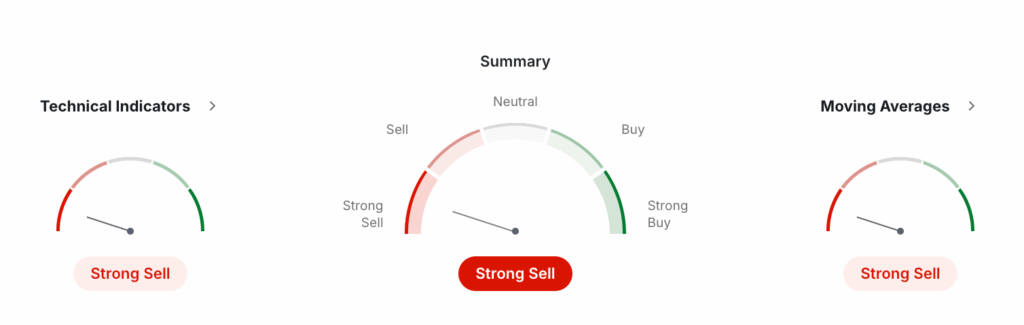
Investing, June 15, 2026
Technical Indicators currently show 7 sell signals and no buy signals, while all 12 monitored moving averages also generate sell signals. Such alignment suggests that sellers continue to dominate the market and that bullish momentum has yet to emerge.
Momentum indicators reinforce this cautious outlook. The RSI (14) stands at 37.29, signaling weak buying pressure without reaching extreme oversold territory. The MACD (12,26) prints -0.082, confirming the prevailing downtrend, while ADX (14) at 28.8 indicates that the bearish trend remains relatively strong.
Several oscillators, however, have entered oversold territory. The Stochastic (11.5), StochRSI (0), Williams %R (-96.3), and Ultimate Oscillator (27.75) all suggest that ADA may be approaching short-term exhaustion. Even so, oversold conditions alone do not guarantee a reversal, as cryptocurrencies can remain oversold during prolonged downtrends.
Overall, the technical picture supports a cautious short-term outlook. Until major indicators begin shifting toward Neutral or Buy signals, Cardano price predictions remain conservative despite the possibility of temporary relief rallies.
Moving averages provide one of the simplest ways to identify the direction of a trend, and Cardano’s current readings point toward continued weakness. According to Investing.com’s monthly data, every major moving average from the 5-day to the 200-day timeframe currently generates a Sell signal.
Short-term averages remain well above the current market price, with the MA5 at 0.2371 and EMA5 at 0.2494, indicating that recent momentum is still negative. Medium-term averages paint a similar picture, as both the MA50 (0.4711) and EMA50 (0.4789) continue to trend significantly above ADA’s current valuation.
Even long-term indicators remain bearish. The MA200 stands at 0.2524, while the EMA200 reaches 0.5838, suggesting that Cardano would need a substantial recovery before regaining a long-term bullish structure.
Although moving averages currently favor sellers, they are lagging indicators by nature. If ADA begins establishing higher highs and higher lows, these signals could gradually shift toward Neutral before eventually confirming a new uptrend.
Pivot points help traders identify important support and resistance zones where buying or selling pressure may increase. Based on the latest monthly data from Investing.com, the Classic Pivot Point stands at 0.2508, serving as the primary level separating bullish and bearish momentum.
The nearest support levels are:
A sustained move below the first support could expose ADA to further downside, while a break beneath the strongest support near 0.15 would reinforce the current bearish trend.
The main resistance levels are:
A breakout above 0.273 could strengthen market sentiment and open the door toward the 0.31–0.33 area. Fibonacci and Woodie pivot calculations identify similar resistance clusters, making this zone particularly important for any medium-term recovery attempt.
As of June 2026, Cardano’s moving averages continue to reflect a broad downtrend across all major timeframes.
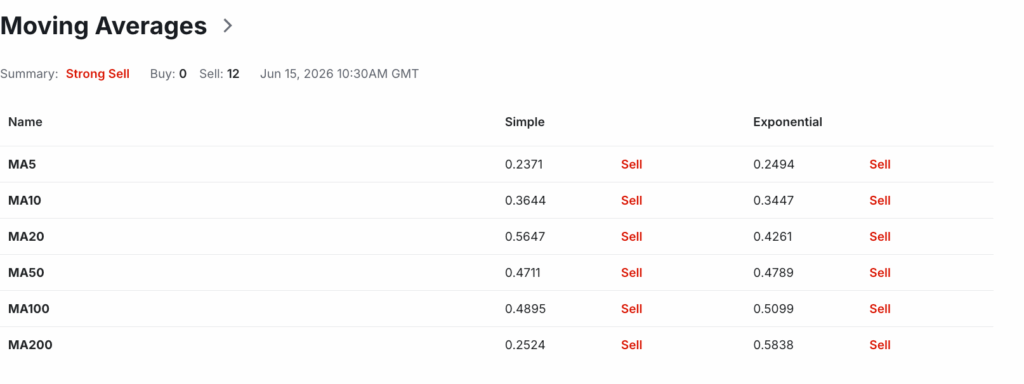
Investing, June 15, 2026
Short-term moving averages:
Medium and long-term averages remain equally bearish:
Oscillators present a mixed picture. While the CCI (-102.55), ROC (-73.46), and Bull/Bear Power (-0.3678) continue to signal selling pressure, the Stochastic, StochRSI, Williams %R, and Ultimate Oscillator all indicate oversold conditions. Meanwhile, the ATR (0.2036) suggests relatively lower volatility compared to periods of major market breakouts.
Taken together, these indicators imply that bearish momentum still dominates, although the probability of short-term technical rebounds increases as oversold conditions deepen.
Like most large-cap cryptocurrencies, Cardano maintains a strong correlation with Bitcoin and the broader digital asset market. In practice, this means that ADA often follows Bitcoin’s direction during both rallies and corrections, although its price swings are typically more pronounced.
During bullish market phases, capital frequently rotates from Bitcoin into leading altcoins such as Cardano, creating opportunities for ADA to outperform the broader market. Conversely, when Bitcoin experiences heavy selling pressure, Cardano often declines even faster as investors reduce exposure to higher-risk assets.
Cardano also shows meaningful correlation with Ethereum and Solana because all three compete within the smart contract ecosystem. Positive developments affecting decentralized finance, staking, or blockchain adoption can therefore benefit the sector as a whole.
No Cardano price prediction can be considered certain because cryptocurrency prices depend on market sentiment, regulation, macroeconomic conditions, and blockchain adoption. For that reason, investors should consider both bullish and bearish scenarios before making any decision.
In a bullish crypto cycle, Cardano could benefit from rising institutional interest, wider adoption of decentralized applications, and continued development of scaling solutions such as Hydra. Strong Bitcoin performance would likely encourage capital to flow into large altcoins, including ADA.
A bearish scenario could emerge if global economic conditions weaken, crypto regulations become more restrictive, or investor appetite for risk declines. Cardano would also face pressure if ecosystem growth slows or competing smart contract platforms attract more developers and users.
Market experts remain divided on Cardano’s future, but most agree that the network’s technological progress will play a bigger role than short-term price fluctuations.
Charles Hoskinson, Cardano’s founder, continues to emphasize upgrades such as Midnight, Ouroboros Leios, and governance improvements as the foundation for long-term adoption. He argues that increasing scalability and real-world blockchain applications could strengthen Cardano’s position among leading smart contract platforms over the coming years.
On-chain analysts have also highlighted continued whale accumulation during the recent market decline, a pattern that has historically preceded stronger recoveries in previous crypto cycles. Although retail sentiment remains weak, large investors appear to be steadily increasing their exposure to ADA.
Not every expert shares this optimistic view. In June 2026, Hoskinson himself warned that difficult market conditions could lead to a wave of project failures within the Cardano ecosystem, stressing that weaker applications may struggle to survive during an extended bear market.
Many factors influence Cardano’s price, making short-term movements difficult to predict. The most important drivers include:
When several positive factors align, ADA can experience rapid price appreciation. Conversely, negative market sentiment can outweigh strong fundamentals in the short term.
Cardano continues to focus on long-term infrastructure rather than short-term hype. One of the most anticipated developments is Ouroboros Leios, a major scalability upgrade designed to significantly increase transaction throughput through a new consensus architecture. The public testnet is expected during 2026, with mainnet implementation planned later if testing proves successful.
At the same time, the network is expanding through Midnight, its privacy-focused sidechain, while Hydra continues improving Layer 2 scalability for payments and decentralized applications. Governance also plays an increasingly important role, with treasury proposals and protocol upgrades now decided through on-chain voting by the community.
Cardano, Ethereum, and Solana all compete in the smart contract sector, but they follow different philosophies. Ethereum dominates decentralized finance and developer activity, Solana prioritizes speed and low fees, while Cardano emphasizes academic research, security, and gradual development.
Cardano generally introduces upgrades more slowly because every major change undergoes extensive testing and peer review. This cautious approach may reduce technical risks but can also delay adoption compared to faster-moving competitors.
| Feature | Cardano | Ethereum | Solana |
| Consensus | Proof of Stake | Proof of Stake | Proof of Stake |
| Main focus | Security & research | Largest smart contract ecosystem | High speed & low fees |
| Typical transaction fees | Low | Medium to high | Very low |
| Scalability roadmap | Hydra & Leios | Layer 2 rollups | Native high throughput |
| Governance | On-chain community voting | Community & developers | Foundation-led ecosystem |
| Strength | Decentralization and formal development | Network effects and liquidity | Performance and user experience |
Each blockchain offers different advantages, and their future success will depend on adoption, developer activity, and real-world use cases rather than transaction speed alone.
Cardano is expected to trade close to its current market price of around $0.18, with normal daily volatility driven by Bitcoin and overall crypto sentiment. Short-term technical indicators currently remain bearish, suggesting limited upside unless market conditions improve.
Nobody can accurately predict ADA’s price one day in advance. Daily movements often depend on Bitcoin’s performance, macroeconomic news, trading volume, and investor sentiment rather than Cardano-specific developments.
The short-term outlook remains cautious. ADA could continue trading within a relatively narrow range unless a major market catalyst or unexpected Cardano announcement changes investor sentiment.
If Bitcoin stabilizes or rebounds, Cardano could follow higher. However, if broader market weakness continues, ADA may remain under pressure and revisit recent support levels.
Current forecasts suggest ADA could trade between $0.16 and $0.37 over the next month. The final outcome will largely depend on overall crypto market conditions and investor demand.
Forecasts differ significantly between analysts. Current estimates range from $0.11 to $1.43, although most models place ADA below $0.5 under normal market conditions.
Most forecasts suggest moderate long-term growth, with predictions ranging between $0.1 and $2.02. Continued ecosystem development could support higher valuations during the next bull market.
Current long-term projections range from $0.26 to $5.08. Such a wide range reflects uncertainty about blockchain adoption, regulation, and the future size of the crypto market.
Long-term estimates vary dramatically. Conservative models project ADA below $1, while highly optimistic forecasts expect prices above $25 if Cardano achieves mass adoption.
DigitalCoinPrice estimates Cardano could trade between $1.55 and $1.78 by 2050. More aggressive forecasts exist, but long-term predictions should always be viewed with caution.
Yes. A return to $1 appears realistic if the cryptocurrency market enters another strong bull cycle and Cardano continues expanding its ecosystem and developer activity.
Reaching $2 is possible over the long term, although it would require a significantly larger market capitalization and much stronger adoption than today.
ADA could revisit its previous all-time high during a future bull market supported by institutional investment, higher blockchain adoption, and favorable macroeconomic conditions.
Most forecasting models do not expect ADA to reach $5 in 2026. Such a move would require an extraordinary rally and market conditions far stronger than current expectations.
While technically possible over the very long term, a $10 ADA price would require massive global adoption and one of the largest market capitalizations in crypto.
A move to $20 would require exceptional growth in network usage, developer activity, and institutional demand. At present, it remains a highly speculative scenario.
Based on its current supply, a $100 price would imply an enormous market valuation. Most analysts consider this target unrealistic under present market assumptions.
That depends on your investment goals and risk tolerance. Cardano offers strong technology and active development but remains a highly volatile cryptocurrency investment.
ADA has the potential to appreciate if adoption continues to grow and the overall crypto market recovers. However, no future price increase can be guaranteed.
There is no fixed price ceiling for ADA. Conservative forecasts remain below $1 over the next few years, while bullish models project prices above $5 and even higher over the long term.
Cardano is considered one of the leading Layer 1 blockchain projects thanks to its research-driven development and strong staking ecosystem. However, like all cryptocurrencies, ADA remains a high-risk investment, and future returns are not guaranteed.
Many investors believe Cardano is undervalued because of its peer-reviewed development model, energy-efficient Proof-of-Stake consensus, and ongoing upgrades such as Hydra and Leios. Whether the market eventually reflects this value depends on adoption and real-world usage.
High staking participation reduces the amount of ADA available for trading, which can lower selling pressure. However, staking alone does not guarantee price appreciation, as demand remains the primary driver of long-term value.
Hydra is Cardano’s Layer 2 scaling solution designed to process transactions much faster and at lower cost. If widely adopted, it could increase network activity and strengthen long-term demand for ADA, potentially supporting higher prices.
Cardano’s decentralized governance, energy-efficient design, and transparent development process make it attractive for some institutional investors. Greater regulatory clarity and ecosystem growth could further increase institutional interest in the coming years.
Our Cardano price prediction combines technical analysis, historical market cycles, blockchain fundamentals, macroeconomic trends, and forecasts from multiple analytical sources. Instead of relying on a single model, we compare different scenarios to provide a balanced long-term outlook while recognizing that cryptocurrency markets remain highly unpredictable.
Understanding Cardano price predictions does not require professional trading experience. The key is to combine technical analysis with fundamental developments surrounding the network. Like every cryptocurrency, ADA moves through cycles of accumulation, expansion, correction, and consolidation. Identifying the current phase helps investors make more rational decisions instead of reacting emotionally to short-term volatility.
Several technical indicators can improve the accuracy of ADA price predictions.
Unlike many cryptocurrencies, Cardano investors should also monitor ecosystem developments such as Hydra, Leios, Midnight, governance upgrades, and staking participation, as these factors can significantly influence long-term value.
Start by identifying the primary trend. A series of higher highs and higher lows usually signals a bullish market, while lower highs and lower lows indicate that sellers remain in control.
Next, identify major support and resistance zones. Support levels often attract buyers, whereas resistance levels frequently trigger profit-taking. A confirmed breakout above resistance may signal the beginning of a stronger rally, while a breakdown below support can accelerate downside momentum.
Always combine chart analysis with technical indicators and trading volume. At the same time, monitor Bitcoin’s price because ADA maintains a strong correlation with the broader cryptocurrency market. Cardano-specific news, protocol upgrades, and governance decisions can also create significant price movements independent of technical patterns.
Chart patterns help traders estimate the probability of future price movements.
Common bullish patterns include:
Common bearish patterns include:
While chart patterns provide valuable signals, they should always be combined with technical indicators, market sentiment, and Cardano’s fundamental developments to produce more reliable price predictions.
Buying Cardano (ADA) is simple, even if you are completely new to cryptocurrency. One of the easiest ways is to use StealthEX, a non-custodial crypto exchange that lets you swap digital assets without creating an account or completing lengthy registration forms.
Just follow these steps:

The entire process usually takes only a few minutes and does not require account creation or storing your funds on an exchange. This makes StealthEX a convenient option for users who value privacy, simplicity, and direct wallet-to-wallet cryptocurrency swaps.
Follow us on Medium, X, Telegram, YouTube, and Publish0x to stay updated about the latest news on StealthEX.io and the rest of the crypto world.
Don’t forget to do your own research before buying any crypto. The views and opinions expressed in this article are solely those of the author.
ADA Cardano Cardano ADA crypto price prediction price prediction




