The biggest Chainlink news of the week is not a price chart. It is a list of clients.
The US Department of Commerce. Brazil's central bank. The Hong Kong Monetary Authority. The Monetary Authority of Singapore. The Reserve Bank of Australia. The Bermuda Monetary Authority. Every one of them has formally integrated infrastructure in a documented, production-level deployment — and that Chainlink news wave landed in the same week that LINK hit $8.35, its highest level since early June. The CoinMarketCap confirms: price at $8.35, weekly gain of 9.93%, market cap at $6.24 billion, circulating supply 748.09 million LINK.
 Source: X(formerly Twitter)
That combination — government adoption at scale and a 10% weekly price move — is the Chainlink news story of July 2026.
The most significant element of today's Chainlink news cycle is not the DeFi integrations or the price data. It is the government deployment list — and what it proves about where Chainlink's infrastructure has actually arrived.
US Department of Commerce — BEA data on-chain for the first time. LINK worked with the US Department of Commerce to bring key macroeconomic data on-chain from the Bureau of Economic Analysis. Real GDP, the PCE Price Index, and Real Final Sales to Private Domestic Purchasers are now available through Chainlink Data Feeds on ten blockchain networks: Arbitrum, Avalanche, Base, Botanix, Ethereum, Linea, Mantle, Optimism, Sonic, and ZKsync. This development builds upon Chainlink's accelerated work with the US government in 2025, including meetings with key officials and regulators to make policy recommendations advancing blockchain industry growth.
Central Bank of Brazil and Hong Kong Monetary Authority — cross-border DvP settlement. In phase two of Brazil's Drex project, It connected the Central Bank of Brazil with the HKMA to orchestrate seamless cross-border trade settlement across jurisdictions. The oracle network blockchain Runtime Environment translated messages between networks, triggered electronic Bill of Lading transfers, and connected off-chain systems. Chainlink CCIP provided secure cross-chain messaging, keeping contract execution and credit release in sync across all platforms — the first instance where a blockchain-based title registry and cross-chain payment infrastructure were connected in a single automated workflow.
Hong Kong Monetary Authority e-HKD Phase 2 — tokenized asset settlement with ANZ and Fidelity International. ANZ, China AMC, and Fidelity International used Chainlink CCIP and the Automated Compliance Engine to meet cross-chain interoperability and compliance requirements for tokenized asset settlement. The solution enables Australian investors to acquire tokenized money market fund units from Hong Kong-based asset managers using e-HKD and tokenized deposits.
Monetary Authority of Singapore — Project Guardian with UBS and SBI Digital Markets. As part of MAS Project Guardian, SBI Digital Markets and UBS Asset Management demonstrated how LINK and a Digital Transfer Agent smart contract enable tokenized funds with automated fund management and transfer agency processes.
Reserve Bank of Australia — Project Acacia with Westpac. Westpac Institutional Bank is integrating Chainlink's Runtime Environment for DvP settlement of tokenized assets across blockchain markets and Australia's existing PayTo domestic payments system. The Australian central bank has estimated tokenization can save asset issuers in Australian markets up to AUD $12 billion annually.
Bermuda Monetary Authority — embedded supervision stablecoin framework. The oracle gaint and Apex Group created an institutional-grade stablecoin infrastructure solution for the Bermuda Monetary Authority's embedded supervision initiative — using CCIP, ACE, and Proof of Reserve to power compliant stablecoin issuance backed by $3.5 trillion in Apex-managed assets.
The price move that accompanied this week's Chainlink news had a specific trigger.
Chainlink's LINK price rose more than 5% after Mantle migrated its $2.5 billion Super Portal to Chainlink CCIP as its exclusive cross-chain infrastructure — unlocking enterprise-grade security at scale and deprecating its legacy bridge entirely.
That migration is structurally significant. When a $2.5 billion platform switches its entire cross-chain infrastructure to CCIP in a single move, it is a competitive validation signal — not just a partnership announcement. The same week, Aave made CCIP its default cross-chain infrastructure across its entire ecosystem and launched Stable Vaults powered by Chainlink CCIP and Price Feeds.
Two major platforms making the same infrastructure decision in the same week is not coincidence — it is a competitive signal about where the cross-chain market is consolidating.
On-chain accumulation preceded both announcements. Wallets holding more than 1,000 LINK reached their highest level this year. Addresses controlling over 100,000 LINK expanded to a record 805. These purchases absorbed much of the selling pressure created by the scheduled unlock of 21 million LINK tokens, reducing the impact of the additional supply entering circulation.
Non-empty Ethereum wallets holding LINK surpassed 900,000 for the first time — a milestone confirmed from on-chain data that no prior Chainlink news cycle has produced.
Open interest increased roughly 10% alongside the price advance, showing fresh leveraged participation. The combination of rising price and rising open interest typically suggests new positions entering the market rather than existing shorts simply closing.
The current Chainlink news price picture from the July 15 CoinMarketCap data: $8.35, up 9.93% on the week, market cap $6.24 billion, volume $315.7 million.
The daily RSI has climbed to around 60 after recovering from oversold territory, showing buyers have regained control without entering overbought conditions. The MACD has completed a bullish crossover above the signal line on the 4-hour chart, while the Chaikin Money Flow remains positive above zero.
LINK is edging higher toward a key resistance trendline near $9.20, projecting roughly 10% upside from current levels. The 50-day EMA sits at $8.12 — LINK is trading above it.
Two levels define the near-term picture:
$8.40 — immediate resistance. A confirmed daily close above $8.40 would strengthen the breakout case and expose the next resistance zone around $8.70, followed by psychological resistance near $9.00.
$8.00 — key support. Failure to hold this level would pull LINK back toward the $7.70–$7.50 demand zone and postpone any attempt to challenge $9.00.
One forward-looking signal deserves specific attention: the DTCC integration. The Depository Trust and Clearing Corporation — the world's largest securities clearinghouse — will integrate Chainlink's Runtime Environment for near real-time asset pricing, margining, and settlement across traditional and blockchain markets, with a production launch scheduled for Q4 2026. If the DTCC integration ships on schedule, it becomes the most significant institutional production deployment in Chainlink's history.
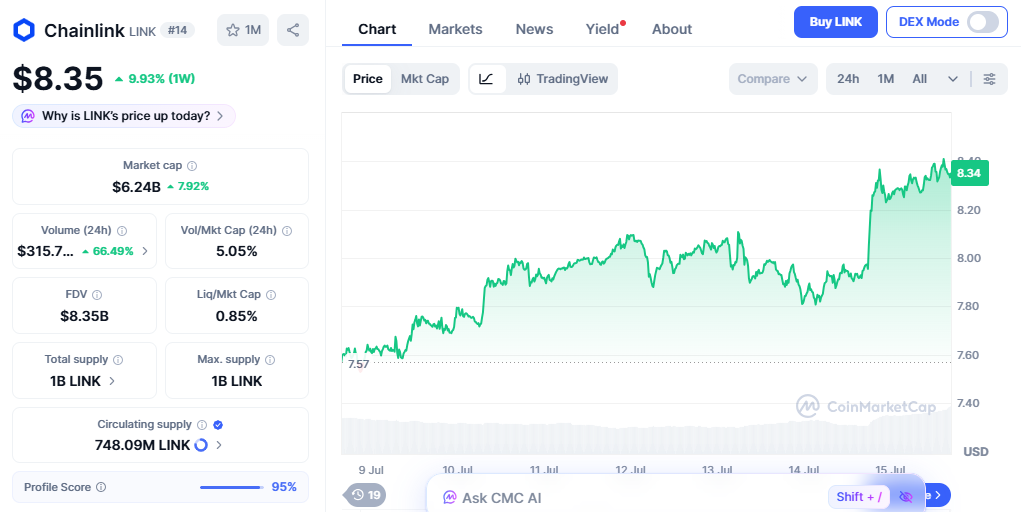 Source: CoinMarketCap Data
All price projections are from public market analyst sources on assumption basis only. No guaranteed outcomes exist. Crypto investments carry significant risk of loss.
Chainlink news this week combines a government adoption list that spans six central banks and financial authorities with a 9.93% weekly price gain to $8.35. Mantle's $2.5B CCIP migration was the price catalyst. Aave's CCIP selection confirmed the infrastructure consolidation signal. 900,000 wallet holders, RSI at 60, open interest up 10%, and the DTCC Q4 production launch approaching. Watch $8.40 for the breakout confirmation and $8.00 as the floor that must hold.
This article is for informational and educational purposes only. It does not constitute financial advice, investment advice, or a recommendation to buy, hold, or sell LINK tokens. All price data is sourced from CoinMarketCap as of July 15, 2026. All government and institutional integration details are from official Chainlink announcements as cited. All LINK price projections are from named public market analyst sources on assumption basis only — no guaranteed outcomes exist. Crypto investments carry significant risk including total loss of capital. Always conduct your own independent research.





