Choosing a crypto API is one of the earliest architectural decisions in any blockchain project, and it shapes everything that follows: what data you can access, how quickly you can ship, and how much infrastructure you end up managing yourself. The landscape in 2026 is more specialized than ever. Some providers focus on aggregated market data and portfolio tracking, others on raw blockchain indexing, and others still on institutional-grade compliance and benchmarking.
This guide covers eight crypto API providers worth evaluating, each serving a distinct set of developer needs. We break down what each one offers, where it fits, and what trade-offs come with it. For a broader list of free and open-source crypto APIs, the community-maintained free-crypto-apis repository on GitHub is also worth bookmarking.
CoinStats started as a portfolio tracking application serving over 1.2 million monthly users and has since opened its data infrastructure to developers through a public REST API. Rather than providing raw blockchain RPC access, the API returns aggregated, pre-structured data: clean wallet balances, transaction histories, DeFi position breakdowns, and market feeds across 120+ blockchain networks. This approach is fundamentally different from providers that focus on a single data vertical like market prices or raw on-chain indexing. CoinStats delivers an application-ready layer built for developers who need a complete view of a user's crypto assets through one integration.
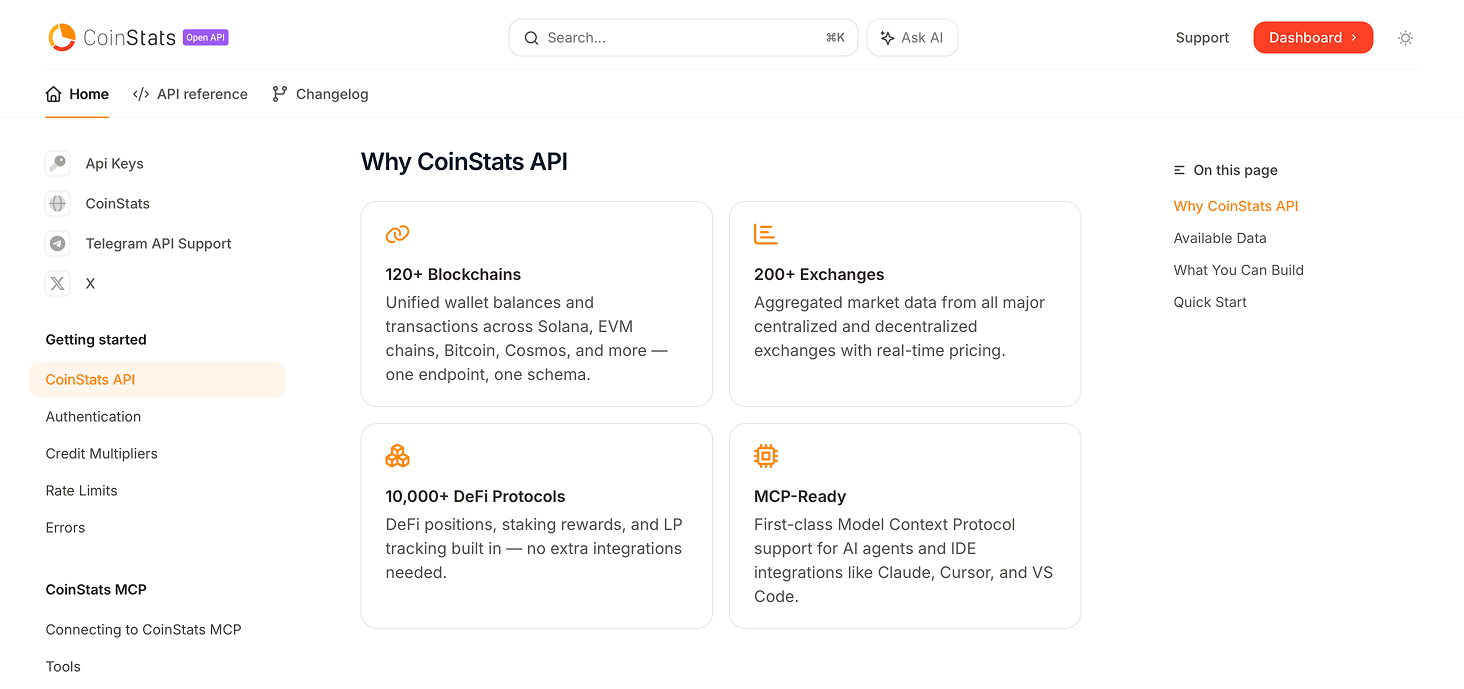
The API unifies data from 200+ exchanges (including Binance, Coinbase, and Hyperliquid) and over 10,000 DeFi protocols. A single API key unlocks access to:
CoinStats uses a credit-based pricing model with a free tier at signup. Credit usage scales with endpoint complexity and request parameters. For example, querying a single-chain wallet balance costs fewer credits than requesting balances across all supported networks. Credit multipliers are documented in the API dashboard, and developers can track usage in real time. Paid plans are available for teams that need higher limits.
Full documentation is available at coinstats.app/api-docs. To get started, sign up at openapi.coinstats.app and grab a free API key.
| Pros | Cons |
|---|---|
| 120+ Blockchains, One Schema: Unified wallet, DeFi, and market data eliminates the need to stitch together multiple providers. | Not a Node Provider: Does not offer raw RPC access or smart contract interaction. Developers needing that layer will need a separate service. |
| Credit-Based Free Tier: Developers can evaluate the full API surface without upfront cost, with transparent credit tracking in the dashboard. | Aggregated Data Focus: Applications requiring sub-second latency for high-frequency trading will need a lower-level infrastructure provider. |
| MCP for AI Agents: First-class Model Context Protocol support is a differentiator for teams building conversational crypto assistants or IDE integrations. | Portfolio Access Requires ShareToken: Pulling user portfolio data involves a ShareToken authentication flow, which adds an integration step. |
| 10,000+ DeFi Protocols: Staking, lending, and LP positions are auto-detected, saving significant development time for portfolio-facing apps. |
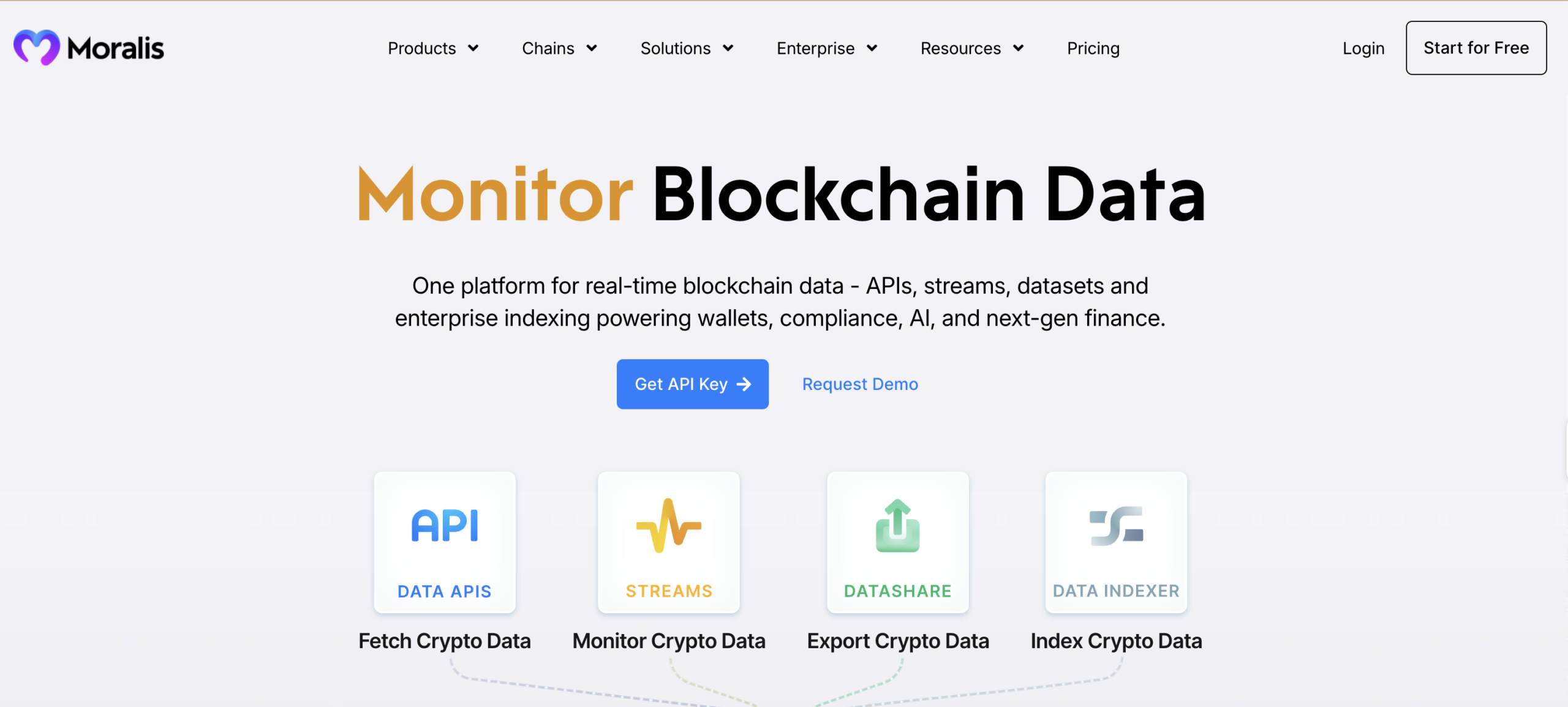
Moralis provides a suite of Web3 APIs built for developers working with on-chain data across EVM chains and Solana. The platform indexes blockchain data and returns it through structured REST endpoints, covering wallet balances, token transfers, NFT metadata, price feeds, and decoded transaction histories. It is built for teams that want to skip the infrastructure work of running their own indexers and nodes.
| Pros | Cons |
|---|---|
| Multi-Chain On-Chain Data: Covers 30+ EVM chains and Solana with decoded, enriched responses out of the box. | On-Chain Only: Does not aggregate centralized exchange data, portfolio analytics, or cross-platform DeFi positions. |
| Streams (Webhooks): Real-time event monitoring without polling reduces infrastructure overhead and latency. | CU Costs Scale Quickly: Complex API methods consume more compute units, and costs can grow rapidly at production volumes. |
| SOC 2 Type 2 Certified: Enterprise-grade security certification adds confidence for compliance-conscious teams. | No Portfolio Aggregation: Developers building full portfolio views across wallets and exchange accounts will need to combine Moralis with another service. |
Alchemy is a blockchain infrastructure company that provides node-as-a-service along with enhanced APIs for tokens, transactions, NFTs, and smart contract interactions. It supports Ethereum, Polygon, Solana, Arbitrum, Optimism, Base, and several other networks. The platform provides the low-level infrastructure layer that powers many production dApps.
| Pros | Cons |
|---|---|
| Large Free Tier: 30 million CUs per month is one of the more generous free offerings among node providers. | Building Blocks, Not Products: Developers who need portfolio views, aggregated exchange data, or DeFi position tracking will need to build those layers themselves. |
| Direct Blockchain Access: JSON-RPC plus enhanced APIs give developers both low-level and structured data options. | CU-Based Pricing Can Be Unpredictable: Complex methods like eth_call consume significantly more CUs than simple calls, making cost forecasting harder. |
| Notify Webhooks: Built-in alerting for address activity and gas price changes reduces the need for custom monitoring infrastructure. | No CEX Data: Alchemy covers on-chain data only. Market data from centralized exchanges requires a separate provider. |
CoinDesk Data is the current name for what was previously known as CCData and, before that, CryptoCompare. CoinDesk acquired the platform in late 2024 and completed the rebrand in early 2025. As an FCA-authorized digital asset data provider, it delivers market reference pricing, indices, and exchange data through its API. The platform is tailored for organizations that need benchmark-grade datasets and clear licensing for compliance-heavy applications.

| Pros | Cons |
|---|---|
| FCA-Authorized, Benchmark-Grade Data: Institutional credibility and regulatory compliance are built into the product. | Non-Transparent Commercial Pricing: Requires sales contact for commercial packages, making cost planning harder for smaller teams. |
| Clear Licensing Terms: Explicit distinction between non-commercial and commercial use provides legal certainty for businesses. | Free Tier Has Lifetime Limit: Unlike providers with monthly resets, the free allocation does not renew. |
| CCIX Reference Rates: Volume-weighted aggregate pricing across exchanges is useful for index construction and fair value calculations. | No Wallet or Portfolio Tracking: Focused entirely on market data and benchmarking, not on aggregating user-level portfolio data. |
Bitquery provides historical and real-time indexed data for 40+ blockchains through GraphQL APIs, WebSocket subscriptions, and cloud data integrations (AWS, Snowflake, Google BigQuery). The platform treats blockchains as queryable databases, letting developers write custom queries that filter, aggregate, and shape on-chain data with precision.
| Pros | Cons |
|---|---|
| GraphQL Flexibility: Developers can write targeted queries that return only the data they need, reducing payload size and processing overhead. | Steeper Learning Curve: GraphQL requires more upfront knowledge compared to standard REST APIs, especially for teams without prior experience. |
| 40+ Blockchain Coverage: Unified schema across chains simplifies multi-chain analytics without maintaining separate integrations. | No CEX Market Data: Bitquery covers on-chain data only. Developers needing centralized exchange pricing will need another provider. |
| Cloud Integrations: Data is available through AWS S3, Snowflake, Google BigQuery, and Kafka, fitting into existing data pipelines. | Pricing Transparency: Paid plan details require signup and dashboard access, making it harder to evaluate costs upfront. |
Kaiko is a digital asset data provider built for institutional clients. It is SOC-2 certified and EU BMR-compliant, making it one of the few crypto data providers that meets the regulatory requirements of traditional financial institutions. Its 2024 acquisition by Deutsche Borse Group further solidified its position in the institutional market.
| Pros | Cons |
|---|---|
| SOC-2 and EU BMR Compliant: One of the few crypto data providers meeting regulatory requirements for traditional financial institutions. | High Entry Price: Starting at approximately $9,500/year, it is outside the budget of most indie developers and early-stage startups. |
| Tick-Level Granularity: Nanosecond-precision trade data and L1-L3 order book depth serve quantitative and HFT use cases. | No On-Chain or Wallet Data: Kaiko covers exchange-level market data only. DeFi positions, wallet tracking, and on-chain analytics are not included. |
| Deutsche Borse Backing: The acquisition adds institutional trust and long-term stability to the platform. | Sales-Driven Onboarding: No self-serve free tier. Evaluation requires engaging with the sales team. |
Coinranking provides a straightforward REST and WebSocket API focused on cryptocurrency pricing and metadata. The platform covers 50,000+ coins with real-time price updates, historical data, and basic market metrics. It is designed to be simple to integrate, with clean JSON responses and minimal setup.
| Pros | Cons |
|---|---|
| Simple Integration: Clean REST API with straightforward JSON responses. Low learning curve for developers getting started quickly. | Basic Data Only: Does not provide wallet tracking, on-chain data, DeFi position aggregation, or technical indicators. |
| WebSocket Streaming: Live price updates without polling are useful for dashboards and tickers that need continuous data. | Limited Free Access: No dedicated free tier. The lowest plan starts at $9/month. |
| Affordable Entry Point: Pricing starts at $9/month, making it accessible for small projects and individual developers. | No Portfolio Aggregation: Not designed for connecting user wallets or exchange accounts for a unified view. |
CoinAPI aggregates market data from over 400 exchanges into a single, standardized format. The platform normalizes order books, trade histories, OHLCV candles, and exchange rate data across centralized and decentralized venues, delivering it through REST, WebSocket, and FIX protocol endpoints. The FIX protocol support caters to institutional trading infrastructure that uses traditional financial messaging standards.

| Pros | Cons |
|---|---|
| 400+ Exchanges, One Schema: Standardized format across centralized and decentralized venues removes per-exchange integration overhead. | Costly at Scale: Heavy usage of tick-level data or deep historical data can drive costs up significantly. |
| FIX Protocol Support: A differentiator for teams integrating with traditional financial infrastructure and institutional trading systems. | Market Data Only: Does not cover wallet tracking, DeFi positions, on-chain analytics, or portfolio-level aggregation. |
| Bulk Historical Downloads: Flat-file data exports are useful for quantitative researchers running extensive backtests. | Niche Focus: Less suited for general-purpose apps, portfolio trackers, or consumer-facing products. |
The right choice depends on what you are building:
Portfolio trackers and wallet apps that need a unified view across chains, exchanges, and DeFi protocols benefit from providers that aggregate and normalize data at the application layer. CoinStats API covers this use case by returning clean, structured wallet and portfolio data across 120+ blockchains through a single integration.
dApps and smart contract projects that need direct blockchain interaction (submitting transactions, reading contract state, event monitoring) require node infrastructure. Alchemy and Moralis both serve this layer, with Moralis adding higher-level abstractions for token and NFT data.
Trading bots and quantitative analysis that pull data from many exchanges simultaneously need standardized market data feeds. CoinAPI and CoinDesk Data each normalize exchange data into consistent schemas, with CoinDesk Data adding institutional-grade compliance features.
On-chain analytics and compliance tools that require flexible querying across blockchain data benefit from Bitquery's GraphQL interface, which lets developers write targeted queries against indexed on-chain data from 40+ networks.
Regulated financial products with specific requirements around data provenance, SOC-2 certification, or EU BMR compliance will need to evaluate Kaiko or CoinDesk Data based on their compliance mandates.
Most production applications end up combining two or more providers. A portfolio app might use CoinStats API for wallet and DeFi data while adding a node provider like Alchemy for direct blockchain interactions. A trading platform might pair CoinAPI's market data with Bitquery's on-chain analytics. The goal is to match each provider's strengths to the specific data layer your application needs, rather than forcing a single API to cover everything.





