Crypto markets are watching Washington closely as fresh reports point to a breakthrough. Senators Thom Tillis and Ruben Gallego have reportedly finalized a bipartisan ethics compromise tied to the bill, according to crypto-focused accounts tracking the negotiations.
Full details of the package have not yet been made public, and the agreement still requires White House sign-off before it can move forward.
The development offers a dose of optimism after weeks of stalled talks, but doubts remain about whether the bill can clear the Senate in time.
The timing could not be tighter. With only seven days remaining before the Senate's August recess, the CLARITY Act still needs 60 votes to overcome a filibuster, and that threshold remains far from locked in.
Reports this week suggest the bill's odds of passage have slipped to a record low of around 27%, a sharp drop for legislation once billed as crypto's biggest near-term catalyst.
Lawmakers now face a narrow window to convert the ethics compromise into floor votes, and market watchers following CLARITY Act news today see the recess deadline as the real test of whether momentum can survive the break.
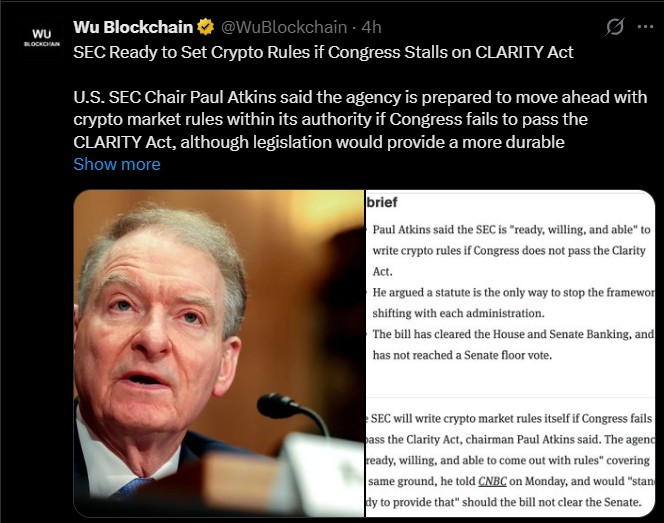
Source: Wu Blockchain X Post
The ethics provisions matter because they sit at the center of the bill's biggest political obstacle: concerns tied to President Trump's personal crypto ventures.
Critics argue that without strong conflict-of-interest language, a new market-structure law could bless arrangements benefiting officials with financial stakes in digital assets.
Supporters counter that clear federal rules on custody, trading, and token classification are overdue and would give the crypto industry certainty it has lacked for years.
The ethics deal is meant to bridge that gap, but whether it satisfies skeptical Democrats is still an open question.
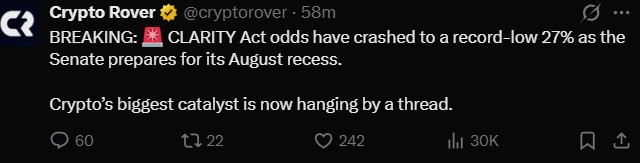
Source: Crypto Rover X Post
Despite the reported compromise, a bloc of Senate Democrats is pushing back hard.
Senator Chris Murphy has framed the bill as inadequate unless it directly addresses what he calls corruption risks tied to the president's crypto holdings.
Senator Elizabeth Warren, the Banking Committee's ranking member, argues the legislation does little to prevent further financial windfalls for Trump-linked ventures.
Senators Chris Van Hollen and Jeff Merkley have joined the opposition, with Van Hollen previously voting against the bill in committee and proposing tougher ethics amendments.
Senator Richard Blumenthal has also criticized the current draft.
Notably, even Democrats seen as friendliest to crypto have reportedly said the bill still falls short, signaling the path to 60 votes runs through more than a handful of holdouts.
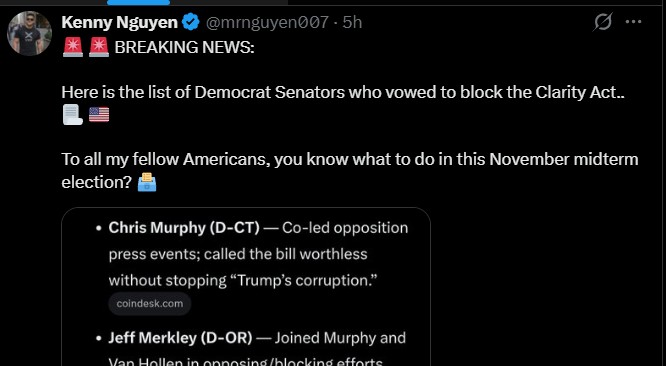
Source: Kenny Naguyen X Post
Regulators aren't waiting idly on Capitol Hill. SEC Chair Paul Atkins has said that if Congress fails to pass the CLARITY Act, the agency is prepared to move ahead on its own with rules covering crypto market structure, including issuance, custody, and trading.
Atkins has acknowledged, though, that legislation would offer far greater permanence, since agency rules can shift with each change in administration.
The SEC has already included crypto market-structure rules in its 2026 regulatory agenda, giving the industry a fallback path even if the bill stalls.

Source: CryptoTice X Post
The bill's legislative journey shows real progress, even if the finish line remains distant.
The CLARITY Act cleared the Senate Banking Committee in May by a 15-to-9 vote, a bipartisan margin that suggested a path forward. Since then, it has not received a full Senate floor vote, leaving it in limbo while leadership works to secure the 60 votes needed for passage. That gap is exactly where the current ethics negotiations aim to close the distance.

Source: Jaden Park X Post
In the days ahead, expect the ethics deal's fine print to become public, along with signals on whether the White House will formally back it. Senate leadership will also need to confirm whether enough Democrats are willing to cross over, since Republicans cannot pass the bill without at least seven Democratic votes. If no deal materializes before recess, the timeline likely slips into fall, extending uncertainty for an industry that has awaited federal market-structure clarity for years.
Key Developments
| Development | Current Status | Why It Matters |
| Bipartisan ethics deal | Reportedly finalized | Could help address Democratic concerns |
| Ethics package details | Not yet released | Key to determining whether opposition softens |
| White House approval | Still required | Deal may not be final without approval |
| Senate support | 60 votes needed | Republicans alone cannot pass the bill |
| Democratic support | Unconfirmed | Several Democrats remain strongly opposed |
| Senate Banking Committee | Passed 15–9 in May | Cleared an important committee hurdle |
| Full Senate vote | Not held yet | Major remaining legislative step |
| SEC fallback | Rules may develop independently | Crypto regulation 2026 may continue even if Congress fails |
For investors, the practical takeaways are straightforward: watch for the release of the ethics package's actual text, track whether the White House endorses it, and monitor whether wavering Democratic senators shift position before the recess deadline. A failed vote wouldn't end market-structure reform outright, since the SEC's independent rulemaking option remains on the table, but it would mean a longer, choppier road for regulatory certainty.
Timeline: CLARITY Act News Today
May 2026: CLARITY Act passes Senate Banking Committee 15–9
↓
July 23, 2026: Updated CLARITY Act text released, reportedly 616 pages
↓
July 29, 2026: Senators continue negotiations over ethics provisions
↓
July 30, 2026: Tillis and Gallego reportedly finalize a bipartisan ethics compromise
↓
July 30, 2026: White House approval remains pending; 60 Senate votes are still unconfirmed
↓
Early August 2026: Senate faces approaching August recess deadline
↓
Next step: Senate vote, further amendments, or delay if lawmakers cannot secure enough support
The Bill remains one of the most consequential pieces of pending crypto legislation, and its fate now hinges on a handful of Senate votes and a still-unreleased ethics compromise.
Whether the Tillis-Gallego deal satisfies skeptical Democrats, or whether the bill slips past the August recess, will shape the next phase of U.S. crypto policy.
With committee approval already secured but a floor vote still pending, the coming days before recess will determine whether this session delivers a landmark crypto law or another delay. Investors should expect more developments soon.
Disclaimer: This article is for informational purposes only and does not constitute financial, legal, or investment advice. Crypto markets and regulations are volatile; always do your own research before making decisions.





