CLOB or Order Book? Find the best matching engine for your exchange.
Building a crypto exchange used to be much simpler.
List a few cryptocurrencies, offer competitive trading fees, and launch the platform.
But today’s traders expect more. They want fast trade execution, deep liquidity, and a smooth trading experience even during periods of high market activity. That’s where the matching engine becomes critical.
For businesses working with a Crypto Exchange Development Company, choosing the right matching engine architecture can directly impact platform performance and future growth. Among the most common options are the traditional Order Book and the Central Limit Order Book (CLOB).
In this guide, we’ll explore how both systems work and help you determine which one is best suited for your crypto exchange goals.
A matching engine serves as the core component of a crypto exchange platform. It continuously matches buy and sell orders while ensuring fair pricing and efficient trade execution.
The effectiveness of a matching engine influences:
As cryptocurrency markets become increasingly competitive, exchange operators need a robust trading engine capable of handling thousands of transactions per second without compromising performance.
A traditional order book records all active buy orders (bids) and sell orders (asks) within a trading market. When a trader places an order, the matching engine searches for a compatible counter-order based on price and quantity.
However, as trading volume increases, traditional order book systems may face scalability limitations and increased latency.
A Central Limit Order Book (CLOB) is an advanced matching engine architecture designed to centralize all buy and sell orders into a single order management system. Unlike basic order books, CLOB prioritizes orders using strict price-time priority rules, ensuring fair and efficient trade execution.
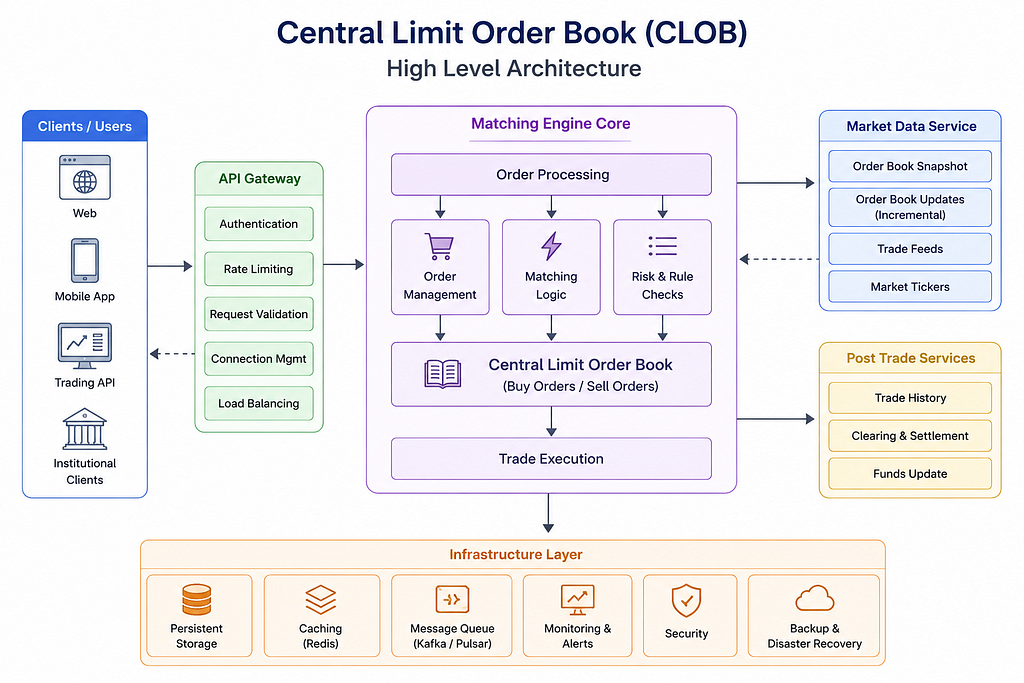
For modern crypto exchange platform development, CLOB architecture has become a preferred choice due to its ability to process large trading volumes efficiently.
Although both systems facilitate trade matching, their underlying infrastructure and operational capabilities differ significantly.
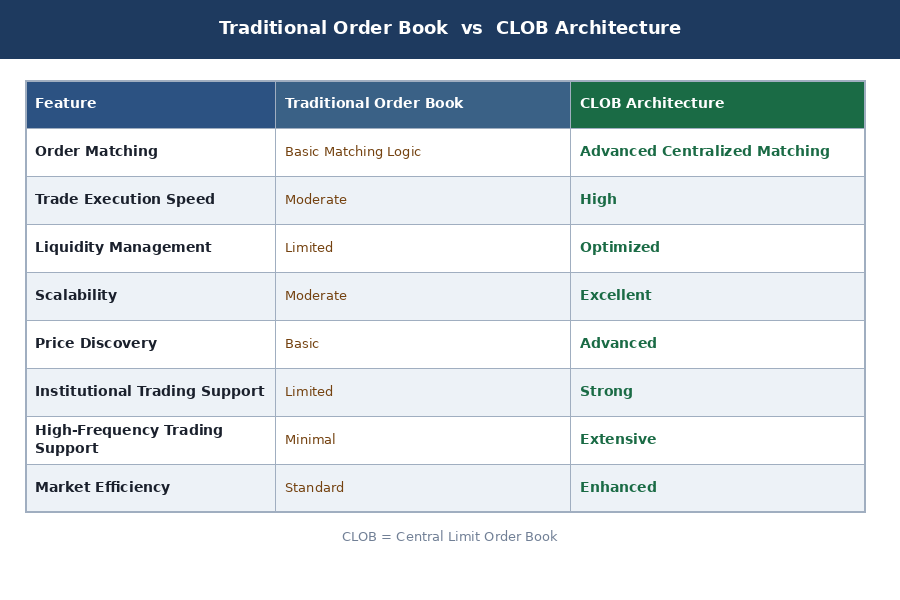
The choice ultimately depends on your exchange’s target audience, expected trading volume, and future growth plans.
Performance is one of the most important considerations when evaluating exchange infrastructure.
CLOB systems are designed to process orders with minimal latency, making them ideal for active trading environments.
Since all orders are managed within a centralized structure, liquidity becomes easier to aggregate, leading to tighter spreads and improved trading opportunities.
As exchanges grow, matching engines must accommodate increasing transaction volumes. CLOB architecture generally offers superior scalability compared to traditional order book systems.
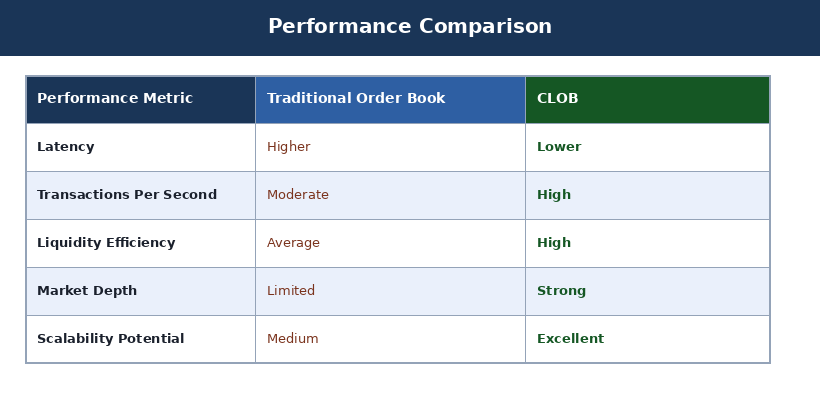
For exchanges expecting significant growth, CLOB often provides a more future-ready foundation.
Yes. One of the primary reasons large exchanges adopt CLOB architecture is its ability to support high-frequency trading (HFT) and institutional investors.
Institutional traders require:
CLOB architecture fulfills these requirements by delivering efficient trade matching and optimized order routing.
As institutional adoption of digital assets continues to grow, exchanges equipped with advanced matching engines gain a significant competitive advantage.
While CLOB offers numerous advantages, implementation comes with challenges.
Building a high-performance matching engine requires sophisticated backend architecture and experienced development teams.
Compared to traditional order books, CLOB solutions typically require greater investment in engineering and testing.
The centralized nature of CLOB systems demands robust security measures to protect against cyber threats and trading disruptions.
Regular performance optimization and infrastructure upgrades are necessary to maintain reliability under heavy trading activity.
Partnering with an experienced Crypto Exchange Development Company can help mitigate these challenges and accelerate deployment.
The ideal matching engine depends on your exchange’s objectives.
Selecting the right architecture early can reduce future migration costs and improve platform performance.
If you’re planning to launch or scale a crypto exchange, choosing the right matching engine is one of the most important decisions you’ll make. With increasing trading activity, the efficiency of your matching engine becomes crucial. The right solution can support rapid trade execution, deeper liquidity, and consistent platform performance. As an exchange founder, CTO, or product owner, you should evaluate your expected user growth, trading activity, and future expansion plans. Whether you’re building a startup exchange or an institutional trading platform, selecting a matching engine that aligns with your long-term vision will position your business for sustainable success.
There is no one-size-fits-all answer in the CLOB versus order book debate.Selecting the best matching engine depends on your platform’s growth strategy and expected trading volume.
When ease of deployment and manageable operational requirements are top priorities, a traditional order book can effectively support your exchange’s initial growth. However, if your vision includes deeper liquidity, faster execution speeds, institutional participation, and long-term scalability, CLOB architecture offers a stronger foundation for growth.
Before making a final decision, assess your business goals, technical requirements, and future expansion plans. Partnering with a trusted Crypto Exchange Development Company
Which Matching Engine Should You Choose? CLOB vs Order Book for Crypto Exchange Success? was originally published in Coinmonks on Medium, where people are continuing the conversation by highlighting and responding to this story.





