Crypto casinos exist, at least in theory, because people want to gamble with crypto. The pitch has always been wrapped up in the culture: wallet-to-wallet payments, no bank in the middle, the chance that the Bitcoin sitting in your balance is worth more by the time you cash out than when you funded it. Volatility was never really hidden from players. It was part of the appeal.
So it’s a little strange that the players betting the most money have, in large part, opted out of it entirely.
Walk through the VIP and high-deposit-limit guides published across the crypto gambling press this year and a pattern shows up again and again. The bigger the bankroll, the more likely it’s denominated in USDT or USDC rather than BTC or ETH. Stablecoins aren’t just one option among many at the top end of the market, for a meaningful share of serious players, they’ve become the default. That’s worth examining on its own terms, because the reason isn’t really about crypto culture at all. It’s arithmetic.
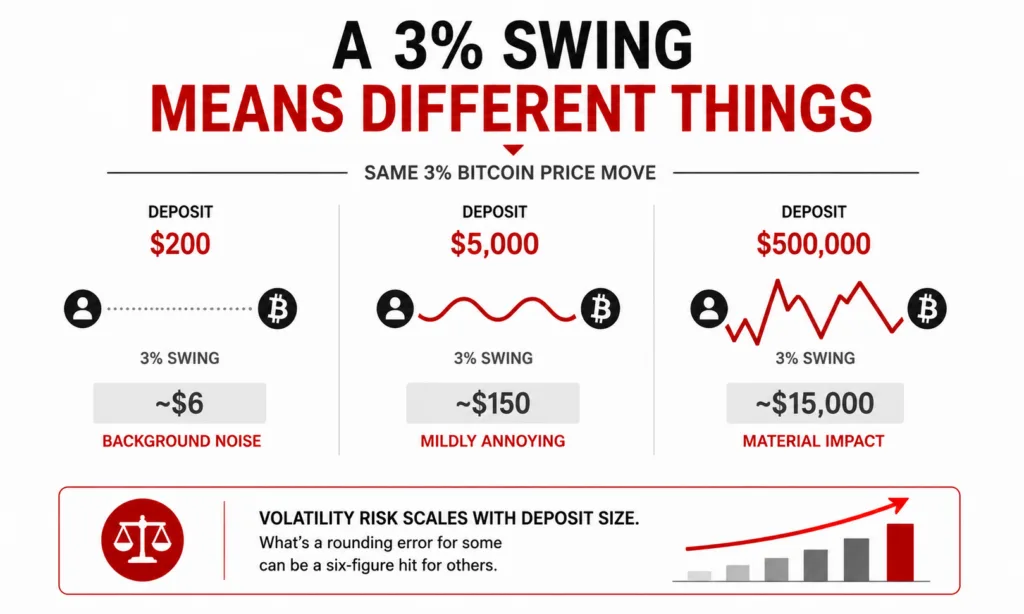
A 3% move in Bitcoin’s price is background noise to a player depositing $200. It’s mildly annoying to a player depositing $5,000. At $500,000, it’s $15,000, a sum that can evaporate or appear before a single hand has been dealt, just from the time it takes a transaction to clear.
That’s the asymmetry driving this shift. Volatility risk scales with deposit size in a way that small-stakes players rarely have to think about and high-stakes players can’t avoid thinking about. The same price swing that’s a rounding error for a casual depositor is a material number for someone moving six figures.
Three separate mechanisms compound here, and each one gets sharper as the deposit gets bigger.
Crypto deposits aren’t instant. Between the moment a transaction is broadcast and the moment it’s confirmed, the underlying asset’s price can move.
A bankroll that sits at one nominal Bitcoin value during deposit can drift meaningfully while the transaction waits to confirm. That drift has nothing to do with the games being played.
For a small deposit, that drift is a few cents. For a high roller, it can be thousands of dollars of value gained or lost before the first bet is even placed.
This is where the stablecoin case gets concrete rather than just theoretical. Routing a six-figure deposit through Ethereum mainnet during a period of network congestion risks steep gas fees and unpredictable confirmation times.
The workaround that high-deposit guides increasingly point to is routing stablecoin transfers through cheaper rails such as TRC-20 on Tron or BEP-20 on BNB Chain.
A six-figure stablecoin deposit on one of those networks typically settles in under two minutes for a flat fee of roughly $1 to $2, a number so small relative to the deposit that it stops being a consideration at all.
This is where the stablecoin case gets concrete rather than just theoretical. Routing a six-figure deposit through Ethereum mainnet during a period of network congestion risks steep gas fees and unpredictable confirmation times.
The workaround that high-deposit guides increasingly point to is routing stablecoin transfers through cheaper rails such as TRC-20 on Tron or BEP-20 on BNB Chain. A six-figure stablecoin deposit on one of those networks typically settles in under two minutes for a flat fee of roughly $1 to $2, a number so small relative to the deposit that it stops being a consideration at all.
A high-stakes player isn’t depositing and immediately cashing out. They’re playing for hours, sometimes longer. Every minute spent at the table is another minute a BTC-denominated balance is exposed to price movement that has nothing to do with the cards, dice, or reels.
Holding a balance in a dollar-pegged token removes that variable entirely, which is precisely why high-roller guides routinely flag stablecoins as the way to “keep balances easy to read” during long sessions.
None of this is unusual. It’s the same logic that makes a business treasury hold operating cash in dollars rather than in a volatile asset, applied to a gambling bankroll instead of a balance sheet.
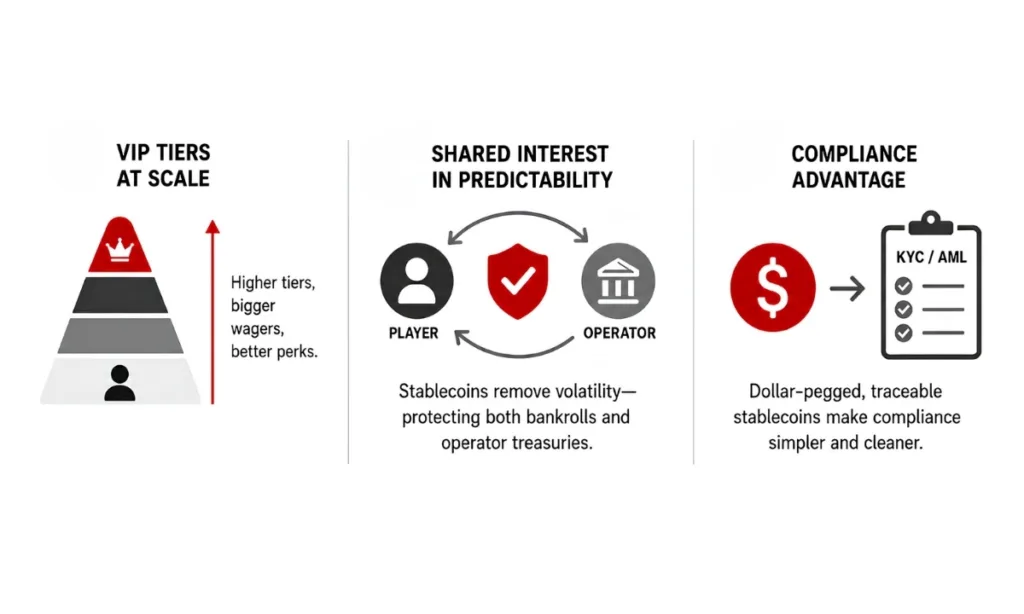
The clearest evidence that this isn’t a marginal preference shows up in how VIP programs are actually structured. Tiered loyalty systems at the largest platforms now run from entry-level thresholds up to genuinely enormous wagering requirements. Some VIP ladders top out at tiers requiring hundreds of millions of dollars in cumulative wagers, unlocking dedicated account managers, custom cashback terms, and white-glove treatment generally reserved for institutional clients in other industries.
At that scale, a casino’s treasury operations matter as much as the player’s preferences. A platform managing six- and seven-figure balances across hundreds of high-value accounts has its own volatility exposure to think about if those balances sit in BTC rather than stablecoins. Predictability isn’t just a player convenience at this point, it’s a shared interest between the player managing personal risk and the operator managing treasury risk.
That alignment is a big part of why stablecoins have become the default infrastructure for high-deposit play rather than a niche option buried in the cashier menu.
There’s a compliance angle here too. Large deposits and withdrawals are exactly the transactions most likely to trigger anti-money-laundering scrutiny, source-of-funds questions, or enhanced KYC review. A dollar-denominated, fully traceable stablecoin transaction is operationally simpler for an operator to document and defend than a Bitcoin transaction whose dollar value was a moving target throughout the session. Stablecoin settlement doesn’t exempt anyone from AML obligations, but it does make the paperwork cleaner, and platforms handling serious money have strong incentives to keep that paperwork clean.
The standard explainer comparing USDT and USDC reads the same way almost everywhere. USDT has deeper liquidity and broader acceptance, USDC is the more transparent, compliance-friendly option. That differentiation is less relevant at small deposit sizes. It gets more interesting once the numbers get large.
USDT’s liquidity advantage matters more, not less, as deposit size increases, because moving a large balance in or out of a platform quickly requires deep markets on the receiving end. Thin liquidity is exactly where a large transaction starts to move its own price, even for a token that’s supposed to be pegged. USDC’s appeal at the high end leans the other way. Reserve transparency and regulatory clarity matter more to a player parking a genuinely large sum somewhere, even briefly, because the question stops being “will this be fast” and starts being “am I confident this balance is actually backed.”
That’s a real tension, not a settled question. A whale optimizing purely for speed and depth of market will lean USDT. A whale optimizing for assurance that a seven-figure balance is fully reserved will lean USDC. Both calculations are rational; they’re just answering different questions, and high-roller guides increasingly treat the choice between the two as a genuine decision point rather than a coin flip.
It would be tidier to say stablecoins have simply won at the top end of the market. They haven’t, not entirely. Plenty of high-stakes players still deposit in Bitcoin or Ethereum deliberately, treating crypto exposure as part of the experience rather than a problem to be engineered away. A player who’s already up significantly mid-session might prefer the optionality of a native coin balance that could appreciate further while they play, rather than a stablecoin balance that, by design, can’t.
That’s a legitimate preference, and native-coin high-roller play hasn’t disappeared from any major platform’s cashier. What’s changed is which pattern represents the median serious player rather than the exception. A few years ago, gambling with volatile crypto and accepting that volatility as part of the bet was close to the default at the high-stakes end of the market. Increasingly, it’s the minority choice that a player opts into deliberately, rather than the default they fall into by using crypto at all.
The interesting thing about stablecoin-only high-roller play isn’t that it’s happening. It’s what it reveals about what these players actually want from crypto casinos in the first place. It was never really the price exposure that mattered. It was everything else including wallet-to-wallet settlement with no bank in the middle, fast confirmation, low fees at scale, and the ability to move serious money without the friction a traditional high-limit casino would impose on the same transaction.
Strip the volatility back out, and what’s left is crypto infrastructure without crypto’s investment thesis: speed and low friction, minus the price-appreciation bet. For the players moving the most money, that trade is starting to look like the obvious one.
The post Why Whales Bet in Dollars: The Quiet Stablecoin Takeover of High-Roller Crypto Gambling appeared first on BitcoinChaser.





