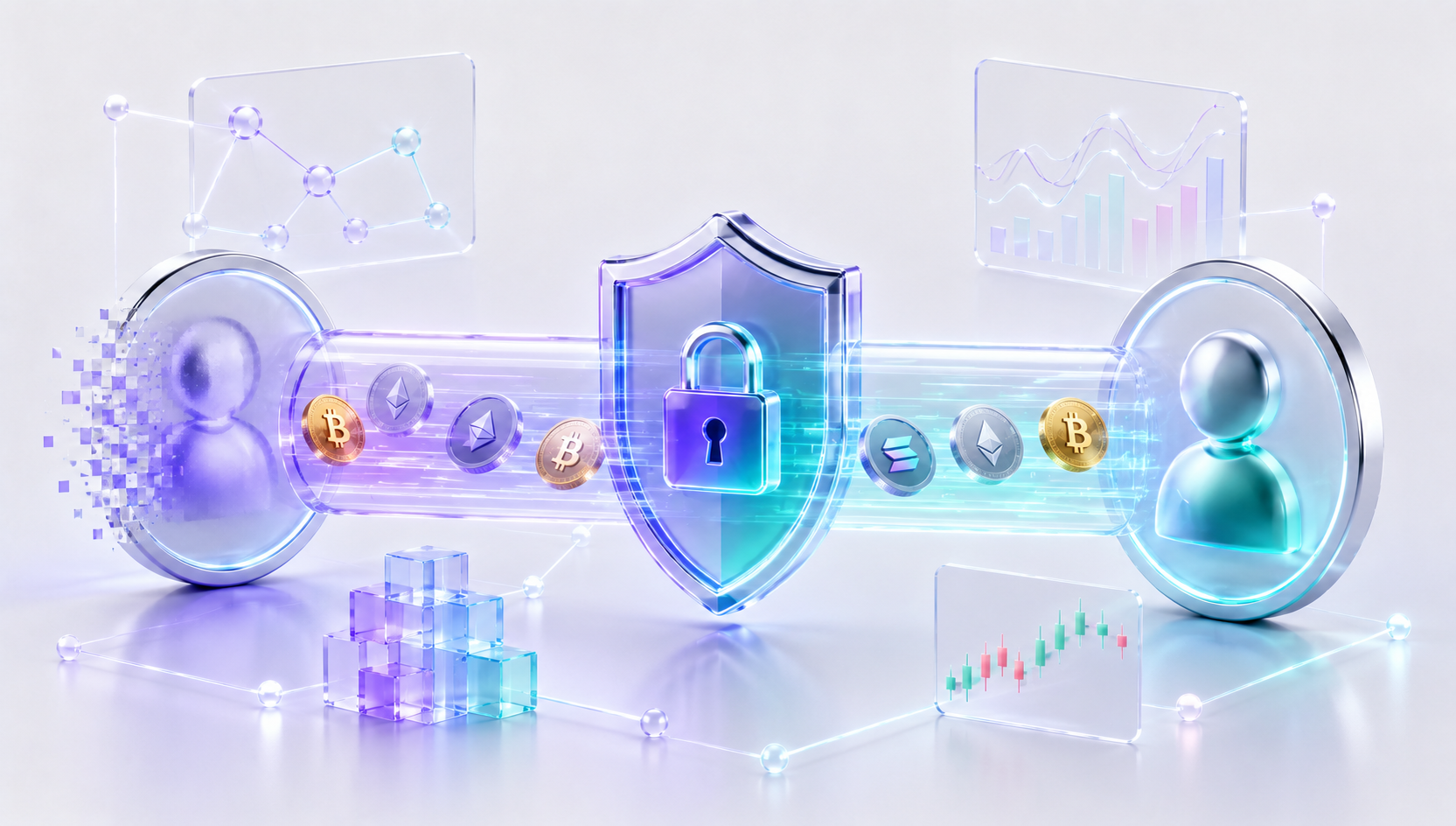
Crypto confidential payments are blockchain payments designed to protect sensitive transaction details from public exposure. Instead of showing every sender, receiver, asset, amount and wallet history to anyone with a block explorer, confidential payment systems use cryptography and controlled disclosure to keep parts of the payment private while still allowing the network to verify that the transfer is valid.
They are not the same as mixers. A mixer usually takes funds from many users, pools or routes them together, and attempts to break the public link between deposit and withdrawal. Confidential payments aim to make privacy part of the payment design itself. The goal is not to “wash” funds after the fact. The goal is to stop unnecessary financial exposure from being created in the first place.
That difference is important. Public blockchains are transparent by default. Anyone can inspect addresses, balances, token approvals, counterparties, payment timing and transaction history. Transparency helps with auditability, but it also exposes salaries, supplier payments, donations, treasury movement, trading behavior, user balances, wallet habits and business relationships. Strong privacy tools give users more control over what they reveal, when they reveal it, and to whom.
A normal blockchain transfer is not like a bank payment that only the sender, receiver, bank and compliance systems can see. On a public chain, the payment usually becomes part of a permanent public record. A simple ETH, USDC, SOL or token transfer can reveal the sending wallet, receiving wallet, timestamp, asset, amount, fee and the broader wallet history around both parties.
That visibility creates practical risks. A freelancer paid in stablecoins may accidentally reveal their full wallet balance to a client. A company paying suppliers on-chain may expose vendor relationships. A trader receiving funds from a known exchange wallet may make portfolio activity easier to track. A donor may not want every future wallet movement connected to a public donation. A DAO treasury may need public accountability without revealing every negotiation, payroll movement or security-sensitive operational wallet.
Privacy-focused wallet design can reduce some exposure, but wallet privacy is only one layer. A deeper look at privacy wallets helps separate wallet-level privacy from protocol-level confidential payments. A wallet can improve address management and user behavior, but the chain may still expose the payment unless the transaction system itself supports confidentiality.
Confidential payment systems usually protect one or more of three things: the sender, the receiver and the amount. Some systems also protect the asset type, memo field, contract interaction or balance state. The technical design varies by chain or protocol, but most models use one or more of these building blocks.
Zero-knowledge proofs let a user prove that a transaction follows the rules without revealing all the underlying data. In a private payment, the network can verify that the sender is authorized, the funds are not being double-spent, and the transaction is valid, while the public record does not reveal the same details a normal transparent transfer would expose.
Zcash is the clearest long-running example. Its shielded transactions use zk-SNARK cryptography so shielded addresses can protect transaction data while still allowing the network to verify validity. Shielded Zcash transfers can hide sender, receiver and amount, while transparent Zcash addresses work more like Bitcoin-style public addresses. The strongest privacy comes from shielded-to-shielded movement rather than entering or exiting through transparent addresses.
Zero-knowledge systems are powerful, but they are not magic. Trusted setups, circuit bugs, wallet mistakes, poor UX, small anonymity sets and metadata leaks can weaken privacy. A solid understanding of ZK crypto risks is useful because privacy claims should be judged by implementation, not branding.
A shielded pool is a private zone where funds can move without exposing every transfer detail publicly. A user may move assets from a transparent address into the shielded pool, transact privately inside it, and later move funds out. The privacy quality depends on pool size, user behavior, timing, asset support and whether users keep reusing patterns that reveal them.
Shielded pools are not mixers in the basic sense. The privacy is built into the transaction model rather than added as a separate laundering step. Still, entry and exit points matter. If a user shields exactly 10,000 units and deshields exactly 10,000 units five minutes later, observers may infer a connection even if the shielded transfer itself is private.
Stealth addresses let a receiver publish one payment identifier while each payment lands at a different on-chain address. That makes it harder for outsiders to link all payments to the same recipient. The sender can generate a fresh destination for that payment, while the receiver can still detect and control the funds.
This is useful for donations, creator payments, merchant payments and recurring user payments where the receiver does not want one public address to become a complete financial profile. Stealth addresses protect receiver privacy better than simply telling users to create new wallets manually, but they still need wallet support and careful handling of metadata.
Confidential payments do not have to mean zero accountability. Some systems support viewing keys or payment disclosures. A viewing key can give an auditor, accountant, exchange, tax professional or compliance team read-only access to specific private transaction details without giving them spending authority.
That design is important for real-world adoption. A business may need private payroll, but it still needs accounting. A user may want transaction privacy from the public, but still need tax records. A regulated institution may need confidential settlement without exposing client flows to competitors. The broader question of crypto privacy and compliance is becoming central because serious privacy design must support legitimate disclosure without turning every payment into public surveillance.
Some newer systems protect more than the final payment. They also hide parts of the execution process. NEAR’s Confidential Intents model is an example of confidential execution for cross-chain transactions, where swaps or payments can be handled in a restricted-visibility environment before settlement. The user experience can feel closer to a normal payment, while sensitive routing and execution details are not broadcast in the usual way.
This is especially relevant for DeFi and cross-chain payments. Public intent, order-flow and routing data can expose user strategy, create front-running risk, leak business relationships and reveal payment timing. Confidential execution can reduce those leaks without forcing users to abandon public blockchain settlement completely.
The cleanest way to separate the two is by purpose and architecture.
| Feature | Confidential Payments | Mixers |
|---|---|---|
| Main Goal | Prevent unnecessary public exposure during payment | Obscure links after funds enter a mixing process |
| Design | Built into protocol, wallet, rollup, shielded pool or payment layer | Separate pooling or routing service |
| User Experience | Can feel like sending a normal private payment | Often requires deposit, wait, withdrawal and manual handling |
| Compliance Potential | May support viewing keys, audit access or selective disclosure | Often harder to reconcile with regulated workflows |
| Main Risk | Metadata leaks, poor implementation, weak anonymity set | Sanctions risk, service risk, tainted-flow risk, regulatory scrutiny |
Confidential payments are better understood as privacy infrastructure. Mixers are usually external obfuscation tools. That does not mean every confidential payment system is automatically safe, compliant or well designed. It means the privacy goal is different.
Private payments can be useful for normal users, not only power users.
A person paid in stablecoins should not have to expose their entire wallet history to an employer, client or customer. A merchant accepting crypto should not automatically reveal supplier wallets, treasury balances or payment flows. A donor should be able to support a cause without turning that donation into a permanent public identifier. A business should be able to settle invoices, refunds, payroll and vendor payments without giving competitors a real-time map of its operations.
DeFi adds another layer. Trading, lending, collateral management and liquidity routing become riskier when every position is visible. Public DeFi can expose liquidation levels, whale flows, treasury actions and arbitrage opportunities before users can react. Private DeFi is not about hiding crime. It is about making open financial infrastructure usable for people and institutions that cannot expose every balance sheet movement. The case for private DeFi is strongest when privacy protects users from surveillance, strategy theft, MEV and unnecessary data leakage.
Confidential payments do not remove every trace. They can hide payment details on-chain, but users can still leak information through exchange deposits, withdrawals, IP metadata, browser fingerprints, wallet reuse, timing patterns, screenshots, public usernames, invoices, customer records, compromised devices or poor operational security.
They also do not remove legal duties. A private transaction can still be taxable. A business can still need accounting records. A regulated company can still need KYC, sanctions screening and audit controls. Privacy protects against unnecessary public exposure; it does not cancel compliance obligations.
Custody remains another risk. A confidential payment wallet still depends on seed phrase security, device safety and careful signing. If the user loses recovery words, signs a malicious transaction or exposes a private key, privacy will not save the funds. A strong crypto wallet safety checklist and proper seed phrase storage remain basic requirements.
Confidential payment systems have several trade-offs.
The first is usability. If privacy requires too many manual steps, users make mistakes. If they need to choose between transparent and shielded modes, they may pick the wrong one. If wallets do not clearly explain entry and exit leaks, users may overestimate their privacy.
The second is liquidity. Private payment systems need enough users and assets to create useful anonymity. A tiny private pool can leak information because few users are creating similar activity.
The third is compliance access. Viewing keys and selective disclosure can help, but not every system supports them well. Institutions need auditability, accounting, internal controls and counterparty risk checks.
The fourth is regulatory perception. Privacy tools can be misunderstood or abused. Projects that want serious adoption need clean explanations, safe defaults, compliance pathways and clear separation from mixer-style laundering narratives.
The fifth is technical complexity. Zero-knowledge circuits, private state, encrypted memos, nullifiers, private execution environments and cross-chain routing all add design risk. A bug in a privacy system can damage both funds and confidentiality.
Crypto confidential payments are a major step toward making blockchain payments usable in the real world. Public ledgers are valuable because they allow verification, settlement and auditability, but full public exposure is not acceptable for every person, business, donation, payroll flow, trade or treasury operation.
The strongest confidential payment systems do not treat privacy as a suspicious add-on. They make selective disclosure, wallet safety, compliance support and user control part of the design. The result is a payment model where the network can verify that a transfer is valid without forcing every user to publish their financial life to the entire internet.
The category is still early, and users should judge each implementation carefully. Good confidential payments reduce exposure without promising perfect anonymity, legal immunity or risk-free privacy. The best designs will be the ones that make private payments feel normal, keep verification intact, and give users enough control to share financial information only when there is a real reason to share it.
The post What Are Crypto Confidential Payments and How Do They Work appeared first on Crypto Adventure.





