
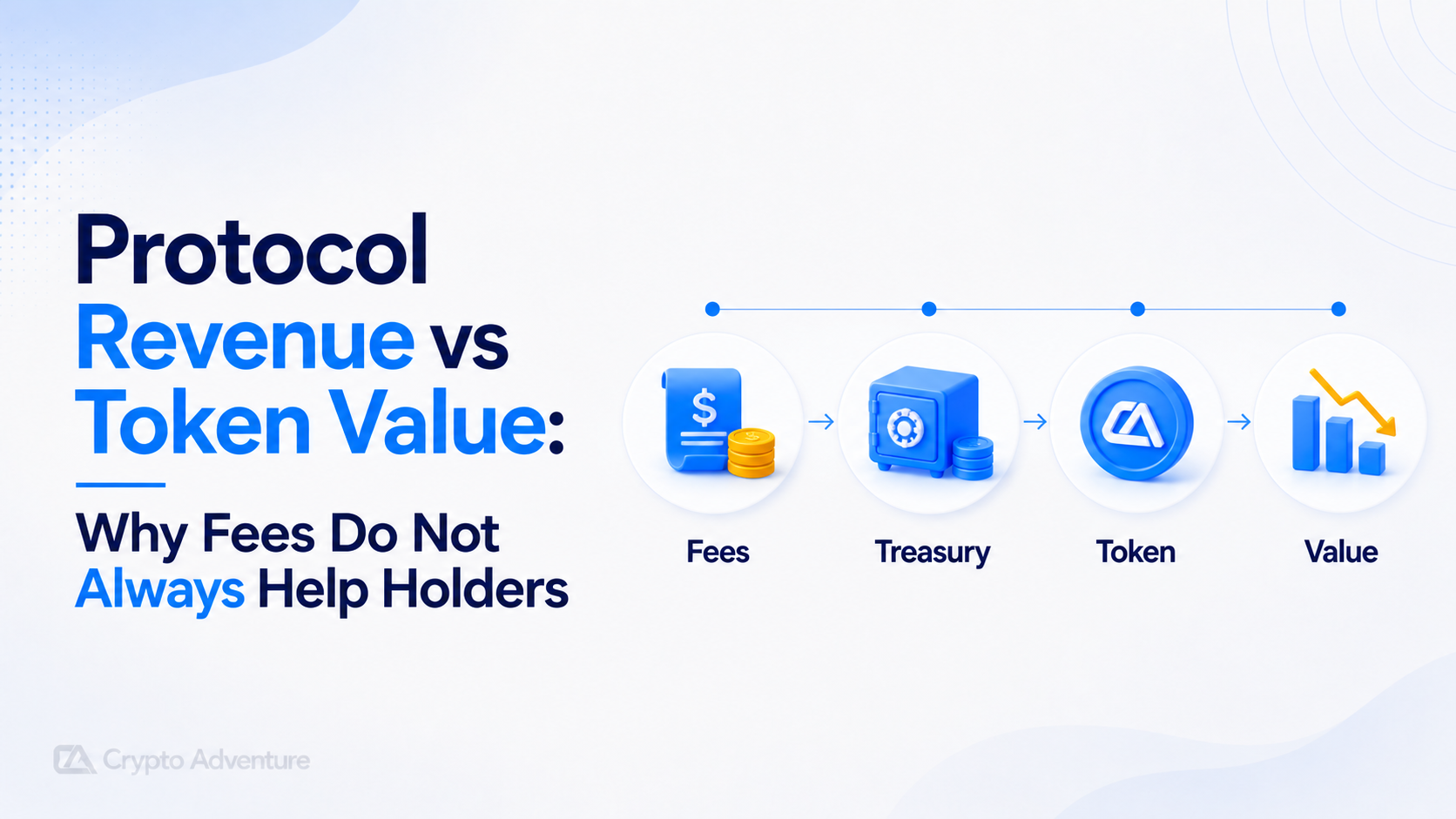
Crypto investors often look at protocol fees and assume the token should rise when fees increase. That shortcut can be dangerous. A protocol can generate real usage, real fees, and real revenue while the token still captures little or none of that value.
The reason is simple: usage value and token value are different layers. A protocol can be useful to traders, borrowers, validators, liquidity providers, developers, or stablecoin users, but the native token only benefits when economic value flows toward the token directly or indirectly.
Fee dashboards make this distinction important. DeFiLlama’s data definitions separate user-paid fees from protocol revenue and token holder revenue. Token Terminal’s revenue metric focuses on the portion of fees a project retains after supply-side participants receive their share. Those definitions help users avoid treating every fee dollar as value for token holders.
Fees measure what users pay to use a protocol. In a DEX, fees may come from swaps. In a lending protocol, fees may come from borrower interest. In a chain, fees may come from transaction execution. In a liquid staking system, fees may come from staking rewards or validator services.
Fees show demand for the product. High fees can mean users are trading, borrowing, minting, staking, bridging, or settling real activity. That is useful because a protocol without fee generation often has weaker evidence of product-market fit.
Fees do not automatically show who captures the value. A DEX may send most fees to liquidity providers. A lending market may route interest to suppliers. A chain may burn fees, pay validators, or split value across sequencers, builders, and stakers. The token holder may sit far away from the cash flow.
Protocol revenue is the portion of fees retained by the protocol, treasury, foundation, DAO, or onchain collector after supply-side participants receive their share. It is closer to business revenue than total fees, but it is still not the same as token holder value.
A protocol can retain revenue and use it for grants, operations, insurance funds, buybacks, treasury growth, developer funding, or ecosystem incentives. Some uses can support long-term value. Others may not reach token holders directly.
Protocol revenue matters because it shows whether the protocol has a path toward self-funding. A protocol that relies only on token emissions can become fragile when incentives dry up. A protocol that earns revenue can fund development, security, liquidity, and operations without constantly selling new tokens.
Token holder revenue is the subset of value distributed to token holders through buybacks, burns, staking rewards, direct distributions, or other mechanisms. This is the closest crypto equivalent to a shareholder-value metric, although tokens are not stocks and rights vary widely.
The difference is critical. A protocol can have high fees, moderate protocol revenue, and zero token holder revenue. In that case, the token may still have governance value, collateral value, staking value, or speculative value, but it does not have direct cash-flow value from protocol activity.
This is why investors should ask one question before using revenue in a valuation: where does the money go?
Fees often bypass token holders because protocols must pay the parties that make the system work. Liquidity providers take trading fees because they supply inventory. Lenders earn interest because they supply capital. Validators earn rewards because they secure the chain. Solvers, sequencers, or relayers may capture value because they handle execution.
That is not a flaw. It is the cost of operating the network. If a protocol diverts too much value away from supply-side participants, liquidity can leave, spreads can widen, borrowing costs can rise, security can weaken, or user experience can suffer.
A fee switch can help token economics, but it can also create trade-offs. If a DEX takes more fees for the protocol, liquidity providers may earn less. If liquidity leaves, trading quality can decline. The protocol then captures a bigger share of a smaller market.
Uniswap is the classic example of the fee-versus-token-value debate. The protocol has generated major trading volume for years, but UNI historically functioned mainly as a governance token rather than a direct fee-claim token.
The current Uniswap protocol fee system is built around collecting fees from protocol versions into onchain collectors and routing those assets through specialized contracts. The UNIfication proposal pushes the model further by connecting protocol fees, governance-controlled collection, and potential UNI burn mechanics.
This matters because the protocol’s business activity and token value path were not always the same. High Uniswap usage did not automatically mean UNI holders received fees. The value link depends on governance activation, fee routing, competitive effects, and whether fee capture harms liquidity.
Aave shows another version of the same issue. The protocol has strong lending-market usage, but user interest flows through a specific reserve design. Aave’s reserve framework manages supply, borrowing, caps, collateral settings, liquidation parameters, and risk controls for each asset market.
The AAVE token has governance utility through the Aave ecosystem, but the connection between protocol activity and token value depends on governance decisions, safety mechanisms, reserve factors, treasury flows, risk modules, and future tokenomics. A lending protocol can be useful and still have a token whose value depends on more than borrower activity.
This is why lending revenue should be analyzed through the full system. Suppliers, borrowers, liquidators, the protocol treasury, safety participants, and token holders can all sit in different places in the value chain.
Buybacks and burns can support token value when the underlying revenue is real, recurring, and large relative to token supply. They can fail when revenue is small, irregular, or already priced in.
A burn reduces supply, but it does not guarantee demand. A buyback creates demand, but it can be weak compared with sell pressure from emissions, unlocks, insiders, treasury grants, or market makers. A staking reward can attract holders, but it can also become circular if rewards are paid in newly emitted tokens rather than real revenue.
Token value improves when the mechanism is durable. A one-time fee spike, temporary trading mania, or short-lived incentive campaign does not create a strong long-term valuation by itself.
A better token framework starts with five questions.
First, who pays the fees? Real users are stronger than subsidized activity.
Second, who receives the fees? Liquidity providers, validators, suppliers, solvers, and token holders may receive different shares.
Third, what does the protocol keep? Treasury revenue can fund operations, but it is not automatically holder income.
Fourth, how does value reach the token? Burns, buybacks, staking rewards, fee sharing, collateral demand, governance power, or no direct mechanism at all.
Fifth, what offsets the value? Token emissions, unlocks, operating expenses, security subsidies, incentive programs, and competitive pressure can all dilute revenue impact.
Protocol revenue can be a strong signal, but it is not the same as token value. Fees show user demand. Protocol revenue shows retained economics. Token holder revenue shows value actually routed to token holders.
A token can underperform even when its protocol is active if fees flow to liquidity providers, validators, suppliers, or the treasury instead of holders. Strong tokenomics require a clear value path, sustainable demand, manageable emissions, and a mechanism that does not damage the product’s competitiveness. Investors should follow the money through the full system before assuming high fees will help the token.
The post Protocol Revenue vs Token Value: Why Fees Do Not Always Help Holders appeared first on Crypto Adventure.





