Russia made two separate moves against crypto mining this week, and together they paint a clear picture of where this crypto mining news story is headed. The government tightened its regional mining ban, while police broke up a hidden mining network built to dodge exactly that kind of enforcement.
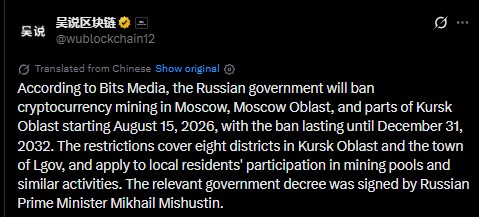
Russia's government signed a decree banning cryptocurrency mining in Moscow, Moscow Oblast, and parts of Kursk Oblast starting August 15, 2026, with the ban running through December 31, 2032.
The order is Government Decree No. 936, dated July 25, 2026, amending an earlier decree from December 23, 2024, and it was officially published on July 31, 2026. Russian Prime Minister Mikhail Mishustin signed it.
The restrictions cover eight named districts in Kursk Oblast, Belovsky, Bolshesoldatsky, Glushkovsky, Korenevsky, Lgovsky, Rylsky, Sudzhansky, and Khomutovsky; plus the town of Lgov, and they apply to local residents' participation in mining pools and similar activities, not just standalone mining operations.
This isn't Russia's first regional mining ban either; Kommersant notes a similar restriction is already active in 13 other energy-deficit regions, including Irkutsk Oblast, Buryatia, and Zabaykalsky Krai.
Source: X Woblockchain12
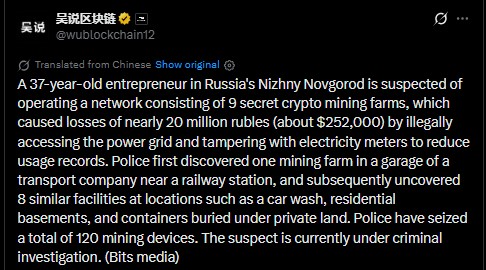
Separately, police in Nizhny Novgorod uncovered a hidden mining operation while investigating a 37-year-old entrepreneur.
A network of 9 secret mining farms.
Roughly 20 million rubles (about $252,000) in losses tied to illegally accessing the power grid.
Tampered electricity meters used to hide real usage records.
The first farm discovered in a garage belonging to a transport company near a railway station.
Eight more farms were found afterward in places like a car wash, residential basements, and containers buried under private land.
A total of 120 mining devices seized by police.
The suspect is currently under criminal investigation.
Source: X @wublockchain12
The mining ban traces back to energy supply concerns rather than a crackdown on crypto itself. Russian officials have repeatedly pointed to strained power capacity in Moscow and the Kursk region, the latter also affected by its proximity to the war in Ukraine, as the reason for restricting mining's heavy electricity draw in these specific areas.
The Nizhny Novgorod case reflects a different but related problem: even where mining is legal elsewhere in Russia, some operators are choosing to steal electricity and hide their setups entirely rather than register and pay for power through normal channels.
Neither story points to a broad market-moving event. Russia has banned mining in specific regions before without triggering major shifts in global mining hash rate or cryptocurrency prices, since large-scale mining operations can often relocate to regions without restrictions.
The bigger effect tends to show up locally, in reduced illegal power draw and stronger enforcement pressure on unregistered miners rather than in token prices.
This wave of crypto mining news shows Russia tightening enforcement on two fronts at once: expanding where mining is banned outright and cracking down harder on operators trying to mine in the shadows.
With the regional ban set to take effect August 15 and the Nizhny Novgorod investigation still ongoing, expect more enforcement stories like this one as authorities continue treating unauthorized crypto mining as an energy and legal problem, not just a cryptocurrency one.
While Russia is tightening rules around crypto mining, it is also moving ahead with broader crypto reforms designed to expand regulated retail Bitcoin access under a structured legal framework.
This article is for educational and informational purposes only and should not be considered financial or investment advice. Always conduct your own research before making investment decisions.





