
| Category | Assessment |
|---|---|
| Product Type | On-chain and market data analytics platform |
| Core Strength | Exchange flows, miner behavior, whale/entity tracking, and Bitcoin market-cycle indicators |
| Main Users | Traders, analysts, funds, media teams, market makers, researchers, and crypto operators |
| API Access | Professional and Premium plans |
| Best Fit | Users who can turn on-chain and derivatives data into repeatable market decisions |
| Main Weakness | Learning curve, paid data depth, and weaker fit for casual altcoin browsing |
| Risk Level | Low product risk, medium interpretation risk |
| Editorial Score | 8.4/10 |
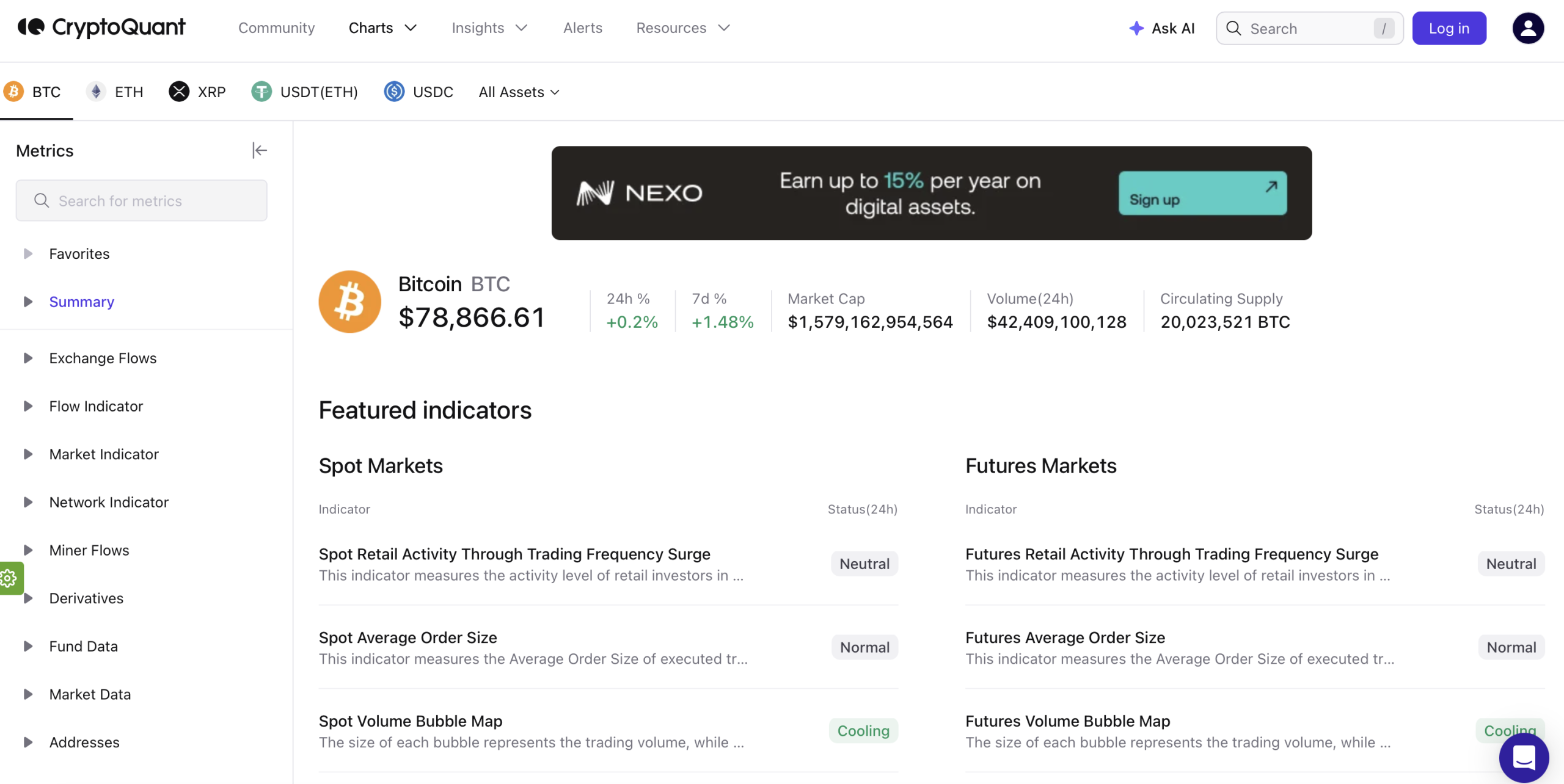
CryptoQuant is an on-chain and market data analytics platform built for crypto traders, investors, institutions, researchers, and media teams that need more than price charts. It combines blockchain data, exchange flows, miner behavior, derivatives metrics, market indicators, entity labels, custom charts, alerts, research, and API access into one research environment.
The platform has been active since 2018 and positions itself as an institutional-grade data provider for digital assets, traditional finance clients, proprietary trading firms, market makers, hedge funds, media companies, and Web3 foundations. That matters because CryptoQuant is not mainly a retail portfolio tracker. Its strongest value comes from market-structure intelligence: where coins are moving, which entities are active, how leverage is building, whether miners are distributing, and whether stablecoin or exchange flows support a market move.
CryptoQuant is strongest for Bitcoin, Ethereum, stablecoins, exchange activity, miner data, and high-signal market indicators. It is less suitable for users who only want a simple token screener, social sentiment feed, or beginner portfolio dashboard.
CryptoQuant’s product covers on-chain and off-chain crypto data. Its main dashboard experience includes pre-built charts, customizable metrics, address labels, cohorts, alerts, and no-code analytics. The platform also gives users access to full-history data, high-resolution datasets, and low-latency proprietary metrics depending on plan level.
The API catalog covers Bitcoin, Ethereum, XRP Ledger, TRON, stablecoins, ERC-20 assets, and altcoin datasets. The data model includes exchange flows, miner flows, network data, market data, fund data, mempool statistics, Lightning Network statistics, ETH 2.0 data, stablecoin exchange flows, ERC-20 flows, XRP DEX data, XRP AMM data, and more.
This is where CryptoQuant feels different from a normal charting product. A user can watch exchange reserves, inflows, outflows, whale ratios, miner reserves, realized profit behavior, funding rates, open interest context, MVRV, SOPR, and other indicators that connect market price with blockchain behavior. The platform is most useful when those metrics are combined into a repeatable research process instead of treated as isolated signals.
Exchange-flow data is CryptoQuant’s strongest use case. The platform tracks coins moving into and out of exchange wallets, which can help users understand potential selling pressure, accumulation, withdrawal behavior, and liquidity movement. Its BTC exchange-flow endpoints cover inflows, outflows, netflows, reserves, transaction counts, and exchange-specific activity.
Entity intelligence is the deeper layer. CryptoQuant classifies important participants such as exchanges, miners, and whales so users can interpret movement by entity type rather than raw wallet address alone. The entity framework explains why exchange, miner, and whale behavior can affect market structure differently. A miner transfer, whale deposit, exchange reserve change, or stablecoin inflow can each carry a different signal.
This is especially useful for Bitcoin. Exchange deposits can suggest potential sell pressure, miner outflows can point to operational selling or reserve changes, and whale behavior can identify accumulation or distribution patterns that price-only charts may miss.
CryptoQuant is also strong for miner analytics. Its BTC miner-flow endpoints cover miner reserves, inflows, outflows, hashrate, revenue, workers, and related pool behavior. That is useful because miners can become important supply-side actors during stress, halving cycles, fee spikes, or profitability compression.
Stablecoin data adds another layer. Exchange stablecoin inflows can show buying power arriving at exchanges, while stablecoin reserves can help users judge whether liquidity is building or leaving centralized trading markets. This is important because crypto rallies often need both spot demand and available dollar liquidity.
Derivatives metrics help complete the picture. Funding rates, leverage signals, and market indicators can show whether price movement is driven by spot accumulation, short covering, long leverage, or crowded positioning. The best CryptoQuant workflow combines all three: on-chain flows, exchange liquidity, and derivatives stress.
CryptoQuant’s API is a major part of its professional value. The available endpoints require bearer-token authentication, and API access is tied to Professional and Premium subscriptions. Endpoints can return JSON or CSV, and some datasets support day, hour, or block-level resolution depending on category and plan.
The no-code analytics product gives non-developers a way to customize metrics without building everything from scratch. Users who understand Excel-style analysis or basic data relationships can build dashboards and indicators without writing full SQL pipelines.
CryptoQuant has also moved into AI-agent data access through its MCP Server beta. The beta connects AI clients to on-chain analytics through the Model Context Protocol, supports more than 245 metrics, and includes natural-language queries, whale tracking, and AI-based interpretation. That is a meaningful upgrade for analysts who want AI tools to query on-chain data directly, though model interpretation still needs human review.
CryptoQuant has a free Basic plan and paid tiers for more serious users. Its current pricing page lists Advanced at $29 per month when billed yearly, Professional at $99 per month when billed yearly, and Premium at $799 with annual billing. Advanced is the natural entry point for active users who need better charts and alerts. Professional is more relevant for users who need API access and deeper workflow capacity. Premium is built for heavy analysts, funds, and teams that need more alerts, API depth, downloads, and higher-volume usage.
The price structure makes sense for the target market. Casual users may find the free plan enough for learning. Active traders and analysts will likely need a paid tier. Teams that automate dashboards, run research models, or monitor several markets need Professional or Premium because API and export access become the real workflow advantage.
CryptoQuant’s biggest strength is actionable flow intelligence. Exchange flows, miner flows, stablecoin movement, whale behavior, and derivatives context give users a clearer view of market pressure than price charts alone.
The second strength is institutional depth. Full-history data, API endpoints, labels, cohorts, alerts, and high-resolution metrics support serious research workflows.
The third strength is Bitcoin and Ethereum market-cycle analysis. Metrics such as MVRV, SOPR, exchange reserves, miner reserves, and funding rates are useful when they are interpreted together.
The fourth strength is workflow flexibility. Users can work through public charts, custom dashboards, no-code analytics, alerts, research reports, API calls, CSV downloads, or AI-agent access through MCP.
CryptoQuant’s main weakness is interpretation risk. On-chain data does not predict price by itself. Exchange inflows can precede selling, but they can also reflect internal transfers, market-making, custody movement, or exchange operations. Miner flows can matter, but they do not always create immediate price pressure.
The second weakness is the learning curve. Metrics such as MVRV, SOPR, MPI, NUPL, whale ratio, funding rates, and exchange netflows require context. Beginners can misread signals if they treat every chart as a trading trigger.
The third weakness is cost. The best workflow features sit behind paid plans, and API-heavy users need higher tiers. The platform is easier to justify for active traders, analysts, funds, or market operators than for casual holders.
The fourth weakness is long-tail coverage. CryptoQuant is excellent for major assets and core market flows, but users researching smaller DeFi protocols, niche L2 ecosystems, wallet-level smart money, or protocol revenue may still need Dune, Nansen, DeFiLlama, Token Terminal, Glassnode, Arkham, or CoinGecko alongside it.
CryptoQuant is one of the strongest on-chain analytics platforms for users who care about exchange flows, Bitcoin cycle behavior, miner activity, stablecoin liquidity, derivatives pressure, and institutional-grade crypto market data. It is not a magic signal engine, and it should not be used as a standalone trading system. Its value comes from helping users build a clearer view of market structure before price action confirms or rejects a thesis.
CryptoQuant earns an 8.4/10 because the data depth, exchange-flow coverage, entity labeling, API access, alerts, and AI-agent MCP direction make it highly useful for serious crypto research. It does not score higher because interpretation remains difficult, premium access can be expensive, and users focused on small-cap ecosystems or DeFi fundamentals will still need complementary tools.
CryptoQuant is best understood as a professional on-chain intelligence platform rather than a basic crypto charting tool. Its strongest role is helping users understand what large entities, exchanges, miners, stablecoin flows, and derivatives markets are doing beneath the surface.
The platform is most valuable for traders, analysts, funds, market makers, and research teams that can turn flow data into disciplined decisions. Casual users can learn from the free charts and public research, but the full value appears when charts, alerts, custom analytics, API data, and entity behavior are combined into a repeatable workflow. CryptoQuant is a strong choice for market-structure analysis, with the important warning that data improves judgment only when the user understands what each metric can and cannot prove.
The post CryptoQuant Review 2026: On-Chain Analytics, Exchange Flows And Market Intelligence appeared first on Crypto Adventure.





