
Crypto’s rebound is happening in a much thinner market. Centralized exchange activity has fallen sharply from the October 2025 peak, while spot volumes have continued to weaken through the first quarter and into April.
CryptoQuant data tracked centralized exchange volume down roughly 48% from its October 2025 high to about $4.3 trillion in March 2026. That was the lowest level since October 2024 and showed how much liquidity left the market after six months of declining activity.
CoinGecko’s Q1 crypto industry report painted the same picture. Top 10 spot centralized exchanges recorded $2.7 trillion in Q1 volume, down 39.1% from $4.5 trillion in Q4. March was the weakest month, with only $0.8 trillion in spot volume, the lowest level since November 2023.
Traders are also noticing that the liquidity dries up across echanges.
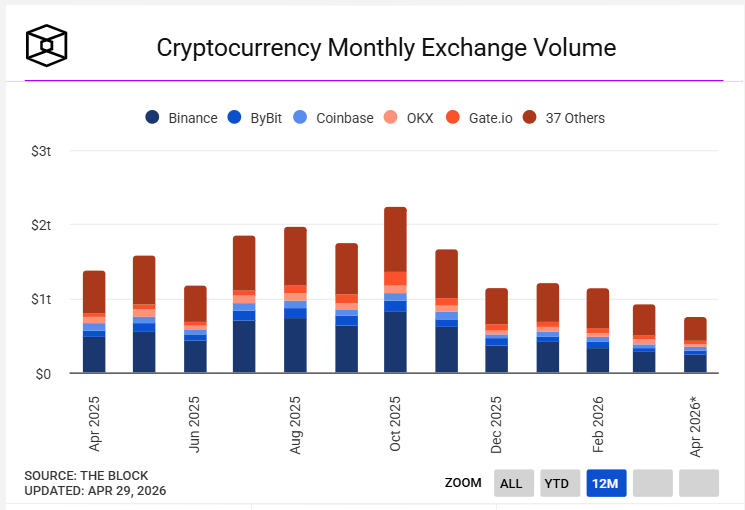
Bitcoin has still managed to bounce, but the move is less convincing without stronger participation. Glassnode showed Bitcoin daily trading volume falling below $8 billion, its lowest level since October 2023.
That is why traders are nervous even when prices move higher. Low volume often means thinner order books, weaker market depth, and sharper reactions to large buy or sell orders. In that environment, Bitcoin can pump fast, but it can also reject hard when liquidity disappears near resistance.
The pressure is visible beyond exchanges. Robinhood said crypto transaction revenue dropped 47% year over year in Q1, another sign that retail activity has cooled. If retail traders stay away and spot liquidity remains weak, Bitcoin’s next breakout attempt may need stronger ETF inflows or institutional demand to hold.
The liquidity drought does not mean crypto trading has stopped. It means activity has shifted. Perpetual futures now dominate centralized exchange volume, while spot markets look weaker.
CryptoQuant-linked market coverage placed perpetual futures volume around $3.5 trillion in March, more than 70% of centralized exchange activity. That makes derivatives the main driver of short-term price action, but it also increases the risk of sudden liquidations when leverage builds too quickly.
This is the problem for May. Crypto still has catalysts, but the market is thinner than it looks. If Bitcoin clears resistance with real volume, liquidity can return quickly. If it fails, the same thin order books could turn a normal pullback into a sharper move.
The post Crypto Volume Slump Deepens As Liquidity Dries Up Across Exchanges appeared first on Crypto Adventure.





