
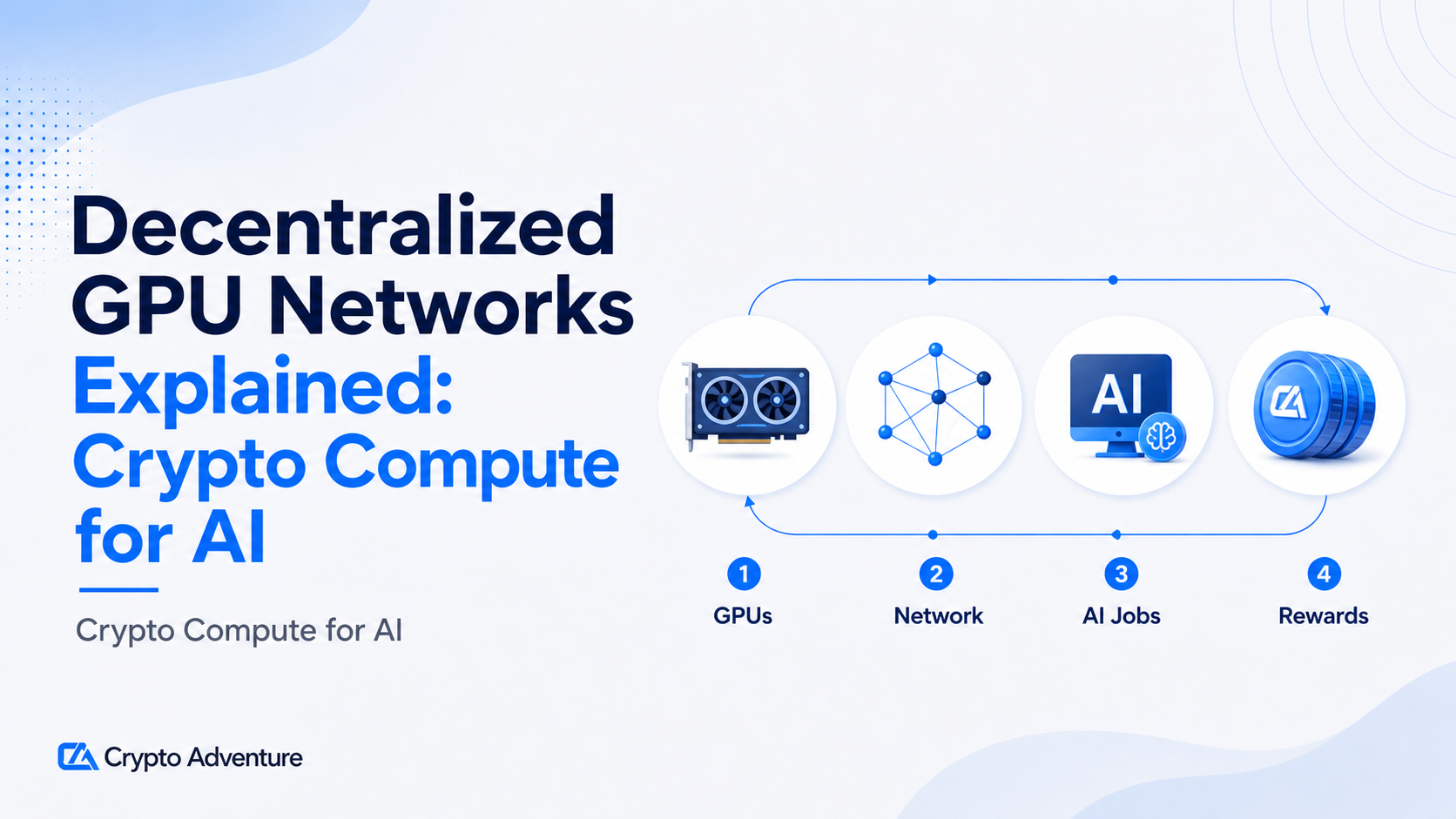
Decentralized GPU networks are open compute markets where independent hardware providers supply graphics processing units to users who need machine learning, rendering, inference, simulation, or other parallel-compute workloads. The idea sits inside the broader DePIN category, because the network coordinates physical infrastructure through crypto-native incentives rather than relying only on one centralized cloud operator.
The core promise is simple enough to understand, but difficult to execute. AI teams need GPUs because modern model training and inference depend on parallel computation. High-end GPUs are expensive, supply can be constrained, and centralized cloud access can involve waitlists, capacity limits, long commitments, or premium pricing. Decentralized GPU networks try to make distributed hardware discoverable, rentable, verifiable, and payable through a marketplace structure.
A mature network needs more than token rewards. It needs workload routing, provider reputation, hardware verification, pricing, uptime standards, payment settlement, data protection, developer tooling, and enough demand to keep useful hardware online. Without those pieces, a decentralized GPU network becomes a token subsidy program rather than a serious compute layer.
The AI compute market is attractive because demand is uneven. Some teams need massive training clusters, while others need smaller bursts of GPU capacity for inference, fine-tuning, rendering, data processing, or experimentation. Centralized clouds handle the enterprise end well, but smaller teams can face cost pressure, geographic constraints, or limited access to the exact hardware they need.
Decentralized GPU networks compete best in that middle zone. They are not usually the first choice for highly sensitive enterprise training jobs that require strict compliance, private networking, and guaranteed support. They are more interesting for teams that can tolerate a more open infrastructure model in exchange for lower cost, flexible access, or specialized hardware availability.
The demand side also includes crypto-native applications. AI agents, on-chain games, generative media platforms, decentralized inference APIs, and model marketplaces may prefer infrastructure that aligns with Web3 payments and permissionless access. That does not make decentralized compute automatically better, but it creates a natural buyer segment that already understands wallets, tokens, and on-chain settlement.
Most decentralized GPU networks follow a two-sided structure. Providers contribute hardware, while users submit jobs or deployments. The protocol or marketplace layer then handles discovery, pricing, coordination, and settlement. Some networks focus on rendering. Others focus on cloud-like deployments, AI clusters, training, inference, or machine learning verification.
Render Network is one of the clearest examples of a GPU marketplace built around creative and compute workloads. It connects GPU providers with requestors and uses a burn-and-mint structure to connect network usage with token flows. Akash Network takes a broader decentralized cloud approach, allowing providers to compete for deployments that can include GPU resources. io.net positions its network around distributed GPU clusters for AI and machine learning teams. Gensyn focuses more directly on machine learning computation, coordination, and verification across heterogeneous devices.
That range matters because “decentralized GPU network” is not one product category. A rendering marketplace, a decentralized Kubernetes-style deployment market, a GPU cluster allocator, and a machine learning verification protocol all solve different problems.
| Network Type | Main Workload Fit | Hardest Challenge |
|---|---|---|
| Rendering Compute | 3D rendering, generative media, creative workloads | Job quality, speed, provider matching |
| Decentralized Cloud | Deployments, containers, apps, GPU instances | Reliability, tooling, enterprise trust |
| AI GPU Clusters | Training, inference, fine-tuning | Hardware verification, latency, orchestration |
| ML Verification Networks | Distributed training and model work | Proving correct work across different devices |
Crypto is not useful here just because payments can happen with tokens. The stronger function is incentive coordination. A decentralized GPU network has to attract supply before demand is fully proven. Tokens can bootstrap that supply by rewarding early providers, funding ecosystem growth, and giving participants a stake in the network’s future.
The risk is that token incentives can create fake health. A network can look active because providers chase rewards, while real customer demand remains thin. That is why token design has to connect supply rewards to useful work. The same logic behind tokenomics evaluation applies strongly to decentralized compute: emissions, unlocks, sinks, demand, and reward rules matter more than hype around AI.
A credible compute token model should answer several questions clearly. What does the token pay for? Does real usage create token demand or token burns? Are providers rewarded for availability, completed jobs, quality, or all three? Can low-quality supply drain emissions? Are token rewards declining as customer revenue grows? How much supply is locked, unlocking, or controlled by insiders?
If the token loop cannot survive without constant speculative demand, the network may struggle once emissions slow or market attention moves elsewhere.
Compute is harder to verify than simple payment settlement. A blockchain can confirm that a payment moved, but it cannot automatically know whether a remote GPU completed an AI workload correctly, protected private data, used the claimed hardware, or delivered results within the needed latency window.
That makes verification one of the defining problems for decentralized GPU networks. Basic provider reputation is useful, but not enough for high-value workloads. Networks may need hardware attestation, benchmark testing, deterministic workloads, cryptographic proofs, redundancy, challenge systems, slashing, escrow, or arbitration. Gensyn’s model is important because it treats machine learning verification as a core protocol problem rather than an afterthought.
Security also extends to smart contracts, payment flows, dashboards, provider software, and job orchestration. Protocol teams still need normal security discipline, including audits, bug bounties, access controls, and incident response. Broader smart contract auditing and security tools matter because decentralized infrastructure can fail through code, not only through hardware.
The strongest advantage is supply expansion. If a network can aggregate idle or underused GPUs from data centers, miners, independent operators, and specialist providers, it can create capacity that would not otherwise appear in a single cloud catalog. That can make compute cheaper or more accessible for certain workloads.
Flexibility is another advantage. Users may be able to rent capacity without long commitments, negotiate through market pricing, or deploy in regions where centralized GPU access is limited. Crypto-native payment rails can also reduce onboarding friction for global users who already hold digital assets.
There is also a strategic decentralization angle. AI infrastructure is increasingly concentrated around a small number of cloud providers, chip suppliers, and model companies. Decentralized GPU networks cannot erase that concentration on their own, but they can create alternative access layers for developers, researchers, creators, and applications that do not want every compute decision routed through the same hyperscale stack.
The weaknesses are just as important. Decentralized GPU networks can struggle with inconsistent hardware, weaker support, uncertain uptime, slower debugging, privacy limits, and harder performance guarantees. AI teams care about cost, but they also care about repeatability. A cheap GPU market is not useful if jobs fail, results vary, or data handling is unclear.
Provider concentration can also appear even inside a decentralized system. If most useful GPUs sit with a few large operators, the network may be decentralized in token ownership but concentrated in real infrastructure. That creates governance, pricing, uptime, and censorship risks.
Token volatility adds another layer. Providers often calculate returns in local currency while rewards may arrive in a volatile token. Users may want predictable pricing while the protocol needs a token economy that captures usage. If pricing, rewards, and emissions move in different directions, both sides of the market can become unstable.
Decentralized GPU networks fit best where users need flexible compute, can manage some infrastructure complexity, and do not require the full enterprise wrapper of a hyperscale cloud. Creative rendering, generative media, AI experimentation, fine-tuning, crypto-native inference, decentralized AI applications, and bursty workloads are natural early markets.
They fit less cleanly where workloads involve strict data regulation, mission-critical uptime, proprietary model weights, highly integrated cloud services, or long-term enterprise support. Over time, better orchestration and verification may expand the addressable market, but the strongest current framing is selective competition rather than full replacement.
Decentralized GPU networks turn distributed hardware into open compute markets for AI and high-performance workloads. Their strongest value appears when they unlock underused GPUs, lower access friction, support flexible workloads, and create a payment and incentive layer that aligns providers with real demand.
The category should not be judged only by AI branding or token performance. The important questions are more mechanical: whether the network has useful hardware, whether workloads complete reliably, whether verification is strong, whether providers earn from real demand rather than only emissions, and whether users would return because the compute product works.
Centralized clouds will remain dominant for enterprise-grade reliability, compliance, and integrated tooling. Decentralized GPU networks can still become valuable infrastructure if they win the markets where open supply, flexible access, and crypto-native coordination create a real advantage.
The post Decentralized GPU Networks Explained: Crypto Compute For AI appeared first on Crypto Adventure.





