
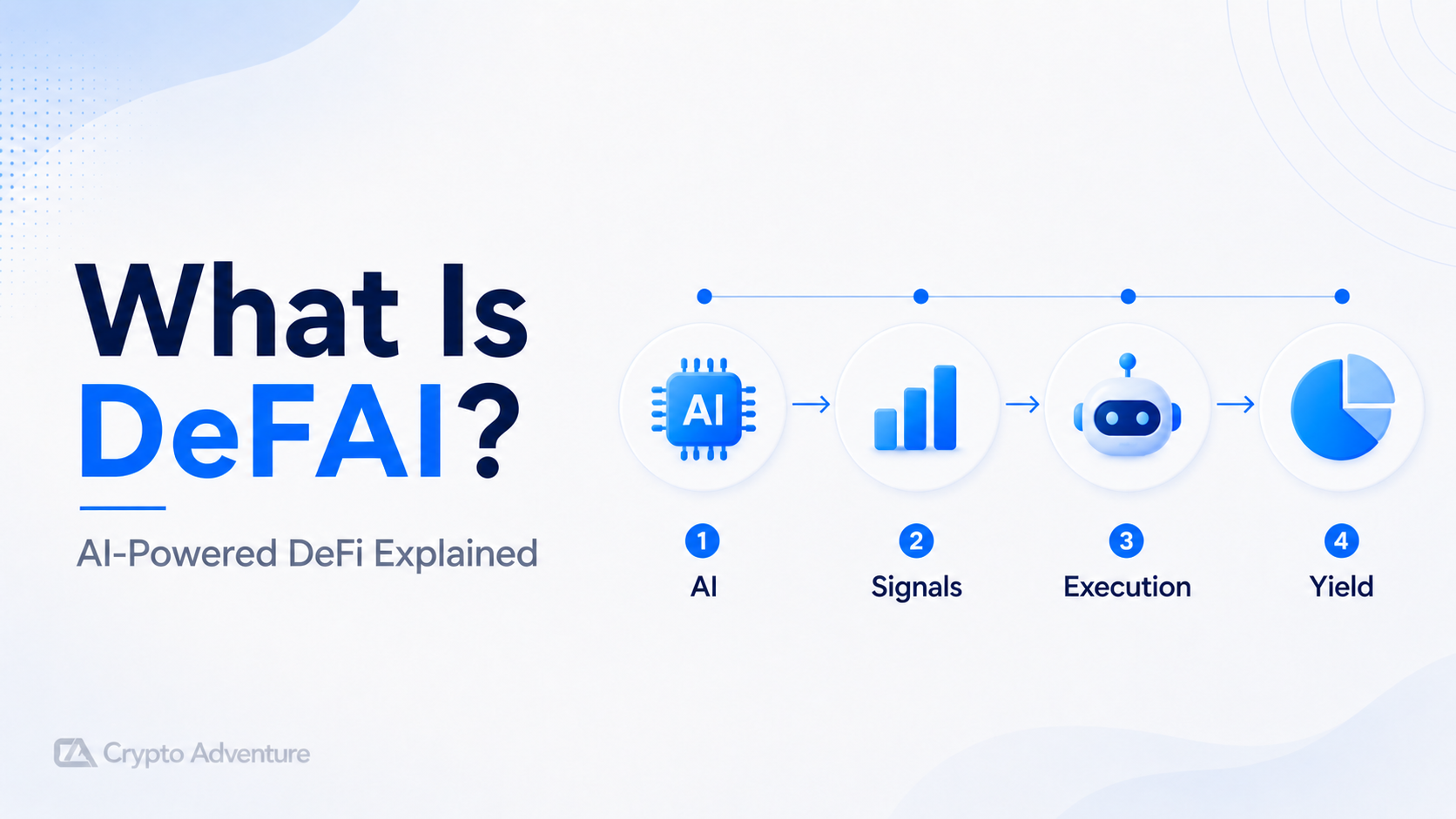
DeFAI means decentralized finance combined with artificial intelligence. It describes DeFi products that use AI agents, automation, natural language interfaces, risk engines, portfolio tools, or on-chain execution systems to help users interact with protocols more easily.
DeFi is powerful, but it can be difficult to use. A user may need to compare pools, bridge assets, approve tokens, manage slippage, track collateral, monitor liquidation risk, and understand several protocols at once. DeFAI tries to reduce that complexity by letting AI systems help analyze options, automate tasks, and execute transactions within user-defined limits.
The strongest DeFAI products are not just chatbots with a crypto logo. They connect data, wallets, protocols, risk controls, and execution. The AI layer may understand the user’s request, but the final result still depends on smart contracts, wallets, liquidity, oracles, and permissions.
A DeFAI system usually has four layers. The first is the interface, where the user can give a natural-language command or choose a strategy. The second is the data layer, where the system reads prices, pools, yields, positions, protocol risk, and wallet balances. The third is the decision layer, where the AI agent suggests or selects an action. The fourth is the execution layer, where transactions are simulated, approved, and sent on-chain.
HeyAnon is one example of this direction. It combines conversational AI with DeFi data and execution so users can manage DeFi operations and read project-related information through simpler commands. Mode is another example, with a chain and ecosystem focused on AI-powered DeFi applications and on-chain agents.
The key point is that DeFAI is not one product category. It can appear as an assistant, yield optimizer, trading agent, portfolio manager, risk monitor, smart wallet, or automated strategy engine.
DeFi has a usability problem. Many protocols are built for technical users who understand wallets, approvals, gas, bridges, position health, and smart contract risk. That limits mainstream adoption.
DeFAI can improve the user experience by translating intent into transactions. A user may ask to earn yield on USDC, reduce liquidation risk, rebalance a portfolio, bridge to another chain, or compare lending markets. The AI system can analyze the steps and prepare the action.
This can make DeFi more accessible, but it also shifts risk. If the agent misunderstands the request, uses weak data, chooses a bad route, or receives too much wallet permission, the user can still lose money.
The first use case is natural-language DeFi. A user can ask for a swap, bridge, lend, borrow, or stake action without manually navigating several apps.
The second use case is yield optimization. An agent can compare lending rates, vaults, reward incentives, liquidity depth, and risk settings before suggesting where capital should move.
The third use case is portfolio monitoring. AI can track positions, liquidation levels, collateral ratios, market changes, and protocol events.
The fourth use case is automated execution. An agent can rebalance, claim rewards, renew positions, repay debt, or adjust collateral within the rules set by the user.
The fifth use case is risk analysis. AI can help summarize audits, governance changes, oracle exposure, liquidity concentration, and protocol dependencies.
AI agents are the most important DeFAI component because they can act across multiple systems. A normal dashboard shows information. An agent can interpret the information and prepare a transaction.
Theoriq focuses on AI-powered asset management for DeFi and on-chain markets. Its product direction shows where the category is heading: fragmented DeFi opportunities can be grouped into a more risk-aware experience where AI helps users understand and manage positions.
Agents can also communicate with other agents, pay for data, request quotes, and use smart wallets. This creates a more automated DeFi environment where software does more of the routine work and users set strategy, permissions, and risk limits.
DeFAI does not remove market risk. A lending market can still face bad debt. A vault can still lose money. A bridge can still fail. A token can still collapse. An oracle can still report bad data.
AI also cannot guarantee good judgment. Models can hallucinate, miss context, overfit recent data, follow malicious prompts, or route funds into risky protocols. The agent can make DeFi easier to use, but easier execution can also make mistakes happen faster.
The strongest DeFAI systems treat AI as an assistant with guardrails, not as an unchecked fund manager. Users should be able to review proposed actions, set limits, simulate transactions, and revoke permissions.
The first risk is bad execution. The AI may choose a route with poor liquidity, high slippage, or hidden bridge risk.
The second risk is permission risk. If the agent receives unlimited token approvals or broad wallet access, one bad instruction can become expensive.
The third risk is data risk. The agent may rely on stale prices, incomplete protocol data, or low-quality yield information.
The fourth risk is prompt injection. A malicious webpage, token page, or protocol response can try to manipulate the agent’s instructions.
The fifth risk is overautomation. A strategy that works in calm markets can fail during volatility if the agent acts without human review.
Users should start with permissions. A DeFAI tool should request narrow access, not unlimited control. Spend limits, protocol allowlists, time limits, and revocation tools matter.
Next comes simulation. The user should see what the agent is about to do, what contracts it will touch, what assets will move, and what risks appear before signing.
Then comes data quality. A DeFAI tool is only useful if it reads reliable prices, liquidity, protocol rules, and account data.
Finally, users should check whether the tool has a clear risk model. Good DeFAI should explain why a strategy is chosen, what could go wrong, and when the agent should stop acting.
DeFAI brings AI agents, automation, and natural-language execution into decentralized finance. It can make DeFi easier by helping users analyze protocols, manage positions, compare yields, execute transactions, and monitor risk.
The opportunity is strong because DeFi remains difficult for normal users. The risk is equally serious because agents can move real funds. The best DeFAI systems will combine useful automation with tight permissions, transaction simulation, reliable data, clear risk controls, and user approval. AI can make DeFi more usable, but it should never replace basic wallet security or financial judgment.
The post What Is DeFAI? AI-Powered DeFi Explained appeared first on Crypto Adventure.





