
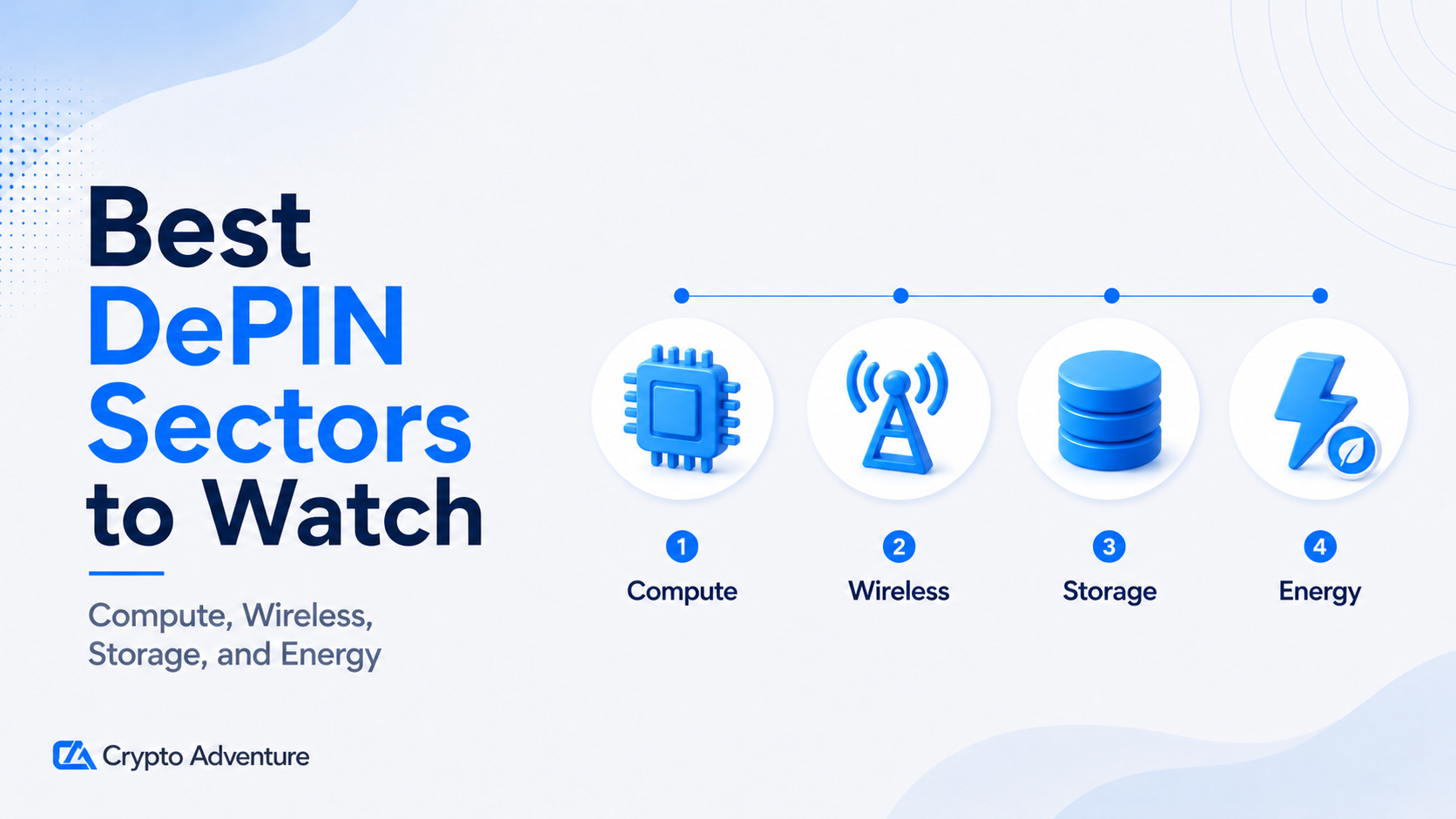
DePIN is not one market. It is a group of infrastructure models that use crypto incentives to coordinate physical resources. A DePIN network can supply compute, wireless coverage, storage, mapping data, sensors, energy coordination, mobility data, or other real-world services. The shared idea is decentralized contribution, but the business mechanics vary widely.
That is why sector selection matters. Compute, wireless, storage, and energy all sound like infrastructure categories, but they do not face the same demand patterns, verification problems, capital costs, customer expectations, or regulatory constraints. A decentralized GPU marketplace is not evaluated like a wireless coverage network. A storage protocol is not evaluated like an energy coordination layer.
The best DePIN sectors are the ones where distributed supply creates a real advantage. That advantage can come from idle hardware, local coverage, cheaper capacity, better geographic distribution, fresher data, or a customer base that values open infrastructure. Token rewards help bootstrap supply, but they do not make a sector attractive by themselves.
Compute is the most visible DePIN sector because AI has increased demand for GPUs, inference, fine-tuning, rendering, and high-performance workloads. Akash focuses on decentralized cloud infrastructure where providers compete to supply compute and GPU resources. Render Network connects GPU owners with creators and compute users, with a model that includes rendering and AI workloads.
The sector’s appeal is straightforward. Many GPUs and servers are underused. Many developers, creators, and AI teams want flexible access without relying entirely on hyperscale cloud providers. A decentralized compute market can aggregate spare capacity and price it through a more open marketplace.
The challenge is quality. AI compute buyers care about performance, hardware type, latency, uptime, workload privacy, data handling, and predictable execution. Cheap capacity is not enough if jobs fail or debugging is difficult. Compute DePIN therefore has to compete not only on price, but on reliability, orchestration, and verification.
Compute deserves close attention because demand is real, but the strongest projects will be the ones that convert available hardware into dependable service rather than only marketing GPU counts.
Wireless is one of the most intuitive DePIN sectors because the physical service is easy to understand. A device either contributes useful coverage or it does not. Helium remains the reference case, with decentralized IoT coverage and mobile offload infrastructure built around community-operated hardware.
Wireless DePIN can compete where centralized buildouts are expensive, slow, or too broad for narrow demand. IoT devices may need low-power long-range connectivity. Mobile users may benefit from offload in dense or strategically placed areas. Local operators may understand where coverage is useful better than a centralized planning team.
The sector also shows why verification matters. A map full of hotspots does not automatically mean valuable service. The network has to verify location, coverage, data transfer, and usefulness. Helium’s Data Credits model adds an important demand-side element because network usage is paid through a dedicated mechanism rather than relying only on token rewards.
Wireless is attractive when coverage becomes real demand. It is weaker when operators deploy hardware mainly to farm emissions in locations that do not help users.
Storage is one of the most mature DePIN categories because the customer need is clear: data has to be stored, retrieved, and protected over time. Filecoin uses Proof of Replication and Proof of Spacetime to verify that storage providers created unique copies of data and continue storing them.
This sector has a natural fit with crypto because decentralized storage needs verification, incentives, and penalties. Providers can pledge capacity, earn fees, and face consequences if they fail to meet commitments. The product is not only cheaper storage. It is a market for verifiable storage with economic accountability.
The challenge is adoption. Enterprise and developer storage buyers care about reliability, retrieval speed, integration, privacy, service support, and predictable pricing. A decentralized storage network may be technically strong but still struggle if user experience or retrieval performance falls short of centralized options.
Storage remains a sector to watch because proof systems are more developed than in many other DePIN categories. The main test is whether storage demand, retrieval tools, and application integration continue to grow beyond token-led participation.
Energy DePIN is potentially one of the most important sectors, but also one of the hardest. The idea is to coordinate distributed energy resources such as solar, batteries, smart meters, flexible loads, electric vehicles, and virtual power plants. Instead of treating energy assets as isolated hardware, decentralized systems can help coordinate them into useful grid services.
Energy Web focuses on blockchain infrastructure for energy-sector applications, with Energy Web X and worker-node networks supporting enterprise calculations and coordination. Powerledger builds software for tracking, tracing, and trading renewable energy and environmental commodities. Newer energy networks such as Daylight push the idea toward household energy assets and reward-based participation.
The opportunity is large because grids need flexibility, clean energy coordination, and better data around distributed assets. The difficulty is equally large. Energy markets are regulated, local, capital-intensive, and operationally sensitive. A network cannot simply add a token and bypass grid rules, interconnection requirements, consumer protection, or utility coordination.
Energy DePIN should be watched with patience. The upside is meaningful, but credible projects need real-world partnerships, regulatory fit, hardware integration, measurement accuracy, and revenue from energy services rather than only speculative token demand.
| Sector | Strongest Demand Driver | Main Verification Problem | Biggest Risk |
|---|---|---|---|
| Compute | AI, rendering, flexible cloud workloads | Hardware quality and job completion | Reliability and enterprise trust |
| Wireless | IoT coverage and mobile offload | Real coverage and useful traffic | Reward farming without demand |
| Storage | Data storage and retrieval | Continuous proof of stored data | Weak user adoption or retrieval friction |
| Energy | Grid flexibility and distributed assets | Asset measurement and service delivery | Regulation and slow commercial adoption |
This comparison makes the sector trade-offs clearer. Compute has the strongest near-term narrative because AI demand is visible. Wireless has the clearest community deployment model. Storage has the strongest proof architecture. Energy has the largest physical-world importance, but also the highest execution difficulty.
Every DePIN sector eventually faces the same question: does the network sell a service people need, or does it mainly sell the hope of future rewards? The answer determines whether token incentives are building infrastructure or only attracting temporary supply.
The strongest projects tie rewards to measurable value. Compute networks should reward completed workloads, not only available hardware. Wireless networks should reward useful coverage and traffic, not only devices. Storage networks should reward reliable commitments, not only capacity claims. Energy networks should reward verified grid value, not only hardware ownership.
That is why DePIN tokenomics deserve close review. Emissions, unlocks, token sinks, customer payments, governance control, and operator economics all decide whether a network can keep useful supply online after early subsidies decline.
The best signals are not always token price or social attention. Better signals include paid usage, customer retention, provider quality, geographic demand, hardware utilization, revenue concentration, reward sustainability, and verification strength. A DePIN project that grows slower but earns from real customers may be healthier than one that grows hardware counts without demand.
Security also matters because DePIN stacks combine smart contracts, off-chain software, hardware, APIs, and physical operations. Projects with weak controls can fail through code bugs, reward exploits, spoofing, bad data, or governance capture. Broader smart contract security diligence is only one part of the picture, but it remains a necessary layer.
Compute, wireless, storage, and energy are the DePIN sectors most worth watching because each connects crypto incentives to a real infrastructure problem. Compute targets AI and cloud capacity. Wireless turns local deployment into coverage. Storage uses proofs to create verifiable capacity. Energy could coordinate distributed assets inside more flexible grids.
None of these sectors should be judged by token rewards alone. The stronger test is whether the network can verify useful work, attract real demand, and keep operators economically aligned after emissions become less important. DePIN becomes credible when tokens help build infrastructure that customers would still pay to use without the hype cycle.
The post Best DePIN Sectors To Watch: Compute, Wireless, Storage, And Energy appeared first on Crypto Adventure.





