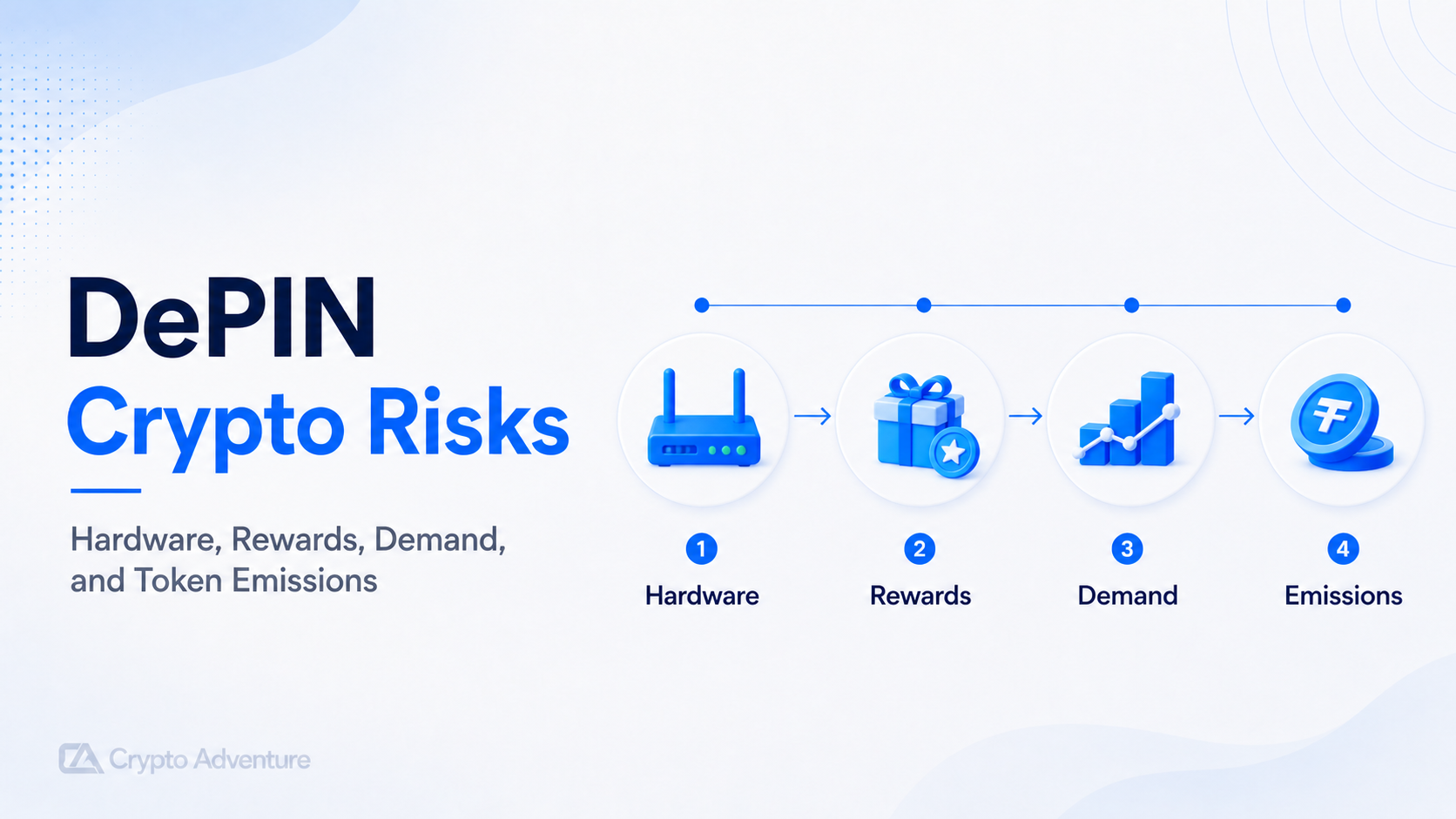
DePIN projects connect crypto incentives to real-world infrastructure. Instead of only moving tokens or running smart contracts, they coordinate hardware such as hotspots, GPUs, storage machines, sensors, cameras, energy assets, mapping devices, or wireless equipment.
That makes DePIN more tangible than many crypto narratives, but it also creates different risks. A DePIN network must attract hardware providers, verify useful work, price services, pay contributors, and generate real demand. If any part breaks, the token can suffer even if the idea sounds strong.
The central tension is simple. DePIN networks often use token emissions to bootstrap supply before demand is mature. Early contributors buy hardware and earn rewards. The network hopes real customers later pay for the service. If demand does not arrive fast enough, emissions can become sell pressure rather than growth fuel.
Hardware is the first DePIN risk because contributors often spend money before earning rewards. A GPU provider, hotspot owner, storage operator, mapper, or sensor operator may need to buy devices, pay electricity, manage internet access, maintain uptime, and handle replacements.
That makes DePIN different from staking a token. A hardware contributor has operational costs. If rewards fall, token price drops, or demand stays weak, the payback period can extend sharply.
Filecoin’s storage provider economics show how serious hardware networks can become. Storage providers need collateral, reliable storage, and operational performance, with slashing possible when reliability standards fail. DePIN hardware is not passive. It is infrastructure work.
Rewards help DePIN networks grow early supply, but they can create false signals. A network may look successful because many contributors join for token rewards, while actual customer demand remains small.
Helium’s Data Credits show a more mature demand-side design. Network usage is paid with non-transferable Data Credits, which are used for data transfer and actions such as hotspot onboarding. This creates a clearer link between real usage and network economics than pure reward emissions alone.
The risk appears when rewards are higher than real demand can support. Contributors may sell earned tokens to cover hardware and operating costs. If buyers are mostly speculators rather than customers, the token can weaken.
Demand risk is the hardest DePIN risk to solve. A network can build supply faster than customers arrive. A wireless network needs devices that actually use coverage. A mapping network needs buyers for map data. A storage network needs clients storing real files. A GPU network needs developers renting compute.
Without demand, token rewards become the main income source. That can work during a growth phase, but it is not durable forever. Real usage needs to replace emissions over time.
Render’s Burn Mint Equilibrium tries to connect real network work with token flows by burning RENDER for Render Credits used in GPU computing work, then minting emissions to reward node operators. This type of model is stronger when actual paid work grows, and weaker when rewards depend more on token incentives than customer demand.
Token emissions are useful during bootstrapping, but they can dilute holders and pressure price. Contributors earn tokens for providing infrastructure, and many need to sell to cover costs. If emissions exceed demand, the token can trend down even while the network expands.
Hivemapper’s global map progress model ties HONEY rewards to map-building progress, with a fixed supply minted as the global map improves. That design gives rewards a clear supply-side purpose. The long-term question is whether demand for map products can support the token economy once mapping rewards mature.
Every DePIN token needs the same test. Are emissions building useful infrastructure that paying customers need, or are they only paying users to create supply nobody buys?
DePIN networks must verify that contributors deliver useful work. A hotspot must provide real coverage. A GPU must complete the job. A storage provider must keep data available. A mapping device must capture accurate road data. A weather sensor must report valid readings.
Verification is hard because the work happens outside the blockchain. If rewards are valuable, contributors may try to spoof, fake, or optimize for rewards instead of useful service. Weak verification can turn a DePIN network into a farm.
Strong DePIN systems use proof mechanisms, audits, reputation, slashing, peer checks, challenge systems, location validation, job verification, and demand-side confirmation. The better the verification, the more likely rewards reflect useful infrastructure.
Hardware can become outdated. A GPU that is competitive today may fall behind new models. A hotspot may lose value if coverage rules change. A sensor may need replacement. A storage device may require maintenance. A mapping camera may become less useful as standards improve.
This creates upgrade risk. Contributors who buy hardware based on current rewards may face lower income if newer devices become more efficient or if network rules change.
Users should treat hardware ROI projections carefully. Token price, reward rate, demand, competition, electricity cost, hardware depreciation, and maintenance can all change.
DePIN networks aim to decentralize infrastructure, but they can still centralize around large operators. Big data centers can dominate GPU supply. Large fleets can dominate mapping. Professional operators can outcompete small contributors.
Some centralization can improve reliability, but it can weaken the narrative if the network becomes dependent on a few large providers. It can also create governance risk if large operators influence reward rules or protocol upgrades.
The best DePIN networks balance professional reliability with broad participation. Too much hobbyist supply can reduce quality. Too much enterprise concentration can reduce decentralization.
DePIN projects can touch regulated markets. Wireless networks may involve spectrum rules. Energy projects may involve grid regulation. Mapping and sensors may involve privacy rules. Compute networks may need workload monitoring. Storage networks may need illegal-content controls. Payment flows may trigger tax and money-transmission obligations.
Real infrastructure brings real-world compliance. A DePIN network cannot rely only on smart contracts when hardware operates in specific locations under local laws.
This risk grows as DePIN projects become more successful. Small experimental networks may fly under the radar. Large infrastructure networks attract regulators, enterprise customers, and compliance obligations.
Users should start with demand. Are real customers paying for the service, or are rewards mainly funded by emissions?
Next comes supply quality. How useful is the hardware? Is coverage, compute, storage, or data actually reliable?
Then comes verification. Can the network prove that contributors delivered the work they were paid for?
After that comes tokenomics. Emissions, burns, credits, staking, slashing, treasury reserves, and unlocks decide whether usage benefits token holders.
Finally, users should check contributor economics. If hardware providers lose money, supply may disappear. If contributors earn too much before demand arrives, token dilution can hurt holders.
DePIN crypto projects are powerful because they connect tokens to real infrastructure. They can build wireless networks, GPU markets, storage systems, maps, sensors, and energy coordination without relying only on centralized companies.
The risks are equally real. Hardware costs, reward farming, weak demand, token emissions, verification failures, centralization, and regulation can all damage a DePIN network. The strongest projects will prove that useful infrastructure creates paying demand, and that token incentives reward real work instead of subsidizing empty supply.
The post DePIN Crypto Risks: Hardware, Rewards, Demand And Token Emissions appeared first on Crypto Adventure.





