By. Fernando Andrade, MS.
The proposed initiative envisions the development of an expansive, decentralized library comprising 600 distinct articles, each to be tokenized into 1,000 unique “serialized coins” or Non-Fungible Tokens (NFTs), culminating in a grand total of NFTs. A fundamental and ambitious stipulation of this project is the embedding of a complete 500-word article copy directly within the on-chain data of each NFT. This requirement is articulated as being akin to the “face art” of a coin, implying immediate and direct visibility of the textual content from the blockchain itself.
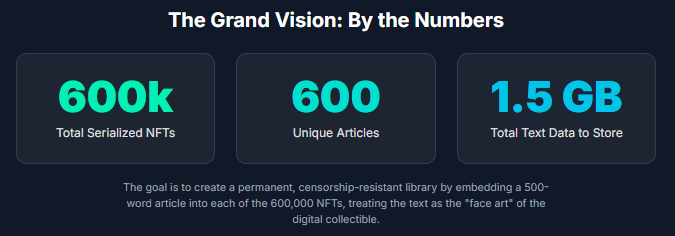
The core challenge inherent in this vision lies in the immense data volume this requirement imposes on direct on-chain storage. The total raw text data for 600,000 articles, each 500 words long, is approximately 1.5 Gigabytes (GB). Storing such a substantial amount of data directly on a blockchain is typically cost-prohibitive and technically complex for current blockchain architectures.
This report demonstrates that direct, full-text storage of 1.5 GB on any mainstream blockchain, including Ethereum Layer 1 (L1), Layer 2 (L2) solutions, or Solana, is economically unfeasible and technically challenging. This is primarily due to exorbitant gas costs, transaction limits, and smart contract design constraints. To address these formidable obstacles, a hybrid architectural solution is proposed. This solution advocates for the utilization of the ERC-1155 token standard, which is recognized for its efficiency in managing large collections and enabling batch operations. The strategy involves storing a cryptographic hash or a Uniform Resource Identifier (URI) reference to the full 500-word article on-chain within the NFT’s metadata. This approach ensures the immutability and verifiable integrity of the content reference. The full 500-word article text itself would then be stored on a decentralized, permanent storage network, with Arweave identified as the optimal candidate. This provides unparalleled cost-effectiveness, censorship resistance, and long-term data availability for the content. Frontend applications would subsequently retrieve and display the article text seamlessly using the on-chain URI, thereby fulfilling the “face art” visibility requirement.
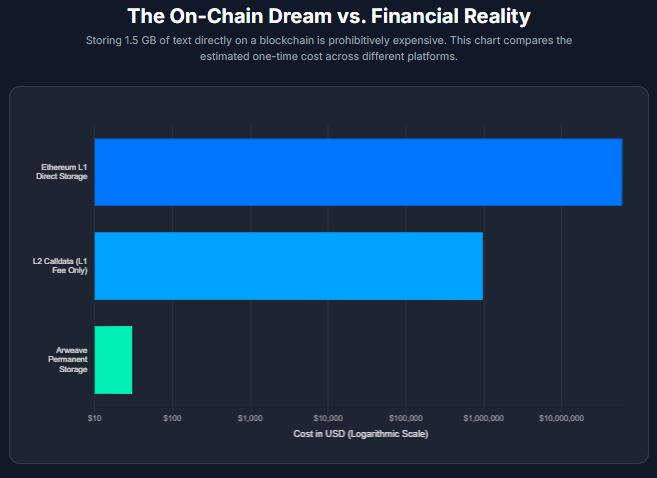
The analysis concludes that direct on-chain storage of 1.5 GB of text on Ethereum L1 would incur costs in the tens of millions of USD. On L2 solutions, while significantly reduced, the costs would still amount to hundreds of thousands of USD, primarily driven by the underlying L1 data availability expenses. Solana, despite its lower per-transaction fees, would necessitate locking up substantial capital for rent exemption across 600,000 accounts and faces inherent transaction size and account interaction limits. Conversely, Arweave offers permanent, decentralized storage for the entire 1.5 GB of text for a one-time cost estimated to be under $30, positioning it as the most viable option for the content itself. The strategic recommendation is to adopt a hybrid model, leveraging ERC-1155 NFTs with on-chain metadata URIs pointing to Arweave for the full textual content, complemented by a robust frontend application for display. This approach judiciously balances the project’s ambitious vision with the prevailing technical and financial realities of blockchain technology.
The foundational aspiration of this project is to establish a permanent and immutable digital library consisting of 600 distinct articles. This endeavor aligns with the burgeoning trend of “Writing NFTs” and the broader movement towards decentralized publishing. These innovations are fundamentally reshaping the landscape for creators, empowering them with enhanced control over their intellectual property and unlocking novel avenues for content monetization (Meegle n.d.; LikeCoin n.d.). In this framework, each article transcends its traditional role as a mere digital file, transforming into a tokenized asset with verifiable on-chain ownership. This shift not only protects the creator’s rights but also fosters new economic models, allowing for royalties to be earned each time the digital asset changes hands (Meegle n.d.).
The project scales this concept dramatically by proposing that each of the 600 source articles will be represented by 1,000 “serialized coins,” effectively creating 1,000 unique NFTs per article. This results in a staggering total of 600,000 individual NFTs. A critical and explicit requirement for each of these 600,000 NFTs is to contain a direct copy of a 500-word article embedded within its on-chain data.
To quantify the data volume implicated by this requirement, a precise calculation is necessary. The average length of an English word is approximately 4.7 characters (ResearchGate n.d.; Wylie Communications 2021). Therefore, a 500-word article would contain roughly 2,350 characters (500 words * 4.7 characters/word). Assuming a standard UTF-8 encoding where each character occupies 1 byte for basic English text, each NFT would carry approximately 2,350 bytes of textual data. Multiplying this by the total number of NFTs yields the raw data volume: 600,000 NFTs * 500 words/NFT * 4.7 characters/word = 1,410,000,000 characters. Converting this to bytes, the total raw data volume for the text alone is approximately 1.41 Gigabytes (GB). For conservative estimation and to account for any overhead, this figure will be rounded up to 1.5 GB.
The user’s explicit statement, “this feature is important as it is like looking at the face art of a coin,” underscores a profound desire for the 500-word text to be immediately and directly accessible and readable from the blockchain itself. This implies a user experience where the content is inherent to the digital asset, visible without reliance on external services for content retrieval. This specific constraint profoundly influences the technical feasibility and cost analysis of the entire project, pushing the boundaries of conventional blockchain data storage practices.
The ambition to store 1.5 GB of textual data directly on-chain for 600,000 NFTs presents significant challenges across various blockchain architectures. Understanding the fundamental storage mechanics and associated costs of prominent blockchain networks is crucial for evaluating the project’s feasibility.
Ethereum’s Virtual Machine (EVM) utilizes a key-value database for its smart contract storage, where each “slot” is a 32-byte (256-bit) value (learnEVM.com n.d.a). Storing data persistently on-chain is inherently expensive because every change must be propagated and maintained by all nodes across the network (learnEVM.com n.d.a). The gas cost for an SSTORE operation, which involves saving a 32-byte word to storage, is particularly high. It costs 20,000 gas if a storage slot is changed from a zero value to a non-zero one. If an existing non-zero value is modified or set to zero, the cost is 5,000 gas, with a refund of 15,000 gas provided if a non-zero value is explicitly set to zero (learnEVM.com n.d.a; Reddit n.d.a; BitKan.com n.d.; Riady 2021; Irwin n.d.). For strings exceeding 32 bytes, Solidity requires the use of multiple storage slots (learnEVM.com n.d.a). Storing even a 32-byte string can incur a base cost of 20,000 gas (Irwin n.d.).
For a 500-word article, estimated at 2,350 bytes, approximately 74 storage slots (2,350 bytes / 32 bytes/slot) would be required per NFT. The initial cost for storing this data for a single NFT, assuming all new slots are being written to, would be 74 slots * 20,000 gas/slot = 1,480,000 gas. Scaling this to the project’s requirement of 600,000 NFTs yields a staggering total of 888,000,000,000 gas (888 billion gas). This calculation, derived directly from the specific gas costs for storage operations, clearly illustrates that storing 500 words of text directly within smart contract storage on Ethereum L1 is astronomically expensive. The projected cost would be in the tens of millions of dollars, rendering this approach financially impossible for the project’s scale. This substantial financial barrier highlights a fundamental misalignment between the project’s direct on-chain storage requirement and the economic realities of Ethereum’s design.
Solana employs an account model where “accounts” serve as storage locations capable of holding diverse data, including balances, smart contract code, or arbitrary state information (Neon EVM n.d.; 57Blocks n.d.; Solana Compass n.d.). Each Solana account has a maximum size limit of 10 MB (57Blocks n.d.; Solana Compass n.d.), which means a 500-word article (approximately 2.35 KB) would comfortably fit within a single Solana account.
However, data storage on Solana incurs a “rent” fee, which compensates network validators for maintaining a working copy of the state in memory (Solana Compass n.d.; Datawallet n.d.; Solana n.d.). This rent can be reclaimed in full if the account is eventually closed (Datawallet n.d.; Solana n.d.). Accounts can achieve “rent-exemption” by maintaining a minimum balance in SOL, equivalent to two years’ worth of rent, which effectively means locking up capital (Solana Compass n.d.). The project’s requirement for 600,000 separate NFTs, each with its own 500-word text, translates into the need for 600,000 individual Solana accounts. Each of these accounts would either incur ongoing rent or require a significant amount of SOL to be locked up for rent exemption. This presents a massive upfront liquidity challenge, as the aggregate capital expenditure would be substantial, even if theoretically reclaimable.
Moreover, Solana transactions are subject to specific limitations, including a maximum of 64 writable accounts and a total transaction size of 1,232 bytes (Neon EVM n.d.; 57Blocks n.d.). Creating and populating 600,000 accounts, each with 2.35 KB of data, would necessitate an enormous number of transactions. While Solana is known for its low per-transaction fees (typically ranging from $0.0001 to $0.0025 USD) (Datawallet n.d.; SwissBorg Academy n.d.a), the sheer volume of transactions required would still lead to a considerable cumulative cost in base transaction fees. This analysis reveals that while Solana’s architecture can technically accommodate the data, its economic model (rent exemption requiring locked capital) and operational overhead (transaction limits for account creation and data population) render it highly impractical and costly for the direct, full-text storage requirement at this scale.
Layer 2 (L2) solutions, such as Optimism and Arbitrum, are designed to alleviate the high transaction costs and scalability limitations of Ethereum L1. They achieve this by processing transactions off-chain and then batching and compressing them before committing the aggregated data back to the Ethereum L1 (Arbitrum Docs n.d.; Bitbond Token Tool n.d.a; Optimism Docs n.d.). The primary cost associated with data storage on L2s is the “L1 Data Fee,” which reflects the expense of posting transaction data to the Ethereum L1 (Arbitrum Docs n.d.; Bitbond Token Tool n.d.a; Optimism Docs n.d.). This cost is determined by the compressed size of the transaction data, with zero bytes costing 4 gas and non-zero bytes costing 16 gas on L1 (Optimism Docs n.d.; learnEVM.com n.d.b). This mechanism is significantly more cost-effective than direct L1 storage (SSTORE) operations, as transaction calldata is generally much less expensive than persistent state storage (learnEVM.com n.d.a; Riady 2021; Irwin n.d.; learnEVM.com n.d.b). Polygon, while not a direct L2 rollup in the same architectural sense as Optimism or Arbitrum, also offers lower transaction fees and capabilities for batch minting (Polygon Support n.d.). For instance, the ERC721A standard facilitates minting approximately 10,000 NFTs per transaction on Polygon (Polygon Support n.d.).
L2s offer a substantial reduction in cost compared to direct Ethereum L1 transaction execution and data availability by leveraging compression and batching. However, the core requirement remains to store 500 words of text per NFT “in the smart contract.” If this implies storing the text directly in the L2 smart contract’s storage state, the underlying EVM storage costs (20,000 gas per 32-byte slot) would still apply, making it nearly as expensive as L1 for the storage component (learnEVM.com n.d.a; Riady 2021; Irwin n.d.). The cost savings on L2s primarily stem from reduced execution fees and lower L1 data availability costs for transaction calldata, not for persistent state storage of large data. If the text were stored as calldata (as part of transaction inputs), it would be immutable and on-chain, but not easily queryable from the contract’s state directly without external indexing or historical transaction parsing. This would violate the spirit of the “in the smart contract” and “face art” direct visibility requirements. Therefore, while L2s make minting more affordable (Optimism Docs n.d.; Polygon Support n.d.; Reddit n.d.b; Decrypt 2021; Bitbond Token Tool n.d.a; Dapper Blog n.d.; Solana News n.d.; Magic Eden Help Center n.d.), they do not fundamentally resolve the prohibitive cost of storing 1.5 GB of readable text within smart contract state for 600,000 NFTs. The cost, even when reduced, would still be in the hundreds of thousands to millions of USD for the L1 data availability component alone, in addition to L2 execution costs.
The calculated total raw text data volume of approximately 1.5 GB represents an exceptionally large amount of data for direct blockchain storage. Attempting to store this volume directly on-chain carries significant implications, including astronomically high gas costs, potential for severe network congestion, challenges with smart contract size limits, and considerably slow transaction processing times.
To illustrate the financial implications, cost estimations for storing 1.5 GB of data across different blockchain environments are presented, based on the following assumptions:
Ethereum L1 (Direct Smart Contract Storage):
Layer 2 Solutions (L1 Data Availability Cost via Calldata):
Solana (Rent Exemption Model):
The calculated costs for direct on-chain storage on Ethereum L1 (exceeding $60 million) and even on L2s (approaching $1 million) are orders of magnitude beyond what is typically considered feasible for storing application-level data. Solana’s rent model, while structurally different, similarly implies a massive capital lockup for 600,000 accounts. This extreme cost points to a fundamental design principle of blockchains: they are optimized for secure, immutable transaction records and state changes, not for bulk data storage (MDPI n.d.; Bachini n.d.; Curvegrid n.d.; Rally.fan n.d.). The “face art” requirement, when interpreted as direct full-text embedding, is in direct conflict with the economic realities and technical limitations of current blockchain technology (MDPI n.d.). This necessitates a re-evaluation of how “on-chain visibility” can be effectively achieved.
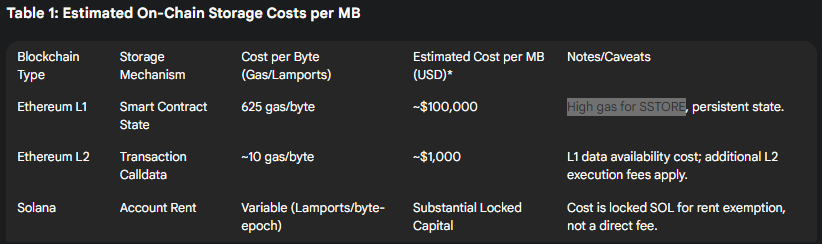
*Assumes ETH @ $3,000, 20 Gwei gas price for Ethereum; SOL @ $150 for Solana. Costs are approximate and fluctuate.
Table 2: Projected Total On-Chain Storage Costs for 1.5 GB Across Selected Blockchains
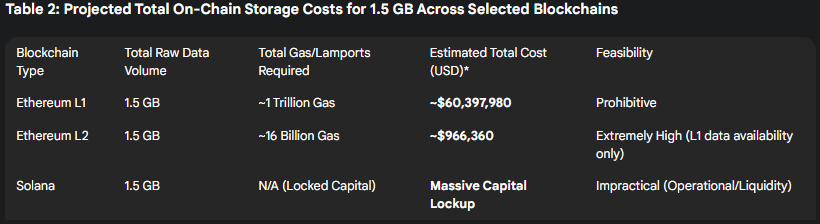
*Assumes ETH @ $3,000, 20 Gwei gas price for Ethereum; SOL @ $150 for Solana. Costs are approximate and fluctuate.
Beyond the prohibitive costs, directly storing 1.5 GB of text on-chain poses several inherent technical and practical challenges.
As demonstrated by the preceding cost analysis, the gas fees associated with storing 1.5 GB of data directly on-chain are astronomical. Even when considering L2 solutions, the underlying L1 data costs remain substantial. Any attempt to write such an immense volume of data to a blockchain would inevitably lead to significant network congestion. This congestion would, in turn, drive up gas prices for all network users and substantially increase the likelihood of transaction failures (BitKan.com n.d.; Coinbase n.d.; Bitbond Token Tool n.d.b; Bitbond Token Tool n.d.c). Such an operation would be detrimental to the network’s overall health and usability.
Blockchains impose block gas limits, which restrict the total amount of computation and data that can be included within a single block. While this is not a hard limit on the total storage capacity of a contract over its lifetime, very large contracts or those that dynamically expand their storage significantly can encounter these limits during deployment or complex operational phases. For instance, while batch minting 10,000 ERC721 tokens on Polygon using ERC721A is achievable, exceeding block gas limits can still be a concern for exceptionally large batches (Polygon Support n.d.). Attempting to embed 1.5 GB of text would almost certainly run into these fundamental block constraints.
Minting 600,000 NFTs, each carrying a substantial data payload, would necessitate an immense number of transactions. Even with the most efficient batching mechanisms, the entire process would be protracted and resource-intensive, potentially spanning days or even weeks (Polygon Support n.d.). The user experience for both minting these NFTs and subsequently interacting with them would be severely degraded due to the high costs and inherent delays. Such a system would struggle to provide the fluid and immediate access implied by the “face art” requirement.
Given the formidable challenges associated with direct, full on-chain text storage, a pragmatic and technically sound architectural solution is imperative. This solution pivots on selecting an optimal token standard and adopting a hybrid storage approach.
The choice of NFT token standard is critical for managing the scale and specific requirements of this project.
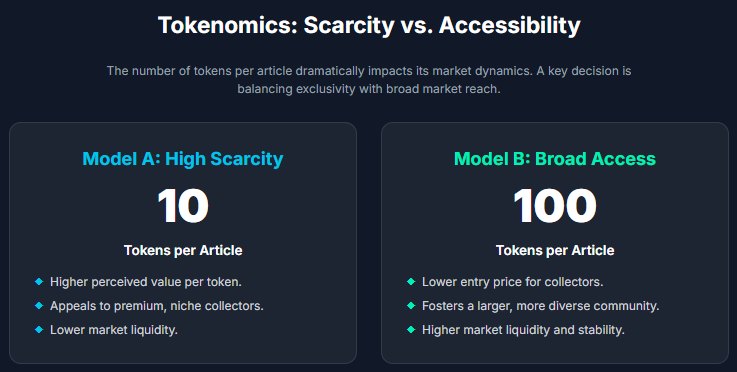
Considering the project’s scale of 600,000 NFTs and the nature of these assets as “serialized coins” (implying multiple copies of core articles), ERC-1155 emerges as the superior choice. It enables the efficient management of the 600 distinct article “types” (each with 1,000 copies) under a single contract. This directly addresses the scalability challenge of minting a large volume of NFTs. By utilizing ERC-1155, the project can designate each of the 600 articles as a distinct _id within the ERC-1155 contract, and then mint 1,000 copies of each _id. This approach streamlines contract logic, reduces deployment complexity, and leverages the inherent batching efficiencies of the ERC-1155 standard, which is paramount for managing the project's large scale economically. The batch minting capabilities of ERC-1155 are crucial, significantly reducing gas costs and transaction overhead compared to individual ERC-721 mints (Polygon Support n.d.; QuickNode Guides n.d.b).
The insistence on having the full 500-word article text “in the smart contract” for each of the 600,000 NFTs reveals a common misconception regarding the core utility of blockchain technology for large data storage (MDPI n.d.). Blockchains are fundamentally designed as distributed ledgers for immutable transaction history and state changes, not as cheap, high-volume data storage layers (MDPI n.d.; Bachini n.d.; Curvegrid n.d.; Rally.fan n.d.). Attempting to force 1.5 GB of raw text into smart contract state would lead to exorbitant costs and severe performance bottlenecks, rendering the project impractical. This understanding necessitates a shift in approach to fulfill the spirit of the requirement (immutability, visibility) rather than its literal interpretation.
As extensively analyzed in Section III.B, directly embedding the full 500-word text (approximately 2.35 KB) into the smart contract’s storage state for each of the 600,000 NFTs is financially prohibitive on EVM chains (Ethereum L1, L2s) due to the high gas costs associated with SSTORE operations (learnEVM.com n.d.a; Riady 2021; Irwin n.d.). While Solana's account model allows for larger data per account (up to 10 MB) (57Blocks n.d.; Solana Compass n.d.), the aggregate capital lockup required for rent exemption across 600,000 accounts makes it equally impractical for the project's envisioned scale.
Storing data as calldata (transaction input data) is significantly more cost-effective than storage on EVM chains (learnEVM.com n.d.b). Data committed as calldata is immutable once a transaction is confirmed. However, calldata is not directly part of the smart contract's persistent state. While it is undeniably "on-chain" and verifiable, retrieving it typically requires parsing historical transaction data, which does not align with the direct "in the smart contract" access implied by the "face art" metaphor. Furthermore, EVM immutable data patterns, such as the "Immutable Diamond" pattern, refer to un-upgradeable proxy contracts and their associated logic, not to direct large data storage within the contract itself (RareSkills.io n.d.).
Solana accounts, with their capacity to store up to 10 MB (57Blocks n.d.; Solana Compass n.d.), are technically capable of holding a 500-word article. However, the challenge lies in managing 600,000 separate accounts and their associated rent or rent exemption costs (Solana Compass n.d.). While it is theoretically possible to segment the text across multiple accounts if necessary, this approach adds considerable complexity and increases the overall rent burden. Solana’s transaction limits, particularly the 64 writable account limit per transaction (Neon EVM n.d.), also pose significant operational challenges for bulk data writes. It is worth noting that Solana’s “compressed NFTs” drastically reduce minting costs by storing only a hash of the NFT’s data on-chain, rather than the full data (Solana News n.d.). This approach aligns closely with the hybrid model proposed in this report.
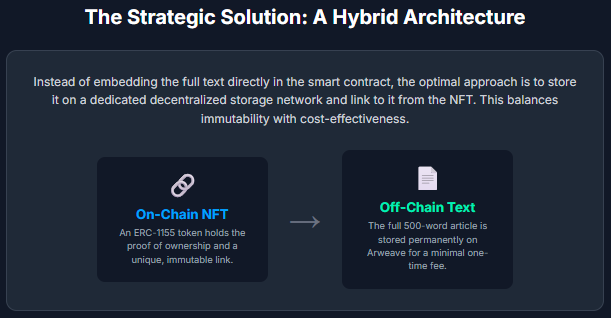
The challenge of storing 1.5 GB of text on-chain is primarily economic and technical. The user’s “face art” requirement emphasizes direct visibility and immutability. The optimal solution involves a hybrid approach that leverages the strengths of both on-chain immutability and off-chain permanent storage.
The established best practice for handling large NFT content is to store a cryptographic hash (a unique digital fingerprint) or a Uniform Resource Identifier (URI) pointing to the content on-chain (Bachini n.d.; Curvegrid n.d.; Rally.fan n.d.; QuickNode Guides n.d.b; NFT.Storage n.d.; OpenSea Developer Documentation n.d.; Moralis n.d.; Fleek.xyz n.d.). This hash or URI is immutable, verifiable, and extremely gas-efficient to store directly on the blockchain. It serves as the definitive on-chain proof of existence and integrity for the associated article. For the “face art” requirement, the tokenURI field within the ERC-1155 contract would point to a metadata JSON file, which in turn contains the reference to the full article.
The full 500-word article text, along with any associated images or multimedia, should be stored on a decentralized, permanent storage network. Arweave stands out as an ideal candidate due to its unique “permaweb” design, which offers permanent storage with a single, upfront payment (Fleek.xyz n.d.; Arweave n.d.a; Solana Compass n.d.; SwissBorg Academy n.d.b).
While Filecoin and IPFS are also viable options for decentralized storage, IPFS typically requires “pinning” services to ensure permanence, and Filecoin’s pricing model is generally based on monthly or yearly subscriptions (Hacker News 2020; Hacker News 2022). Arweave’s one-time payment for permanent storage aligns more closely with the “immutable library” vision of the project. This makes Arweave the optimal complement to on-chain immutability, providing a cost-effective solution for bulk data storage while ensuring the content’s long-term availability. By storing the full article text on Arweave and placing an immutable Arweave hash/URI (e.g., ar://<hash>) within the NFT's on-chain metadata, the project achieves verifiable on-chain immutability and cost-effectiveness. The bulk of the data storage cost is moved off-chain to a highly efficient solution, which is the established best practice for NFTs (Curvegrid n.d.; Rally.fan n.d.; Fleek.xyz n.d.).

Both the ERC-721 and ERC-1155 standards define a tokenURI (or uri for ERC-1155) method that returns a URL (typically HTTP or IPFS) to the NFT's metadata JSON file (QuickNode Guides n.d.b; NFT.Storage n.d.; OpenSea Developer Documentation n.d.). This JSON file can then contain standard fields such as name, description, image, and attributes. Crucially, a custom field (e.g., article_text) can be included within this JSON where the full 500-word article text is directly embedded (Mirror World n.d.; OpenSea Developer Documentation n.d.; Fleek.xyz n.d.; ArDrive.io n.d.). The tokenURI itself would be an Arweave URL (e.g., ar://<hash>), ensuring that the metadata and the embedded text are permanently stored on the permaweb (Mirror World n.d.; OpenSea Developer Documentation n.d.; Fleek.xyz n.d.).
Metadata Structure Example (JSON on Arweave):
{
  "name": "Article Title [Coin #X]",
  "description": "A serialized coin representing a segment of the decentralized article library.",
  "image": "ar://<hash_of_coin_image>", // Optional: if each coin has unique visual art
  "attributes": [],
  "article_text": "The full 500-word article content goes here, directly embedded."
}While the full text is not literally stored within the smart contract’s state, its immutable reference is securely recorded on-chain. Frontend applications, such as a dedicated decentralized application (dApp) or NFT marketplaces like OpenSea, can query the tokenURI from the smart contract (QuickNode Guides n.d.b; NFT.Storage n.d.; OpenSea Developer Documentation n.d.; Moralis n.d.). They then utilize this URI to fetch the JSON metadata file from Arweave. The embedded article_text field within the retrieved JSON can then be directly displayed to the user, fulfilling the "face art" requirement for immediate visibility and readability. This approach is the established best practice for delivering rich NFT experiences, balancing on-chain integrity with practical data storage solutions (Curvegrid n.d.; OpenSea Developer Documentation n.d.; Fleek.xyz n.d.).
The successful implementation of this large-scale textual NFT library necessitates a well-defined roadmap addressing smart contract development, minting strategies, frontend integration, and long-term sustainability.
The foundational step involves developing an ERC-1155 compliant smart contract. This contract must incorporate logic for the tokenURI function to dynamically generate Arweave URIs for each NFT's metadata, ensuring a direct link to the content. Robust access control mechanisms for minting and administrative functions are paramount to prevent unauthorized operations. Throughout the contract design and development process, a strong emphasis must be placed on gas optimization, particularly for minting functions, even with the benefits of batching (Riady 2021). Finally, rigorous security audits are indispensable to identify and mitigate common vulnerabilities inherent in smart contracts, safeguarding the integrity of the entire system (GitHub n.d.).
Leveraging the ERC-1155 standard’s inherent batch minting capabilities is crucial for efficiently issuing 600,000 NFTs (QuickNode Guides n.d.b). A phased rollout strategy for these NFTs should be planned, potentially in batches of 1,000 (corresponding to each article’s serialized coins) or larger, depending on real-time network conditions and prevailing gas prices. The minting process should ideally utilize a chosen Ethereum Layer 2 solution (e.g., Polygon, Arbitrum, Optimism) to minimize transaction costs associated with the on-chain reference (Optimism Docs n.d.; Polygon Support n.d.; Bitbond Token Tool n.d.a). Alternatively, Solana’s compressed NFTs could also be considered for their extremely low on-chain reference minting costs (Solana News n.d.).
A user-friendly decentralized application (dApp) is essential for interacting with the NFT contract. This dApp will be responsible for parsing the tokenURI retrieved from the smart contract, fetching the corresponding metadata JSON from Arweave, and prominently rendering the 500-word article text. The frontend must be designed for responsiveness and efficient data loading to provide a smooth and immediate "face art" viewing experience. Consideration should also be given to integrating with existing NFT marketplaces by adhering to their established metadata standards, enhancing discoverability and interoperability (NFT.Storage n.d.; OpenSea Developer Documentation n.d.).
The proposed Arweave solution inherently ensures long-term data permanence without requiring ongoing maintenance costs for storage, as payments are one-time and designed for perpetual availability (Arweave n.d.a; Solana Compass n.d.). If the smart contract is designed as immutable, its maintenance requirements would be minimal (RareSkills.io n.d.; QuickNode Guides n.d.a). Updates to the frontend application would be managed off-chain, providing flexibility and ease of deployment without affecting the core blockchain assets. This architecture establishes a sustainable foundation for the decentralized article library.
The comprehensive analysis presented in this white paper unequivocally demonstrates that the direct on-chain storage of 1.5 GB of textual content for 600,000 NFTs is financially and technically infeasible on current mainstream blockchain architectures. The exorbitant costs associated with such an endeavor, coupled with the inherent technical limitations of blockchain as a bulk data storage medium, render this approach impractical for a project of this scale.
The most viable and cost-effective path forward is a hybrid architectural approach that judiciously combines the immutability and verifiable integrity of on-chain references with the efficiency and permanence of off-chain decentralized storage. This strategy allows the project to fulfill the spirit of the “face art” requirement — providing immediate and verifiable access to the article content — without succumbing to the prohibitive costs and technical complexities of literal on-chain embedding.
Based on this analysis, the following strategic recommendations are put forth for the project’s execution, balancing its ambitious vision with the realities of current blockchain technology:
By embracing this hybrid architecture, the project can successfully establish a large-scale, decentralized textual NFT library that is both economically sustainable and technically robust, delivering on the core vision of immutable, accessible content.
57Blocks. n.d. “Deep Dive into Resource Limitations in Solana Development — CU Edition.” Accessed July 29, 2025. https://57blocks.io/blog/deep-dive-into-resource-limitations-in-solana-development-cu-edition.
Andrade, Fernando. 2025a. “Chapter 1: The Alexandria Archetype.” In Book 1: The Crime of Forgetting: A Forensic History of the War on Knowledge. Radegen Biotechnology Press, internal publication.
Arbitrum Docs. n.d. “Gas and Fees.” Accessed July 29, 2025. https://docs.arbitrum.io/how-arbitrum-works/gas-fees.
ArDrive.io. n.d. “Arweave and NFT Metadata.” Blog. Accessed July 29, 2025. https://ardrive.io/arweave-and-nft-metadata.
Arweave. n.d.a. “The economics of storing large datasets on Arweave.” Permaweb | Journal. Accessed July 29, 2025. https://permaweb-journal.arweave.net/article/economics-storing-large-data-on-arweave.html.
Arweave. n.d.b. “Arweave Data Storage Fees.” Accessed July 29, 2025. https://sjodcre-ar-web_arlink.arweave.net/learn/fees.
Bachini, James. n.d. “Best Practices for Storing Large Data in Solidity.” Accessed July 29, 2025. https://jamesbachini.com/best-practices-for-storing-large-data-in-solidity/.
BitKan.com. n.d. “How much does Ethereum cost per MB? Does ETH have high fees?” Accessed July 29, 2025. https://bitkan.com/learn/crypto-basics/how-much-does-ethereum-cost-per-mb-does-eth-have-high-fees-11926.
Bitbond Token Tool. n.d.a. “Create NFT Smart Contract on Arbitrum.” Accessed July 29, 2025. https://tokentool.bitbond.com/create-nft/arbitrum.
Bitbond Token Tool. n.d.b. “Optimism Gas Price.” Accessed July 29, 2025. https://tokentool.bitbond.com/gas-price/optimism.
Bitbond Token Tool. n.d.c. “Avalanche Gas Price.” Accessed July 29, 2025. https://tokentool.bitbond.com/gas-price/avalanche.
Coinbase. n.d. “What are gas fees?” Accessed July 29, 2025. https://www.coinbase.com/learn/crypto-basics/what-are-gas-fees.
Community Labs. n.d. “Quick Guide to ArFleet: The Decentralized Storage Layer Built on Top of Arweave and AO.” Blog. Accessed July 29, 2025. https://www.communitylabs.com/blog/quick-guide-to-arfleet-the-decentralized-storage-layer-built-on-top-of-arweave-and-ao.
Curvegrid. n.d. “NFT On-Chain vs. Off-Chain Data.” Accessed July 29, 2025. https://www.curvegrid.com/blog/2023-03-02-nft-on-chain-vs-off-chain-data.
Dapper Blog. n.d. “How Much Does It Cost to Mint an NFT?” Accessed July 29, 2025. https://blog.meetdapper.com/posts/nft-minting-fees-costs.
Datawallet. n.d. “What are Solana Fees? (Gas, Priority & Rent).” Accessed July 29, 2025. https://www.datawallet.com/crypto/solana-gas-fees.
Decrypt. 2021. “Charles Hoskinson Outlines Future for Cardano at Virtual…” September 22, 2021. https://decrypt.co/81892.
Fleek.xyz. n.d. “NFT Metadata: Storage & Formatting Best Practices.” Guides. Accessed July 29, 2025. https://fleek.xyz/guides/storing-nft-metadata-and-standards/.
GitHub. n.d. “slowmist/solana-smart-contract-security-best-practices.” Accessed July 29, 2025. https://github.com/slowmist/solana-smart-contract-security-best-practices.
Hacker News. 2020. “Has anyone calculated approximate annual storage price per GB?” October 15, 2020. https://news.ycombinator.com/item?id=24791621.
Hacker News. 2022. “So how much does it cost to store 1gb of data for one month on/with filecoin? I.” July 12, 2022. https://news.ycombinator.com/item?id=32080570.
Irwin, Marvin. n.d. “Gas estimation and large strings in the Ethereum virtual machine feat. Remix and Klaytn.” Medium. Accessed July 29, 2025. https://medium.com/@marvinirwin/gas-estimation-and-large-strings-in-the-ethereum-virtual-machine-feat-remix-and-klaytn-649e6db073f.
Internet Archive. 2024b. “Internet Archive and the Wayback Machine Under DDoS Cyber-Attack.” Internet Archive Blogs, May 28, 2024. https://blog.archive.org/2024/05/28/internet-archive-and-the-wayback-machine-under-ddos-cyber-attack/.
learnEVM.com. n.d.a. “Working with Contract Storage — A free, advanced course for Solidity Developers.” Accessed July 29, 2025. https://learnevm.com/chapters/evm/storage.
learnEVM.com. n.d.b. “EVM Calldata.” Accessed July 29, 2025. https://learnevm.com/chapters/fn/calldata.
LikeCoin. n.d. “Writing NFT FAQ | LikeCoin — Decentralize Publishing.” Accessed July 29, 2025. https://docs.like.co/depub/writing-nft.
Magic Eden Help Center. n.d. “The Costs of Free Mints on Solana.” Accessed July 29, 2025. https://help.magiceden.io/en/articles/8560165-the-costs-of-free-mints-on-solana.
MDPI. n.d. “Comprehensive Review of Storage Optimization Techniques in Blockchain Systems.” Accessed July 29, 2025. https://www.mdpi.com/2076-3417/15/1/243.
Meegle. n.d. “Digital Collectibles — Web3.” Accessed July 29, 2025. https://www.meegle.com/en_us/topics/web3/digital-collectibles.
Mirror World. n.d. “How to prepare NFT Metadata.” Accessed July 29, 2025. https://www.mirrorworld.fun/docs/guides/how-to-prepare-nft-metadata.
Moralis. n.d. “How to Get ERC-721 On-Chain Metadata.” Accessed July 29, 2025. https://developers.moralis.io/how-to-get-erc-721-on-chain-metadata/.
Neon EVM. n.d. “Solana’s 64-Account Limit: Thinking Past the Constraint.” Blog. Accessed July 29, 2025. https://www.neonevm.org/blog/solanas-64-account-limit-thinking-past-the-constraint.
NFT.Storage. n.d. “Store and mint NFTs using ERC-1155 metadata standards.” Accessed July 29, 2025. https://classic-app.nft.storage/docs/how-to/mint-erc-1155/.
OpenSea Developer Documentation. n.d. “Metadata Standards.” Accessed July 29, 2025. https://docs.opensea.io/docs/metadata-standards.
Optimism Docs. n.d. “Transaction fees on OP Mainnet.” Accessed July 29, 2025. https://docs.optimism.io/stack/transactions/fees.
Polygon Support. n.d. “Batch Mint with ERC721A and ERC721Psi.” Accessed July 29, 2025. https://support.polygon.technology/support/solutions/articles/82000902367-batch-mint-with-erc721a-and-erc721psi.
QuickNode Guides. n.d.a. “How to Make an Immutable Solana Program.” Accessed July 29, 2025. https://www.quicknode.com/guides/solana-development/anchor/how-to-make-immutible-solana-programs.
QuickNode Guides. n.d.b. “How to Create and Deploy an ERC-1155 NFT.” Accessed July 29, 2025. https://www.quicknode.com/guides/ethereum-development/nfts/how-to-create-and-deploy-an-erc-1155-nft.
Rally.fan. n.d. “Where and How are NFTs Stored? On-Chain, Off-Chain and Decentralized Storage.” Blog. Accessed July 29, 2025. https://rally.fan/blog/where-and-how-are-nfts-stored-on-chain-off-chain-and-decentralized-storage.
RareSkills.io. n.d. “The Diamond Proxy Pattern Explained.” Accessed July 29, 2025. https://rareskills.io/post/diamond-proxy.
Reddit. n.d.a. “Can someone double check my math on fee per byte calculation? : r/ethereum.” Accessed July 29, 2025. https://www.reddit.com/r/ethereum/comments/q7ylvm/can_someone_double_check_my_math_on_fee_per_byte/.
Reddit. n.d.b. “How much does it cost to mint erc-721 tokens?.” Accessed July 29, 2025. https://www.reddit.com/r/ethdev/comments/loq4qs/how_much_does_it_cost_to_mint_erc721_tokens/.
ResearchGate. n.d. “Average word length in the English language. Different colours indicate.” Accessed July 29, 2025. https://www.researchgate.net/figure/Average-word-length-in-the-English-language-Different-colours-indicate-the-results-for_fig1_230764201.
Riady, Yos. 2021. “How to Write Gas Efficient Contracts in Solidity.” May 17, 2021. https://yos.io/2021/05/17/gas-efficient-solidity/.
Solana. n.d. “How to Calculate Account Creation Cost.” Developers Cookbook. Accessed July 29, 2025. https://solana.com/developers/cookbook/accounts/calculate-rent.
Solana Compass. n.d. “Arweave: Building a Permanent, Decentralized Information Storage System.” Accessed July 29, 2025. https://solanacompass.com/learn/Validated/validated-a-decentralized-collective-memory-with-sam-williams.
Solana News. n.d. “State compression brings down cost of minting 1 million NFTs on Solana to ~$110.” Accessed July 29, 2025. https://solana.com/en/news/state-compression-compressed-nfts-solana.
SwissBorg Academy. n.d.a. “How Much Do Solana Fees Cost? Transaction Fee Guide.” Accessed July 29, 2025. https://academy.swissborg.com/en/learn/solana-fees.
SwissBorg Academy. n.d.b. “What is Arweave? Decentralized Permanent Storage on Solana.” Accessed July 29, 2025. https://academy.swissborg.com/en/learn/arweave.
The University of Chicago Press. 2017. The Chicago Manual of Style. 17th ed. Chicago: The University of Chicago Press. https://archive.org/details/dokumen.pub_chicago-manual-of-style-17thnbsped.
Wylie Communications. 2021. “What’s the best length of a word online?” November 11, 2021. https://www.wyliecomm.com/2021/11/whats-the-best-length-of-a-word-online/#:~:text=The%20average%20word%20in%20the,word%20length%20to%204.7%20characters%3F.
By embracing this hybrid architecture, the project can successfully establish a large-scale, decentralized textual NFT library that is both economically sustainable and technically robust, delivering on the core vision of immutable, accessible content.
White Paper: Architecting a Large-Scale On-Chain Textual NFT Library for Decentralized Publishing was originally published in Coinmonks on Medium, where people are continuing the conversation by highlighting and responding to this story.





