Solana Validators Can Now Vote On-Chain to Shape Protocol Decisions — Starting With Alpenglow
Solana just gave its validators something they didn't have before: a formal, on-chain voice. The foundation announced on July 01 that the on-chain governance is now live. Validators can now vote on core protocol decisions on the chain. This will be done by a new system called Solana Governance Proposals, or SGPs.
This is a significant move. Till now, major network decisions were made off-chain by informal discussion and developers' consent. Launch of SGPs changes everything. Now, validators can contribute on the blockchain itself in a transparent manner. Voting is stake-weighted, which means the voting power depends upon the number of tokens staked.
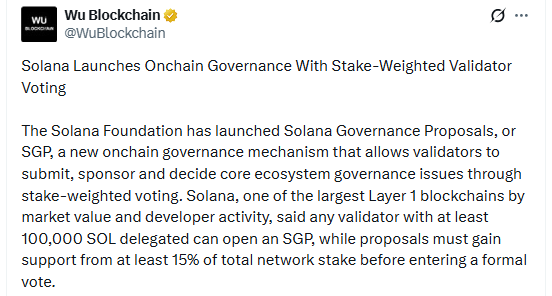
Source: X official
The SGP process works in three steps. First, a validator with at least 100,000 SOL delegated to its vote account submits a proposal. Second, that proposal needs support from at least 15% of Solana's active stakeholders before voting formally opens. Third, once voting begins, each validator's weight is determined by how much stake is delegated to them.
What makes this different from traditional crypto governance is the verification method. Every vote is proven using a Merkle proof — a cryptographic check that confirms a validator's stake amount at the time of the snapshot. There's no way to fake it.
Individual stakers get a say too. Even if your validator contribution in a direction you disagree with, you can override that vote using your own stake account Merkle proof. The Solana Foundation calls this "delegator sovereignty."
The Solana Foundation's own documentation names Alpenglow as the kind of proposal SGPs were built for. Alpenglow is Solana's next major consensus upgrade. It aims to cut confirmation times from around 12.8 seconds to 150 milliseconds. It would also remove Proof of History and on-chain vote transactions from the Solana blockchain core process entirely.
That's a fundamental change to how the network works. Under the old system, getting validators aligned on something that big would involve long forum debates and no clear on-chain mechanism to settle the outcome. SGPs give that mechanism.
The governance system uses Alpenglow explicitly as an example of what should go through an SGP before any detailed technical work begins.
Here's what you need to know if you hold or stake SOL:
For validators: You can now formally propose directional changes to the network. To do that, your vote account must have at least 100,000 SOL staked.
For stakers: You can override your validator's contribution on any proposal using your own stake account proof.
For developers: SGPs set direction; SIMDs (Solana Improvement Documents) handle the technical details. The two systems are designed to work together, not replace each other.
For SOL holders: Every major network decision going forward — including Alpenglow — may first go through a public, on-chain vote.
The svmgov program runs the voting. The NCN snapshot program verifies stake weights independently before any vote is cast.
No SGP has been formally submitted yet. The system went live on July 1, and the community is still getting familiar with the process. Alpenglow is in validator testing and remains the most likely first major proposal.
The Solana Foundation hasn't set a deadline for when the Alpenglow governance discussion will begin. Developers have described Q3 2026 as the realistic window for Alpenglow's mainnet direction, with scope for Q4 if testnet stability requires more time.
What's clear is that the Solana on-chain governance route for validators to shape the network's future. That's a structural upgrade, not just a feature launch.
Disclaimer: This article is for informational purposes only and does not constitute financial or investment advice. Always do your own research before making any investment decision.





