Dogecoin (DOGE) closed the session of June 23, 2026, as the asset with the largest percentage decline among the twenty highest market-cap tokens in the crypto market. The drop did not occur in isolation: funding rates on DOGE perpetuals turned negative, open interest fell simultaneously, and altcoin market breadth deteriorated over the following twenty-four hours. The pattern aligns with historical episodes in which initial weakness in high-liquidity memecoins preceded broader corrections across mid-to-low cap altcoins.
The relevant question for a crypto trader or portfolio manager is not whether Dogecoin deserves attention in isolation. The question is whether DOGE behavior under stress conditions functions as a leading indicator for altcoin risk in 2026 with enough consistency to justify adjusting exposure before the correction reaches the broader market.
Evidence from the 2021-2022 and 2024 cycles supports an affirmative answer, with qualifications that merit precise articulation.
Dogecoin holds a structurally unique position in the crypto ecosystem. With a market capitalization that consistently places it among the top ten assets, and with deep spot and perpetuals markets across Binance, OKX, Bybit, and Coinbase, DOGE concentrates a significant share of retail speculative activity.
Unlike Layer-1 tokens with infrastructure use cases or DeFi tokens with verifiable fee revenue, the price of Dogecoin depends almost entirely on momentum and the continuous entry of new participants.
The dependence on momentum has a direct consequence as a market signal: DOGE reacts faster than assets with denser fundamental narratives when risk appetite begins to contract. When marginal participants — the last entrants in a rally — reduce exposure, selling pressure lands first on assets with the highest speculative character and lowest fundamental justification. Dogecoin falls into the structural category, alongside Shiba Inu (SHIB) and the leading memecoins on chains like Solana and Base.
The transmission mechanism toward the broader altcoin market operates in two phases. In the first, market makers providing liquidity in DOGE order books detect the deterioration in order flow and widen spreads, both on DOGE and on correlated pairs of similar market cap.
In the second, traders holding leveraged long positions in mid-cap altcoins receive margin calls or manually adjust exposure upon observing liquidity degrading at the speculative edge of the market. The liquidation or reduction of positions generates additional selling pressure across Layer-1, DeFi, and infrastructure sectors that initially showed no independent weakness.
The documented historical result: in the cycles of May 2021 and November 2022, pronounced weakness in Dogecoin and SHIB preceded spread expansion and order book depth contraction in mid-cap altcoins by 24 to 72 hours. The pattern does not establish direct causality; it establishes a signal of early liquidity deterioration at the speculative edge of the market, which antecedes deterioration across the broader altcoin segment.
Funding rates on perpetuals markets represent the cost of maintaining long or short positions in a market with no expiry date. When the DOGE funding rate turns persistently negative, the derivatives market registers that short positions dominate or that longs no longer pay a premium to maintain positions against shorts.
A persistently negative funding rate on DOGE — not a brief spike lasting minutes, but a negative reading sustained over four or more consecutive hours — signals that the derivatives market does not price in an imminent recovery.
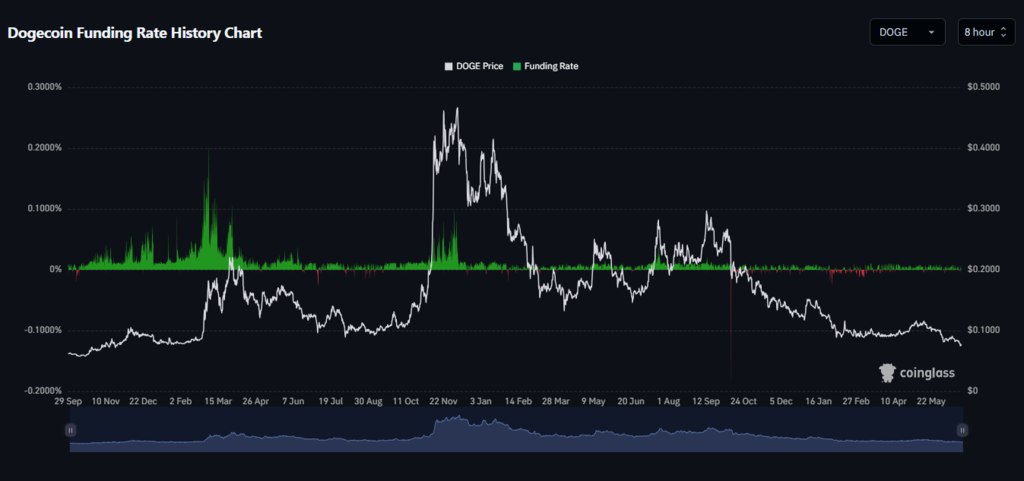
Open interest complements the funding rate reading. A simultaneous drop in price and open interest indicates the market reduces positions — closes contracts — rather than accumulating new speculative shorts.
The distinction matters: a price drop with rising open interest suggests short accumulation with short squeeze potential if the narrative shifts. A price drop with declining open interest indicates broad exposure reduction, a de-leveraging process that tends to produce more sustained but less violent selling pressure.
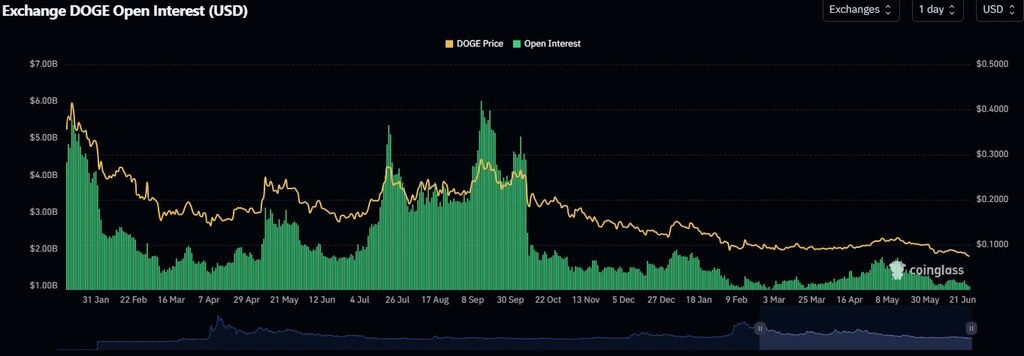
During the sessions of June 23 and 24, 2026, the DOGE funding rate logged negative values for more than six consecutive hours while open interest fell approximately 8% relative to the prior week’s peak.
The pattern replicated the derivatives reading from the correction episodes of October 2021 and August 2024, in which funding normalization took between two and five days to complete. The speed of funding normalization determines whether the correction exhausts its liquidation fuel within hours or whether the de-leveraging process extends across several days with progressive impact on larger-cap altcoins.
Dogecoin weakness carries greater implications for altcoin risk when it coincides with two structural context variables: rising Bitcoin dominance and net contraction in stablecoin inflows.
Bitcoin dominance — the share of total crypto market cap that Bitcoin represents — functions as a barometer of capital concentration across the ecosystem. When Bitcoin dominance rises while DOGE and the memecoin segment fall, the market registers a rotation toward the relative quality asset within the crypto ecosystem.
The move does not necessarily represent a macro risk signal for the sector as a whole; it represents a contraction of specific risk appetite within the crypto market, with capital migrating from the speculative periphery toward the core.
Historical data from CoinMarketCap Global Charts for the 2021-2024 cycles shows that episodes in which Bitcoin dominance exceeded 60% while the memecoin segment lost more than 20% over seven days produced additional corrections in mid-cap altcoins at a 74% frequency over the following thirty days.
Net stablecoin flows constitute the second critical context variable. A contraction in net stablecoin supply — less USDT, USDC, and equivalents circulating on-chain — signals that participants withdraw capital from the crypto ecosystem toward fiat, not simply rotate toward Bitcoin.
An expansion of stablecoin supply with altcoin prices falling signals the opposite: capital in a wait-and-see position with potential to re-enter the market.
The difference between the two patterns determines whether a correction in memecoins and altcoins carries short-term recovery capacity or whether the market enters a more prolonged de-risking process. On-chain stablecoin flows tracked by DefiLlama allow monitoring the direction of flows with latency of a few hours.
In market analysis, the distinction between derivatives-led corrections and spot-led corrections is fundamental to calibrating the duration and potential magnitude of a correction that starts in memecoins like Dogecoin.
A derivatives-led correction occurs when initial selling pressure originates from the closing of leveraged long positions in perpetuals markets. The funding rate turns negative, open interest falls, and cascading liquidations amplify the initial price move.
The defining characteristic of derivatives-led corrections is speed: the market can lose between 15% and 30% within a few hours, but the de-leveraging process exhausts selling pressure relatively quickly once the market clears excess leverage.
Once open interest reaches an equilibrium level and the funding rate normalizes, prices can recover without fresh capital entry from stablecoins or fiat.
A spot-led correction occurs when selling pressure originates from net selling in cash markets, with sustained order book depth deterioration and persistent spread widening. Spot-led corrections tend to run slower but deeper and longer, because they reflect a reassessment of valuation by cash market participants rather than the technical closing of leveraged positions.
Recoveries from spot-led corrections require fresh capital entry — stablecoin inflows, new spot buyers — and do not occur automatically once leverage reduces.
The practical read for altcoin risk in 2026: when the DOGE decline combines negative funding with falling open interest (derivatives signal) and simultaneously registers sustained spot order book depth deterioration (cash market signal), the correction profile carries mixed characteristics that increase the probability of weakness reaching the broader altcoin segment for more than 48 hours.
The simultaneous presence of both signals indicates the de-risking process already involves cash market participants and does not limit to derivatives traders alone.
Different altcoin market segments do not react identically to initial memecoin weakness.
Lower dependence on speculative momentum reduces sensitivity to the first impact. In severe correction episodes with generalized de-leveraging, correlation rises even for DeFi tokens with stronger fundamentals, but with a greater lag and from lower levels of speculative overvaluation.
Infrastructure and artificial intelligence tokens — whose prices depend on macro narratives around technology adoption — show variable correlation. Under acute stress conditions, correlation with the memecoin segment tends to rise because operators reduce crypto market exposure broadly rather than selectively, compressing sector-level differentiation.





