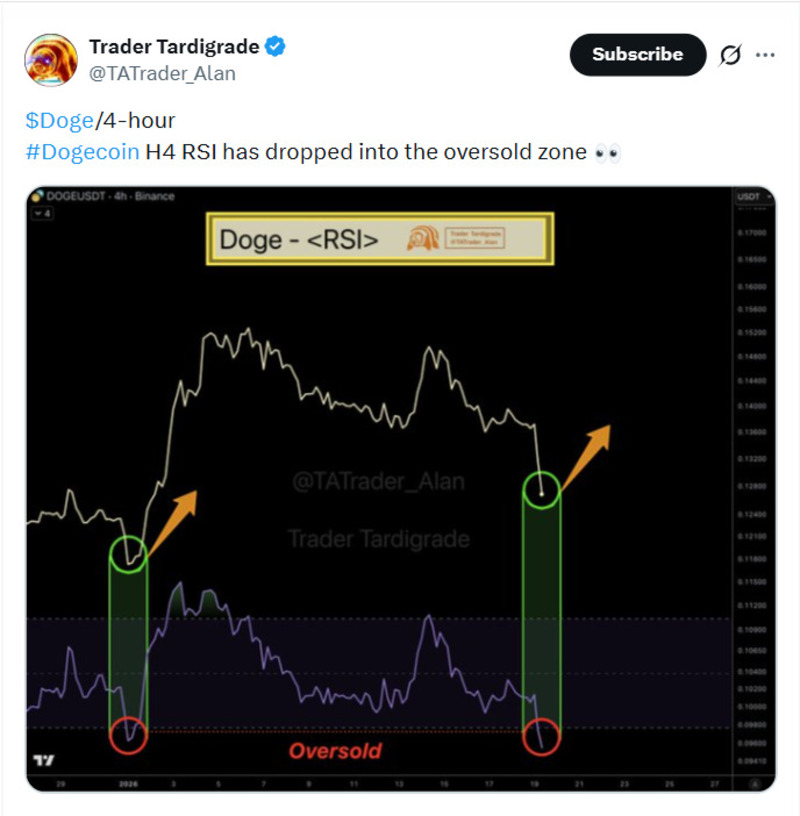
Dogecoin experienced renewed downside pressure during the week after slipping below the $0.1300 and $0.1250 support levels, briefly reaching lows near $0.1154 before attempting a modest rebound. Although prices recovered toward the $0.1220 area, the move has not yet been supported by strong momentum indicators, keeping the short-term outlook cautious.
At the same time, Zero Knowledge Proof (ZKP) is being evaluated through its access control architecture, where zero-knowledge proofs are used to manage eligibility and permissions without exposing private user data. This infrastructure-led design is increasingly referenced in broader discussions around how blockchain systems may evolve in 2026, particularly in areas requiring verification without disclosure.
Recent price action in Dogecoin has altered its short-term technical structure, with resistance now outweighing upside momentum.
Key technical observations include:

Momentum indicators continue to reflect caution. The hourly RSI remains below the 50 level, while the MACD suggests fading bullish pressure. Without a sustained move above the $0.1350 region, trading conditions are likely to remain range-bound, with continued sensitivity around the $0.1200 area.
Beyond price movements, Dogecoin’s on-chain data currently offers limited confirmation of a strong recovery phase. Recent observations include:
These factors suggest that while Dogecoin maintains strong liquidity and visibility, recent price stabilization lacks deeper network-driven reinforcement. As a result, short-term direction remains closely tied to sentiment shifts rather than structural demand.
ZKP is a blockchain designed to support permissioned and verifiable execution without revealing underlying data. Through the use of zero-knowledge cryptography, the network allows outcomes, permissions, and eligibility checks to be confirmed while keeping sensitive logic and user information private. Its architecture places privacy, controlled participation, and execution accuracy at the protocol level.
Unlike assets primarily influenced by market sentiment, ZKP is structured around controlled participation and verifiable processes. A central element of its architecture is granular access control, implemented through zero-knowledge proofs.
This framework enables permission management based on token ownership while preserving privacy. Core components include:
Defined access tiers include:
By using zero-knowledge proofs, ZKP allows participants to confirm access rights without revealing identity or sensitive data, aligning confidentiality requirements with functional access control.
Granular access control becomes increasingly relevant as blockchain systems expand into areas involving sensitive computation and data handling. Within the ZKP framework:
This approach supports ZKP’s broader focus on private execution, where verification is maintained without unnecessary exposure, positioning the network within emerging privacy-focused infrastructure discussions.
Beyond access control, ZKP reflects an infrastructure-first approach aimed at reducing execution risk. Structural characteristics include:
By emphasizing system design over short-term price movement, ZKP highlights how privacy and verification can function as core protocol features rather than optional layers.
Dogecoin’s recent movement below key support levels underscores how sentiment-driven assets can remain vulnerable when momentum and on-chain engagement weaken. While short-term rebounds are possible, sustained recovery typically requires stronger network participation.
ZKP follows a different development path. Its granular access control system, validated through zero-knowledge proofs, emphasizes private execution and controlled participation. As attention around data protection and verification continues to grow, infrastructure models that enable validation without disclosure are becoming more prominent in broader blockchain discussions heading into 2026.

Why is Dogecoin finding it hard to recover?
Soft technical momentum and limited on-chain growth are constraining upside attempts.
What does granular access control mean in ZKP?
It refers to tiered permissions validated through zero-knowledge proofs without exposing user data.
How does ZKP maintain privacy?
Eligibility and permissions are verified cryptographically, reducing the need for identity or data disclosure.
This article contains information about a cryptocurrency presale. Crypto Economy is not associated with the project. As with any initiative within the crypto ecosystem, we encourage users to do their own research before participating, carefully considering both the potential and the risks involved. This content is for informational purposes only and does not constitute investment advice.





