In a major DTCC Tokenization Update, the Depository Trust & Clearing Corporation has confirmed it will launch its full Tokenization Service in October 2026, following a landmark live trial that successfully processed real production trades using tokenized securities.
DTCC provides custody and asset servicing for securities worth roughly $114 trillion, making this one of the most significant institutional moves toward blockchain-based markets to date.
On July 15, 2026, DTCC announced it had successfully converted assets held at The Depository Trust Company (DTC) into tokens and used them in real production trades, a milestone the company called the largest tokenize production initiative to date in terms of breadth of use cases, asset classes, and participants.
The event tested multiple transaction types in a live production environment, including:
Collateral pledges
Securities lending
U.S. Treasury and repo delivery-versus-payment (DVP) trades
Equity DVP and delivery-versus-delivery (DVD) trades
Equity token transfers
Central counterparty (CCP) margin workflows
The digital conversions ran across two blockchain networks, LFDT's Besu (DTCC's private network) and Canton (a public network), part of what it describes as a multi-chain strategy built for resiliency, scalability, and choice.
According to DTCC's official tokenization page, the service will allow DTC-held securities to be converted between traditional and tokenized forms, letting DTC participants move assets between approved wallets around the clock.
Because both the traditional and tokenized versions share the same CUSIP, tokenized assets carry identical legal and economic rights and investor protections as traditional securities.
DTC-issued tokens will also come with built-in compliance controls, including the ability to mint, burn, force transfer, clawback, pause, and freeze tokens as needed.
More than 30 firms spanning traditional finance and digital markets participated in the July trial, according to DTCC's official release, underscoring how broad the industry buy-in already is.
Participants included BlackRock, J.P. Morgan, Goldman Sachs, Citadel Securities, CME Group, Nasdaq, the New York Stock Exchange, Circle, Chainlink, Fireblocks, State Street Investment Management, Vanguard, and dozens of others across banking, asset management, and blockchain infrastructure.
A separate social post from Coin Bureau additionally reported that Russell 1000 stocks, including Nvidia, Apple, and Microsoft, would be among the equities eligible for tokenize once the service launches.
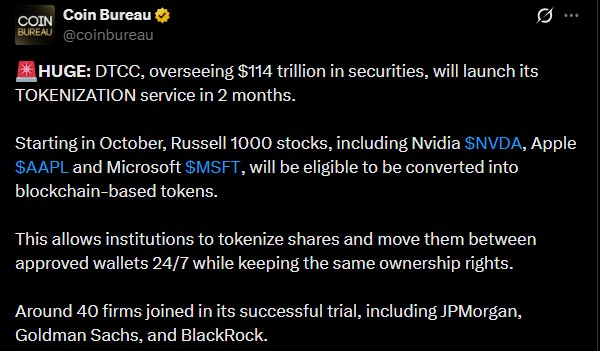
Source: Coinbureau Team on X
Frank La Salla, President and CEO, said the firm demonstrated that "the same institutional rigor" applied to traditional assets can now extend to tokenize, calling the upcoming service "a critical enabler of the digital ecosystem of the future."
Brian Steele, president of Clearing & Securities Services added that tokenize can enable real-time collateral mobility, enhance liquidity, and reduce counterparty risk, while DTC-tokenized assets keep the same investor protections as traditional securities.
This milestone lands seven months after DTC received a No-Action Letter from the U.S. Securities and Exchange Commission, authorizing it to operate a tokenize service for the real-world assets it custodies.
The service was developed alongside the Industry Working Group, which has grown to more than 100 members and partners.
With DTCC sitting at the center of U.S. post-trade infrastructure, this DTCC Tokenization service Update signals that tokenized securities are moving from pilot programs into mainstream institutional plumbing.
With a successful live trial behind it and October 2026 now confirmed as the launch window, this DTCC Tokenization Update marks a genuine turning point for how traditional securitie may move, settle, and trade going forward.
As more than 30 major institutions have already tested the system, the coming months will show how quickly tokenized equities and other assets move from trial to everyday market infrastructure.
This article is for educational and informational purposes only and should not be considered financial or investment advice. Always conduct your own research before making investment decisions





