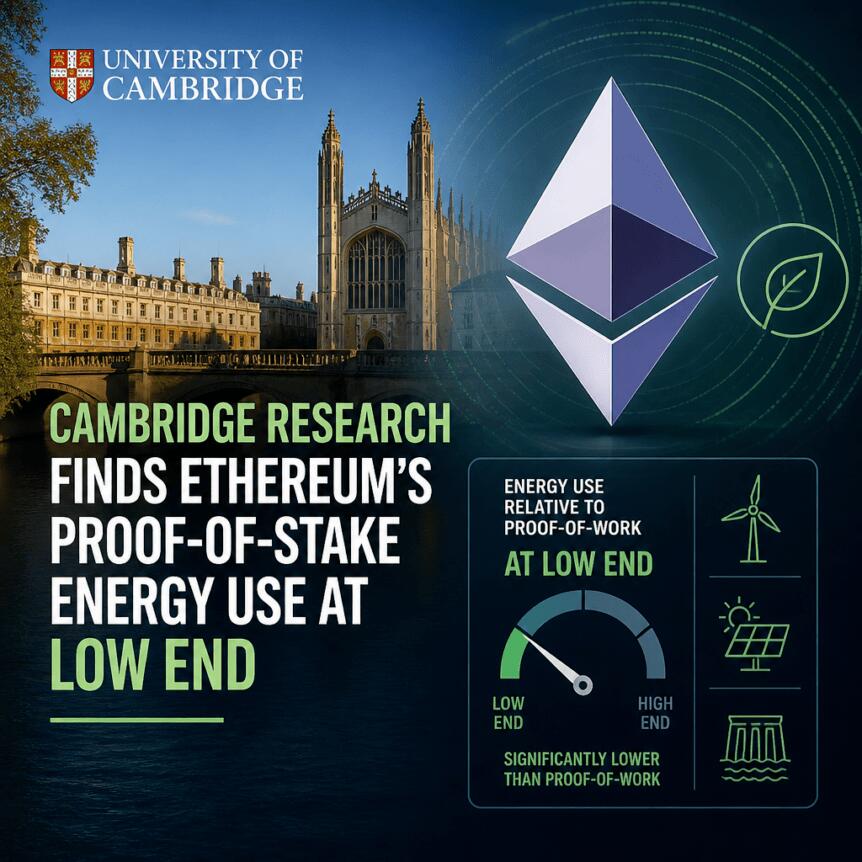
Ethereum’s post-Merge operating footprint is looking cleaner than its proof-of-work era, but a new assessment from Cambridge underlines a more nuanced reality: the network’s energy intensity sits near the lower end among major proof-of-stake blockchains, yet Ethereum still consumes more electricity than most of the other PoS networks included in the comparison.
In a study published by the Cambridge Centre for Alternative Finance, researchers estimated Ethereum uses about 7.87 gigawatt-hours (GWh) of electricity annually. On an economic-adjusted basis—energy consumed per unit of market value—the network works out to roughly 33 kilowatt-hours (kWh) per $1 million, the second-lowest among the PoS networks evaluated, behind BNB Chain.
Cambridge’s work is part of an ongoing effort to quantify blockchain sustainability using measurable inputs rather than high-level assumptions. The study focuses on Ethereum’s proof-of-stake period and aims to give policymakers and investors a more current foundation for comparing energy usage across networks.
Using its framework, Cambridge estimated not only overall electricity consumption but also a way to compare energy use against each network’s economic scale. In that adjusted view, Ethereum’s ~33 kWh per $1 million figure ranks just behind BNB Chain among the proof-of-stake networks assessed.
By contrast, the study reports that Solana consumed the most electricity within the comparison group, at approximately 13.48 GWh per year. Cambridge also calculated that Solana’s energy intensity was about 283 kWh per $1 million—around 8.5 times Ethereum’s—while the networks in the comparison combined consumed roughly 38 GWh.
A central part of the report is its attempt to map Ethereum’s power consumption to real-world operating conditions. Cambridge measured electricity draw at the “wall” for 20 combinations of Ethereum node software clients, using both typical consumer and professional hardware setups.
In the modeling, a “typical home” setup was associated with about 18 watts of power use, while a workstation-class environment ran at roughly 153 watts. Combining these profiles with Ethereum’s observed mix of node types and hosting patterns, Cambridge estimated that a representative node averages around 105 watts.
To scale from device power to network-wide consumption, the study counted an estimated 8,522 discoverable full nodes. Cambridge’s distribution estimate suggested 64% of these nodes operate via cloud or enterprise facilities, with the remaining 36% connected through residential arrangements.
This distinction matters because grid power varies significantly by location. Cambridge’s conclusion is that Ethereum’s remaining emissions are driven mainly by the electricity grids powering those nodes—an important point for sustainability discussions that often focus on the blockchain protocol itself rather than the infrastructure around it.
Beyond the amount of electricity, the study also evaluates the composition of the energy mix used by Ethereum’s node operators. Cambridge estimated that 56.4% of Ethereum’s electricity input comes from renewable and nuclear sources, while the remaining 43.6% is attributed to fossil fuels.
For readers weighing what “low energy intensity” means in practice, this split is a key detail. A network can be comparatively efficient on a per-value basis while still depending partly on fossil generation depending on where its infrastructure is hosted and how local grids are powered.
In the broader context of sustainability claims, this approach also shifts the conversation toward operational decisions—such as hosting preferences and the regional electricity mix—rather than treating energy use as a purely network-intrinsic property.
Ethereum’s current footprint cannot be understood without reference to the major shift it underwent. Ethereum moved from proof-of-work mining to proof-of-stake validation through the Merge in September 2022. The change replaced miners competing with energy-intensive computation with validators who secure the network by staking Ether.
Cambridge’s paper also aligns with widely cited post-Merge findings that the upgrade dramatically cut electricity use by removing the mining component. Cointelegraph previously reported that the Merge reduced Ethereum’s network power consumption by more than 99.9%, and this new Cambridge assessment extends that theme by quantifying what remains after the protocol change.
Put differently: Ethereum’s energy intensity is now shaped far more by validator and infrastructure choices than by consensus-related hardware competition—making current estimates a better reflection of modern operations than any projection from the mining era.
Going forward, investors and policymakers will likely want to watch how these estimates evolve as node hosting patterns and regional energy mixes change, and whether newer measurement approaches continue to refine the relationship between electricity use, market value, and real-world infrastructure.
This article was originally published as Cambridge Research Finds Ethereum’s Proof-of-Stake Energy Use at Low End on Crypto Breaking News – your trusted source for crypto news, Bitcoin news, and blockchain updates.





