EU Crypto Central Contact requirements are now officially extending to digital asset firms after the European Commission adopted a delegated act broadening a longstanding anti-money laundering oversight tool beyond its original scope.
The move brings crypto exchanges and similar platforms operating across borders in line with rules that have applied to traditional payment and e-cash issuers for years.
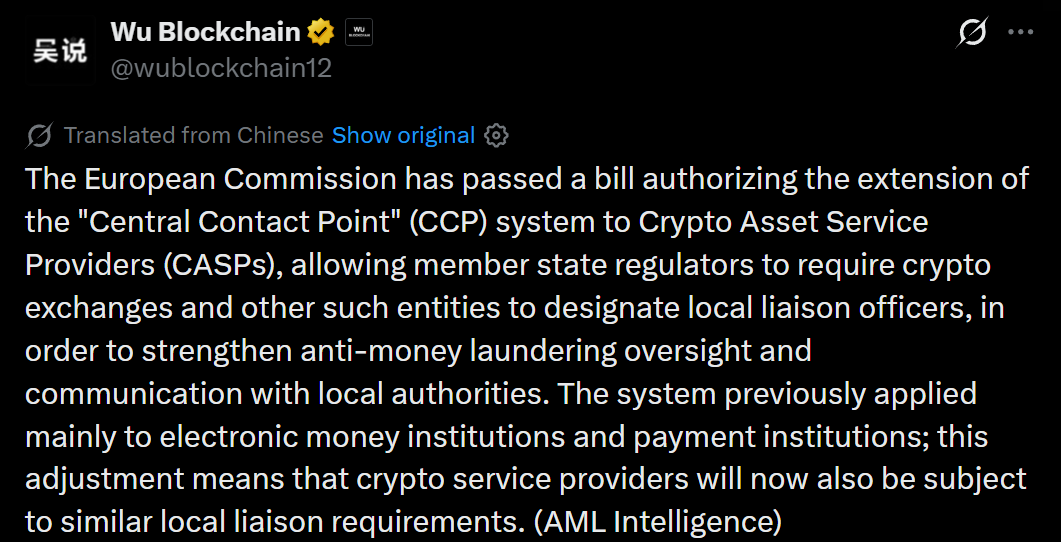
Source: WuBlockchain on X
The underlying framework requires certain foreign firms operating in an EU country without a full branch presence to appoint a designated local representative who liaises directly with that country's regulators.
This representative acts on behalf of the appointing company and helps ensure day-to-day compliance with local anti-financial crime and counter-terrorist financing rules.
Until now this requirement applied specifically to electronic money issuers and payment service providers, leaving digital asset service providers outside its reach.
The legal basis for this expansion traces back to a 2023 regulation on information accompanying fund transfers, which broadened underlying anti-money laundering law to formally cover digital asset service providers for the first time.
That change created a gap, since the technical rules governing when and how a local contact point must be appointed had never been updated to actually include these firms.
The European Banking Authority spent months drafting updated technical standards to close that gap, working through a formal consultation process before submitting its final proposal for adoption.
Key elements of the newly extended framework include:
A designated local contact person representing the exchange to national regulators
Coverage triggered once a firm's cumulative service activity in a host country crosses roughly three million euros annually
An alternative risk-based trigger allowing regulators to require a local representative even below that threshold
A broadened definition of establishment covering firms that serve customers mainly online with limited physical presence
Rather than relying on a single fixed rule, the framework combines two separate paths toward requiring a local contact point.
One path is purely financial, based on the total value of services a firm provides within a given country each year, while the second path lets regulators step in regardless of size whenever they have reasonable grounds to suspect elevated money laundering or terrorist financing risk tied to a firm's local operations.
This dual approach mirrors exactly how the same system already functions for payment and e-money issuers, rather than introducing an entirely separate standard just for digital assets.
Detail | Information |
System being extended | Local liaison requirement under EU AML law |
Previously covered firms | Electronic money issuers and payment service providers |
Newly covered firms | Crypto-asset service providers |
Financial trigger threshold | Around 3 million euros in annual service value per country |
Alternative trigger | Elevated money laundering or terrorist financing risk |
Legal basis | Article 45 of the EU's anti-money laundering directive |
Next procedural step | Parliament and Council scrutiny before Official Journal publication |
Even though the Commission has now formally adopted the underlying delegated act, the rules are not yet fully binding law.
The measure still needs to pass through a scrutiny period involving the European Parliament and the Council before it can be published in the Official Journal of the European Union.
Once published, the regulation becomes binding across every member state twenty days later, without requiring separate national implementing legislation.
This expansion of EU Crypto Central Contact obligations marks a meaningful step toward treating digital asset firms the same way regulators already treat traditional payment and e-money businesses operating across borders.
With a clear financial threshold, a separate risk-based trigger, and a broadened definition of what counts as an establishment, the framework gives national regulators a formal tool to demand local accountability from crypto platforms once the remaining legislative steps are complete.
This content covers financial markets and is for general information only. It is not financial, investment, trading, or legal advice. Crypto assets are volatile and can lose value fast. Always do your own research. Speak with a licensed financial advisor before making investment decisions.





