Organizations invested in legal teams, updated privacy policies, and redesigned data management processes to meet regulatory requirements.
Today, the conversation has changed.
GDPR is no longer just about avoiding penalties. It has become a strategic advantage that helps businesses earn customer trust, strengthen cybersecurity, improve operational efficiency, and compete in an increasingly privacy conscious digital economy.
As consumers become more aware of how their personal information is collected and used, companies that prioritize privacy are standing out from the competition.
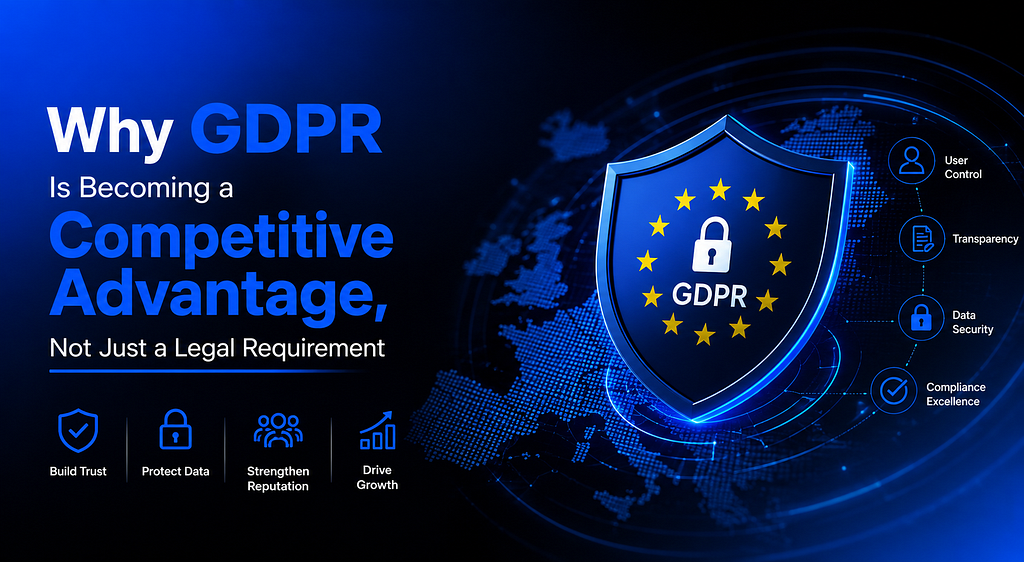
Digital businesses thrive on trust.
Whether it is a fintech platform, ecommerce marketplace, healthcare provider, or SaaS company, customers expect their personal information to be handled responsibly. A single data breach or misuse of customer information can damage a company’s reputation for years.
GDPR encourages organizations to build transparent relationships with users by clearly explaining what data is collected, why it is needed, and how it will be protected.
When customers know their privacy is respected, they are more likely to remain loyal, recommend the business to others, and share information confidently.
In today’s digital economy, trust has become one of the most valuable business assets.
One of GDPR’s most important principles is Privacy by Design.
Instead of treating privacy as an afterthought, organizations are encouraged to integrate data protection into products and services from the very beginning.
This approach leads to:
Building privacy into product development often results in cleaner systems, lower security risks, and more resilient digital infrastructure.
Cyber threats continue to evolve.
Ransomware attacks, phishing campaigns, insider threats, and third party breaches are becoming more sophisticated every year.
GDPR encourages organizations to adopt stronger security measures, including:
These practices not only support compliance but also reduce operational risks and financial losses caused by cyber incidents.
Companies that invest in security are better prepared to respond quickly when threats emerge.
Customers now compare businesses on more than price and features.
Privacy has become a purchasing factor.
Organizations that openly demonstrate responsible data handling can differentiate themselves from competitors that treat privacy as merely a legal obligation.
This is especially important for:
Displaying a strong commitment to data protection reassures enterprise customers, investors, and partners who increasingly evaluate privacy practices before making business decisions.
Although GDPR is a European regulation, its influence extends far beyond Europe.
Many countries have introduced similar privacy laws inspired by GDPR, making it one of the most influential data protection frameworks in the world.
Organizations that build GDPR aligned processes often find it easier to expand internationally because they already follow high standards for data governance.
For growing businesses, compliance becomes an investment that supports future expansion rather than an operational burden.
GDPR encourages businesses to collect only the data they genuinely need.
While this may seem restrictive, it often improves data quality.
Instead of maintaining massive databases filled with outdated or unnecessary information, organizations work with more accurate, relevant, and reliable datasets.
The result is:
Less data, when managed effectively, often creates more business value.
Leading technology companies increasingly highlight privacy as part of their brand identity.
Customers are actively choosing organizations that demonstrate transparency, accountability, and ethical data practices.
Privacy is evolving from a compliance function into a marketing advantage.
Businesses that communicate their commitment to protecting customer information create stronger emotional connections with users and strengthen long term brand loyalty.
Artificial intelligence, embedded finance, digital identity, cloud computing, and connected devices are generating more personal data than ever before.
As innovation accelerates, privacy expectations will continue to grow.
Organizations that build privacy into their culture today will be better prepared for tomorrow’s regulations, customer expectations, and technological changes.
Rather than viewing GDPR as a legal hurdle, forward thinking businesses recognize it as a foundation for sustainable digital growth.
GDPR has evolved beyond compliance.
It represents a shift toward responsible innovation, stronger cybersecurity, and greater customer confidence.
Businesses that embrace privacy as a core business strategy are discovering that compliance is not simply about avoiding fines. It is about building trust, improving resilience, attracting enterprise customers, and creating a lasting competitive advantage.
In a world where data powers every digital interaction, the companies that protect it best will be the ones that earn the greatest confidence and achieve long term success.
Why GDPR Is Becoming a Competitive Advantage, Not Just a Legal Requirement was originally published in Coinmonks on Medium, where people are continuing the conversation by highlighting and responding to this story.





