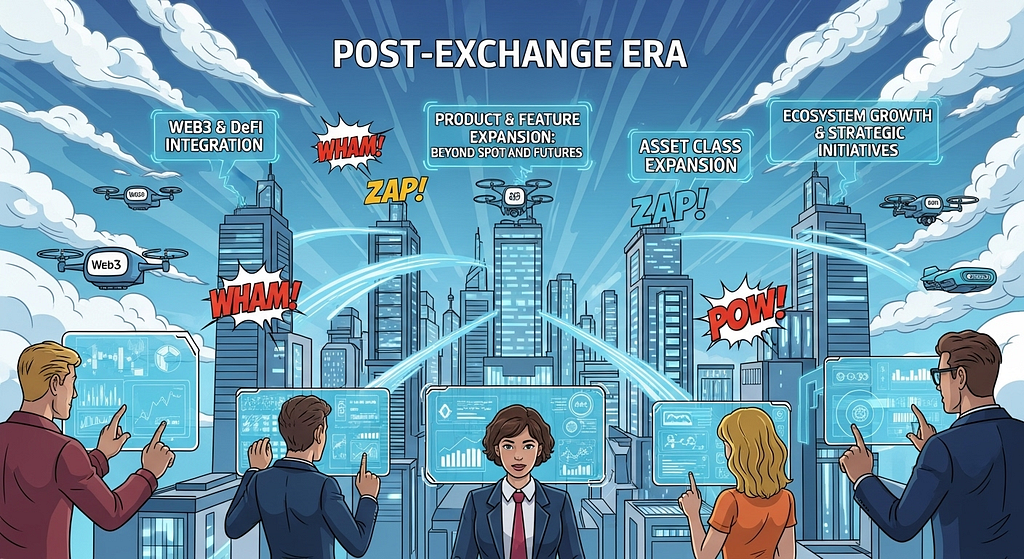
From the vantage point of seven years in the trenches of exchanges, media, and infrastructure, a clear cycle is emerging. The monolithic, walled-garden model of the centralized exchange (CEX) is becoming a relic. We are entering the “post-exchange” era, where the battle is no longer just about liquidity or fees, but about who can build the most comprehensive, seamless, and integrated Web3 ecosystem. The leading platforms of today are not just places to trade; they are morphing into multifaceted financial hubs, infrastructure providers, and gateways to the on-chain world.
The most fundamental shift is the deliberate blurring of the lines between centralized and decentralized finance. Exchanges are no longer just observing DeFi from a distance; they are actively building bridges to absorb its functionalities and abstract away its complexities.
A prime example is Bybit’s revamped Web3 offering, which now supports on-chain trading directly from a user’s main centralized account. This move is significant as it eliminates the traditional hurdles of connecting external wallets and managing gas tokens, lowering the barrier to DeFi for millions of CEX users. Similarly, OKX is doubling down on its own infrastructure with the formal launch of a fee and rebate system for its DEX; its API has already been integrated by major players like Magic Eden, and it has open-sourced its new Solana routing contract to contribute to the broader ecosystem. This positions OKX not merely as a participant but as a core service provider in the decentralized economy. Bitget is following a similar path by integrating its Bitget Wallet with leading DEXs on Base, like Aerodrome, and supporting tokenized assets from platforms like Centrifuge, effectively turning its wallet into a multi-chain passport for DeFi.
Parallel to DeFi integration, exchanges are expanding their service stacks to capture the entire user journey, from discovery to yield generation. They are evolving into financial super-apps that offer services akin to, and often innovating upon, traditional finance.
Binance, for instance, is moving aggressively into the yield-generation space. Its recent promotional campaigns for USDC deposits and borrowing create sophisticated arbitrage opportunities, allowing users to perform complex yield strategies within a single platform. This is complemented by features like “Auto-Earn” on OKX, which seamlessly puts idle trading capital to work, maximizing capital efficiency for users.
Perhaps the most significant expansion is into Real-World Assets (RWAs). Both Bybit and Bitget are making concerted pushes here. Bybit’s launch of its xStocks series and Bitget’s introduction of RWA Index Contracts signal a clear ambition to become the primary venues for trading tokenized traditional assets. This move could unlock trillions in value and fundamentally reshape global capital flows, positioning these exchanges at the center of a new financial paradigm.
In this new era, user loyalty is paramount. Exchanges are now fiercely competing to build ecosystems that provide value far beyond the trade. This involves fostering communities, providing intelligence, and leveraging next-generation technology.
Ecosystem funds have become a key weapon in this race. OKX’s launch of a $100 million fund for its X Layer is a strategic move to bootstrap its own Layer-2 network, ensuring a vibrant ecosystem of dApps and users. This financial muscle is complemented by strategic talent acquisition, such as bringing on former Coinbase and Kraken executive Marcus Hughes to navigate global government affairs.
Community and information are also central. Binance is cultivating a social ecosystem with Binance Square, a content and discussion hub, alongside Binance Alpha for project discovery and enhancing its social investing tools like Copy Trading with new customizable features. These are designed to create a sticky environment that keeps users engaged. This push extends beyond the digital realm, with moves like Bitget’s renewed partnership with the top Spanish football league, LALIGA, to boost its global brand presence.
Finally, Artificial Intelligence is being integrated to enhance the user experience. Bitget’s full launch of its AI trading assistant, GetAgent, offers users intelligent, data-driven insights and automated strategies, democratizing access to sophisticated trading tools. This push into AI, combined with a focus on transparency through mechanisms like Bitget adopting Chainlink’s Proof of Reserve, demonstrates a commitment to building trust and providing advanced, user-centric tools in the post-FTX landscape.
The takeaway is clear: the term “crypto exchange” is becoming increasingly inadequate. The winners of the next cycle won’t be the platforms with the tightest spreads alone, but those that successfully transform into integrated Web3 gateways — offering a seamless blend of CeFi usability and DeFi innovation, comprehensive financial tools, and a rich ecosystem that captures the user’s entire digital asset journey.
To provide a clearer, more granular view of these strategic shifts, here is a classified breakdown of the specific initiatives recently announced by these major players, illustrating the broader trend of exchanges evolving into comprehensive Web3 ecosystems.
Exchanges are aggressively building infrastructure to make DeFi more accessible to their massive user bases. The focus is on abstracting away the complexities of wallets, gas fees, and cross-chain interactions.
The core trading experience is being enhanced with more sophisticated tools, AI, and integrated yield-generating products to maximize capital efficiency and user engagement.
A clear trend is the move to list and promote tokenized assets that represent real-world value, such as stocks and credit, opening up new markets.
Beyond products, exchanges are investing heavily in their own ecosystems through venture funding, strategic partnerships, and a focus on transparency and community.
Aggressive promotional campaigns remain a key tool for attracting liquidity and new users, often centered around stablecoins and high-profile assets.
Beyond the Order Book: Exchanges in the Post-CEX Era was originally published in Coinmonks on Medium, where people are continuing the conversation by highlighting and responding to this story.





