From tokenized Treasuries and institutional finance to real-world assets, Solana is positioning itself as one of the fastest-growing blockchain infrastructures for the future of capital markets.
The tokenization of real-world assets is rapidly becoming one of the largest opportunities in digital finance. As trillions of dollars in traditional assets begin migrating onto blockchain networks, the competition is no longer just about smart contracts — it is about building the infrastructure capable of supporting institutional capital. Among the leading contenders, Solana has emerged as one of the fastest-growing platforms for Real-World Assets (RWAs), combining high throughput, low transaction costs, and a rapidly expanding financial ecosystem.
Disclaimer: This content is for educational and informational purposes only and does not constitute financial, investment, or professional advice. We do not recommend any buying, selling, or holding of digital assets.
All views are the author’s own. Digital assets involve high risk and volatility, and readers should conduct their own research before making any decisions.
This report is not sponsored by any mentioned companies.
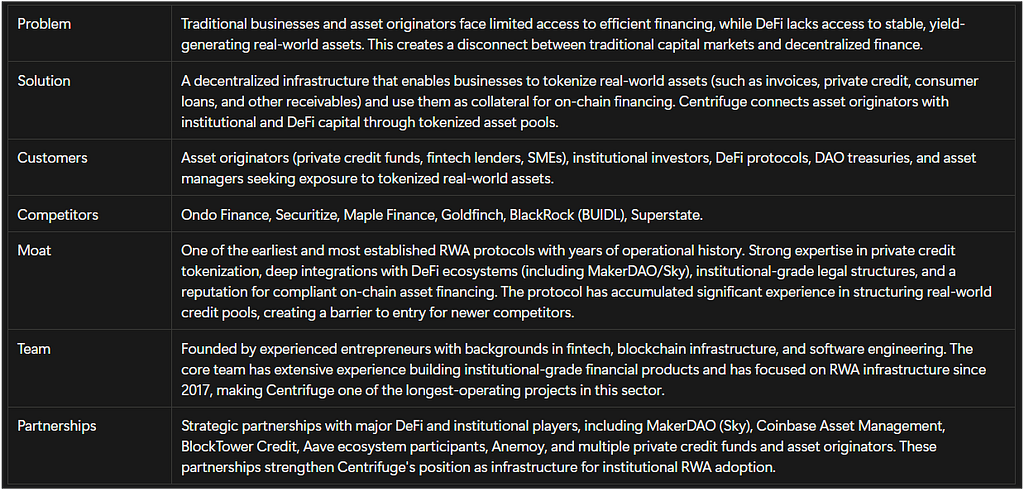
Solana can no longer be considered just a layer 1 blockchain. In recent years, it has been transforming into a financial infrastructure capable of serving both crypto-native applications and institutional solutions in the field of tokenization of real assets. It is this transformation that is the main investment thesis of the project.
Solana’s greatest competitive advantage remains network effects. The large number of users, developers, DeFi protocols and liquidity creates barriers for competitors that are difficult to replicate with similar technological characteristics.
At the same time, Solana’s success increasingly depends not on technology, but on its ability to become a standard for new financial infrastructure. It is the scaling of RWA, stablecoins and institutional applications that determines the quality of business in the coming years..
Business rating: 9/10.
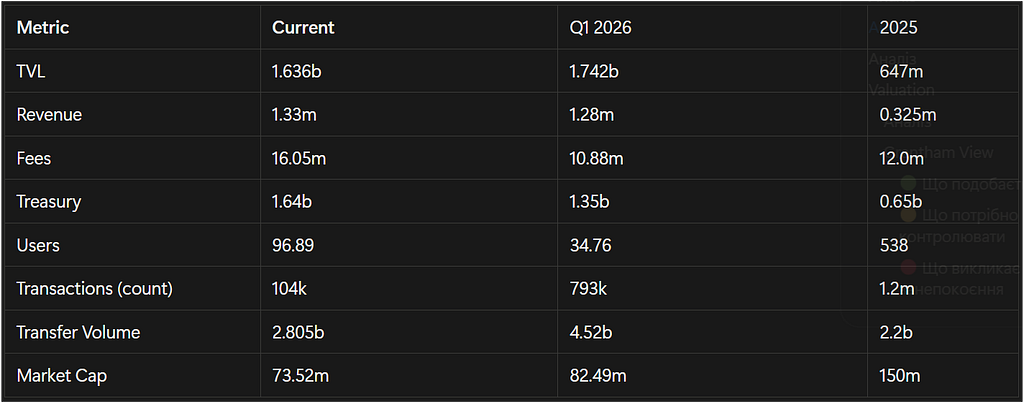
Current financials show a consolidation phase after an exceptionally strong 2025 cycle. The decline in TVL, fees, and revenues does not appear to be a structural problem, as the network continues to be among the world leaders in terms of the number of users, transactions, and transfer volume.
A particularly positive signal is the stable size of the Treasury. This provides a resource for further development of the ecosystem even in the event of a prolonged bear market.
In the next stages of analysis, it is worth assessing not the absolute values of TVL, but the efficiency of network monetization — that is, whether revenues are growing faster than economic activity.
Financial rating: 8.6/10
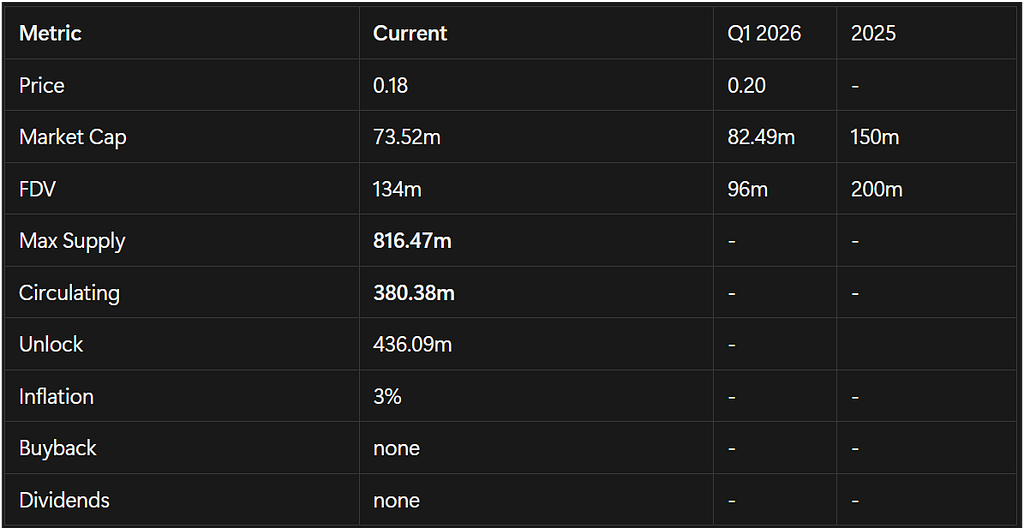
SOL remains one of the strongest utility tokens among Layer-1 networks. The demand for the token is directly related to the use of the network through the payment of fees, staking and participation in consensus.
However, from the perspective of a fundamental investor, tokenomics is not yet perfect. The main drawback remains the lack of a mechanism that would directly transfer the economic growth of the ecosystem to the token holders. In the long term, this aspect will determine how quickly the market capitalization can reflect the real growth of the business..
Tokenomics rating: 8/10
Solana’s current valuation looks much more reasonable than it did at the peak of the previous cycle. The market has already priced in some of the over-optimism, while the network’s fundamentals remain strong.
For an investor, this means that Solana today looks more like a quality business with a moderate valuation than an over-capitalized speculative asset. However, the potential for further growth will largely depend on the development of the RWA sector and institutional use of the network..
Valuation Score: 8.3/10
Solana has long ceased to be just a fast blockchain and is gradually becoming a full-fledged financial infrastructure for digital assets and tokenization of real assets. The business has strong network effects, a significant user base and one of the most active ecosystems in the crypto industry. At the same time, the current token economy does not yet fully reflect the fundamental strength of the network, and financial indicators after the peak of 2025 demonstrate a phase of normalization. For a long-term investor, Solana remains one of the highest-quality crypto assets, but its investment attractiveness will largely depend on the ability to convert the growth of the network into stable accumulation of value for SOL holders.
What is positive (✅):
Main concerns (🔴):
Yes.
If Solana were a private company, it would be one of the highest-quality infrastructure businesses in the digital economy. It has strong network effects, one of the largest developer communities, high user activity, and is gradually becoming a platform for tokenizing real assets, stablecoins, and institutional financial applications. The combination of scalable technology, low costs, and a broad ecosystem creates high barriers to competition and provides long-term growth potential.
Yes, but with some caveats.
SOL is one of the strongest tokens among Layer-1 networks due to its fundamental role in the ecosystem: it is used to pay fees, staking, and ensure network security. After a significant correction, the market valuation has become more justified relative to fundamental indicators.
At the same time, the main drawback remains the mechanism of value accumulation. The value of the token today depends mainly on the growth of network usage and market demand, and not on the direct distribution of economic results among SOL holders. This makes the investment thesis less predictable compared to businesses where shareholders directly receive a part of the value created.
Solana’s transition to A+ requires the fulfillment of several key conditions:
Solana’s RWA Revolution: Why Wall Street Is Moving On-Chain was originally published in Coinmonks on Medium, where people are continuing the conversation by highlighting and responding to this story.





