Germany's Federal Ministry of Finance has sent its draft bill on the taxation of crypto assets into interdepartmental consultation. For the first time the paper states what the plan is meant to raise: 160 million euros from 2028, rising to around 350 million euros a year by 2031. On the morning of the same day, Finance Minister Lars Klingbeil presented a budget to the Bundestag with 555.4 billion euros in spending and 118.7 billion euros in new borrowing. Put the two figures side by side and you have the real news in this draft.
We covered the substance of the draft when the cutoff date became known: as the draft stands, crypto assets acquired up to December 31, 2026 stay under today's rules with a one-year holding period. The details are in our article on the cutoff date and grandfathering. This piece takes on the number that has been added since, and places it in the budget it is meant to serve.
| Item | Draft bill of the Federal Ministry of Finance |
|---|---|
| Taxation | investment income, flat withholding tax of 25 percent plus solidarity surcharge |
| Cutoff date | acquisition after December 31, 2026 |
| Existing holdings | no retroactive inclusion |
| Entry into force | January 1, 2027 |
| Tax withheld at source | from January 1, 2028 |
| Loss offsetting | possible against shares and other securities |
| Favourability check | yes, where the personal tax rate is below 25 percent |
| Exempt amount | saver's allowance of 1,000 euros |
| Staking and lending | treated as investment income |
| Expected revenue | 160 million euros from 2028, around 350 million euros by 2031 |
The explanatory memorandum says crypto assets “increasingly represent a possible form of private capital investment and are acquired and disposed of on a growing market”. Ministry sources describe the intention like this: it is unfair for earned income and capital income to be taxed while gains on crypto assets remain largely untaxed.
On five points this draft is markedly friendlier to investors than the bill the Bundestag voted on in May. The cutoff date lies in the future, not in the past. The rate is 25 percent instead of up to 45 percent. Losses can be offset against securities instead of silting up in a pot of their own. There is a favourability check. And an allowance takes the place of the former exemption limit. That belongs in a sober assessment before anyone looks at the number.
The 2027 federal budget provides for spending of 555.4 billion euros. Net borrowing in the core budget is 118.7 billion euros, of which 33.4 billion comes from the regular debt rule and 85.4 billion from the carve-out for defence and security. Add the special funds and new borrowing reaches 203.7 billion euros.
From this the comparison of scale can be recalculated, and the arithmetic belongs with it so that the figure stays verifiable:
Anyone who takes total borrowing of 203.7 billion euros as the basis instead of the core budget arrives at around seven hours. We deliberately calculate with the lower figure, because it presents the plan more favourably and the statement still holds.
The crypto tax is part of an action plan against tax fraud and undeclared money that is meant to raise around one billion euros in total. At 160 million euros, the crypto share is the smaller part of it.
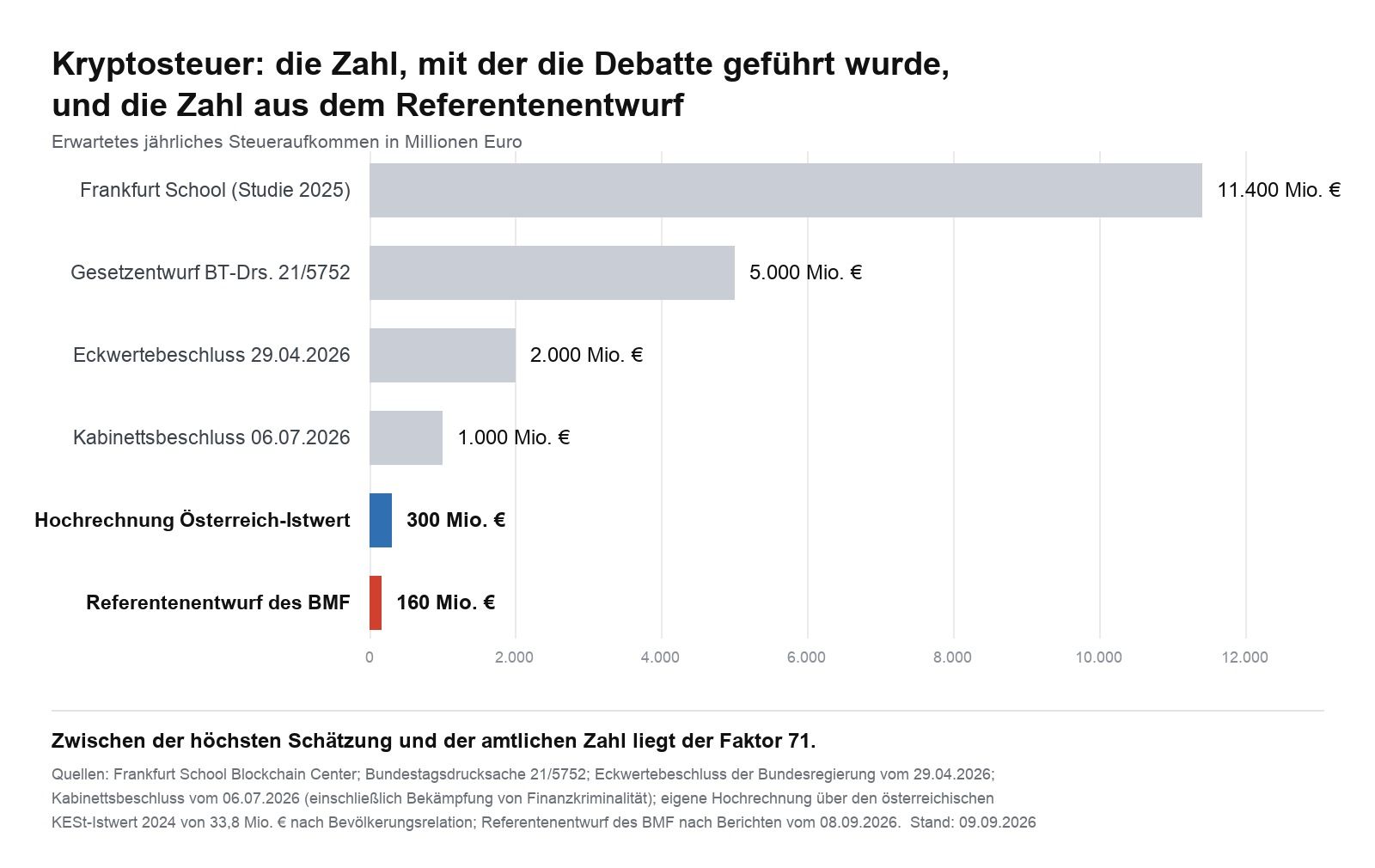
The debate about abolishing the holding period has been conducted since the spring of 2026 with figures many times higher. The trail can be traced without a gap:
| Date | Source | Expected revenue |
|---|---|---|
| 2025 | Frankfurt School Blockchain Center | up to 11.4 billion euros |
| May 5, 2026 | bill, Bundestag printed paper 21/5752 | at least 5 billion euros |
| April 29, 2026 | benchmark decision of the federal government | 2 billion euros |
| July 6, 2026 | cabinet decision, including financial crime | 1 billion euros |
| September 8, 2026 | draft bill of the Federal Ministry of Finance | 160 million euros |
Between the highest figure and the official one lies a factor of 71. That is no nuance within an estimate; it is the difference between a budget item and a rounding error.
All of this was open to verification early on. Austria abolished the holding period back in 2022 and is the only real-world test in Europe. There, service providers remitted 33.8 million euros of capital gains tax on cryptocurrencies in 2024. Scale that value up to Germany by population and you land at around 300 million euros. We published that extrapolation on August 12, 2026, four weeks before the draft appeared; it can be read in the statement on the reply from the Finance Committee. The Federal Ministry of Finance is today in the same order of magnitude, while the figures used politically were off by a factor of six to seventy.
The Bitcoin Bundesverband put fifteen questions on methodology to the estimate of 11.4 billion euros, among them the origin of the data, the representativeness of the sample and the missing margins of error. They remain unanswered to this day.
In his introductory speech Klingbeil defended the new borrowing as investment, named infrastructure, hospitals and schools, and announced a relief package of ten billion euros that is to be financed by higher taxation of very high incomes. The balanced budget, he said, had become “a fetish” in a period of low interest rates.
Crypto assets, bitcoin, the holding period and Section 23 of the Income Tax Act did not appear in the speech. Nor does the crypto tax appear as a separate item in the 2027 budget. Both are explicable and are no contradiction: under the draft the revenue is not due to flow before 2028, which puts it outside the budget year the Bundestag is currently debating. Reading concealment into that overstates the case. The timing remains striking. The draft went into consultation on the day the minister spoke about the budget it is supposed to contribute to.

The stated intention is to tax speculation. For short-term investors the chosen model achieves the opposite. Anyone who sells crypto assets within a year today pays their personal income tax rate of up to 45 percent plus the solidarity surcharge. Under the draft, the same investor will in future pay a flat 25 percent. Olav Gutting, a member of parliament for the CDU/CSU, had already worked that effect out on July 31, 2026.
The reform therefore relieves short-term trading and burdens long-term holding, which is tax-free after one year today. On a gain of 100,000 euros after more than a year of holding, the effect can be quantified: 0 euros of tax today, 26,375 euros including the solidarity surcharge under the draft.
For holdings acquired up to December 31, 2026, nothing changes as the draft stands. They remain within today's system: hold for a year, then sell tax-free. That also applies to a purchase in December 2026 whose one-year period does not run out until December 2027. What counts is the day of acquisition, not the date of the sale and not the calendar year.
From this follows an incentive to bring planned purchases forward into the fourth quarter of 2026. Three things belong with that consideration:
On the market effect, about which a great deal is being written just now, a sober assessment: a pull-forward effect is plausible, and its size is limited. On the Frankfurt School's estimate, around seven million German investors hold crypto assets worth some 400 billion euros. Even if a high single-digit billion sum were additionally invested in the closing months of the year, it would spread across a global trading volume that runs into tens of billions of US dollars a day in bitcoin alone. Deriving a price forecast from that sells a supposition as a calculation.
The draft bill is the working version produced by a specialist unit. Ahead of it lie the interdepartmental consultation, the hearing of the associations, the cabinet decision, the three readings in the Bundestag and the consideration by the Bundesrat. At each of these stages the tax rate, the cutoff date and the transitional rules can still be changed.
In parallel, Bundestag petition 201716 is running. It reached the quorum of 30,000 signatures within 48 hours in August and is therefore entitled to a public hearing in the Petitions Committee. The signing period runs until September 15, 2026. We have set out where the procedure stands in a separate article.
No. Today's legal position is unchanged: gains from a sale of privately held assets are taxable where less than a year lies between acquisition and sale. Once a year has passed they remain tax-free.
As the draft stands, yes, because the acquisition falls before the cutoff date. That is not legally binding as long as no law has been passed.
Every single execution is an acquisition in its own right with a date of its own. Instalments up to December 31, 2026 would fall under the old rule, instalments from January 2027 under the new one.
The law is intended to enter into force on January 1, 2027, but it covers only assets acquired from that date. The automatic deduction of tax by the service providers is not due to begin before January 1, 2028.
On the estimate in the draft bill, 160 million euros from 2028 and around 350 million euros a year by 2031.
(As of September 9, 2026. This article is not investment advice. Prices and fee structures change; check the terms with the provider before you buy.)





