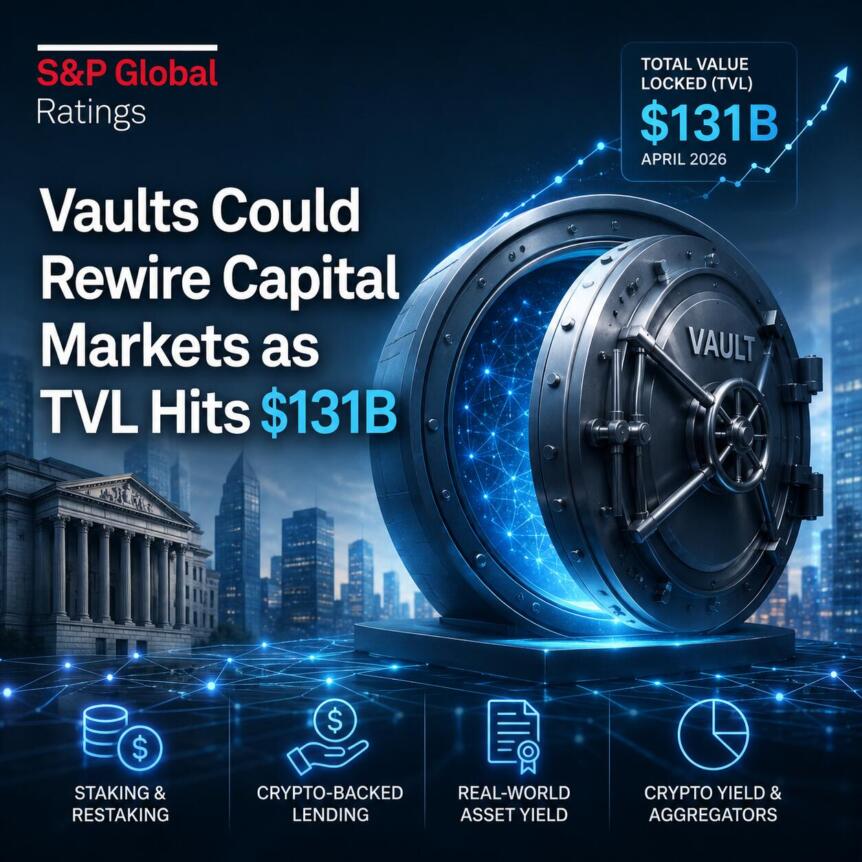
S&P Global Ratings released a primer this week examining the role of digital asset “vaults”—on‑chain pooled investment vehicles that issue share tokens and deploy capital according to a defined strategy. The report highlights rapid expansion in deposits and says vaults could migrate beyond crypto-native uses to handle tokenized real‑world assets (RWAs) and functions traditionally performed by funds and intermediaries. At the same time, S&P warns that leverage mechanics, uneven disclosure practices, technical failure modes and regulatory ambiguity could constrain their path to wider institutional adoption.
Vaults aggregate deposits and allocate them across strategies via smart contracts, or a hybrid of automated code and discretionary manager decisions. Investors receive tokenised shares that represent a proportional claim on the pooled assets and any returns. That structure makes vaults a different primitive from direct asset ownership: they can implement dynamic, multi‑asset strategies, reallocate automatically and integrate with other protocols.
Market metrics cited by S&P show the space has expanded sharply: total deposits in vaults rose to about US$131 billion as of April 2026, from roughly US$24 billion in April 2023. But the firm notes that approximately 94% of current activity is concentrated in crypto‑native strategies such as staking, crypto‑backed lending and yield aggregation.
S&P argues vaults could eventually support a wide range of financial functions traditionally carried out by private credit funds, money market vehicles, hedge funds and more. The combination of automation, composability and secondary‑market liquidity turns pooled on‑chain assets into reusable building blocks: vault shares can be traded, posted as collateral, or blended into composite strategies.
The report also points to a potential bridge to much larger markets. For example, tokens representing treasury or repo‑like instruments could be used as collateral on‑chain; because global repo turnover is many times the market capitalization of crypto assets, even modest uptake could materially increase vault activity.
Leverage and looping. Vault architectures and composability enable recursive reuse of collateral. Borrowed funds can be redeployed as collateral to generate additional exposure, a practice S&P calls “looping.” Looping can occur at the depositor level—similar to margin—or at the vault level, where curators’ actions raise leverage for all depositors. That amplifies returns in good times and can accelerate deleveraging and cascading liquidations during stress.
Technical failure modes. Reliance on smart contracts, external oracles and protocol integrations introduces risks not seen in traditional funds. Code bugs, oracle failures or integration errors can produce direct losses or disrupt settlement and rebalancing processes.
Disclosure and transparency gaps. While on‑chain transactions are visible, S&P notes that raw blockchain data is often hard to interpret and does not substitute for structured disclosures. Many vaults focus on headline yield figures and provide limited, non‑standardised information on mandate, allocation limits, leverage practices and governance. Where disclosures exist, mechanisms such as “time locks”—typically several days for concentration changes—are used to give depositors exit windows, but monitoring these changes can be resource intensive.
Regulatory ambiguity. Uncertainty over whether vault tokens constitute securities or other regulated instruments is a major constraint on institutional participation. Vault shares can represent tokenised ownership of RWAs or resemble investment contracts under legal tests used by regulators. Without clearer cross‑jurisdictional frameworks, many institutions remain cautious.
S&P observes early consolidation among vault curators and infrastructure providers. On one relatively mature platform, Morpho, two curators accounted for roughly 77% of deposits as of April 2026. The ratings firm expects further concentration as operators scale, risk and disclosure standards rise, and traditional finance entrants and established market makers expand their presence. Names mentioned as active or interested participants in the market include Apollo, Wintermute and Bitwise—signalling growing crossover between legacy asset managers, trading firms and crypto infrastructure players.
The primer’s central contention is that vaults have technical and economic features that could make them useful building blocks for tokenised capital markets, but that a series of market‑level changes is likely required before large institutional flows arrive. Those include clearer regulatory guidance, more standardised disclosures and independent operational controls—custody, audited smart contracts, resilient oracles and third‑party risk engines. Without those, S&P warns, vaults risk remaining a predominantly crypto‑native toolkit rather than forming the plumbing for broader financial markets.
For market participants and policymakers, S&P’s analysis provides a roadmap of trade‑offs: vaults can improve capital efficiency and liquidity, but the same composability that delivers benefits also increases interconnectedness and systemic risk. How participants, platforms and regulators respond will determine whether vaults evolve into core market infrastructure or remain an increasingly sophisticated corner of the crypto ecosystem.
This article was originally published as S&P: Vaults Could Rewire Capital Markets as TVL Hits $131B on Crypto Breaking News – your trusted source for crypto news, Bitcoin news, and blockchain updates.





