Hedera (HBAR) remains one of the most discussed enterprise-focused cryptocurrencies in the market. Investors continue to watch its progress closely because the project aims to provide fast, low-cost, and scalable distributed ledger technology for businesses, developers, and institutions. As a result, many market participants want to understand where the HBAR price could move in the coming years.
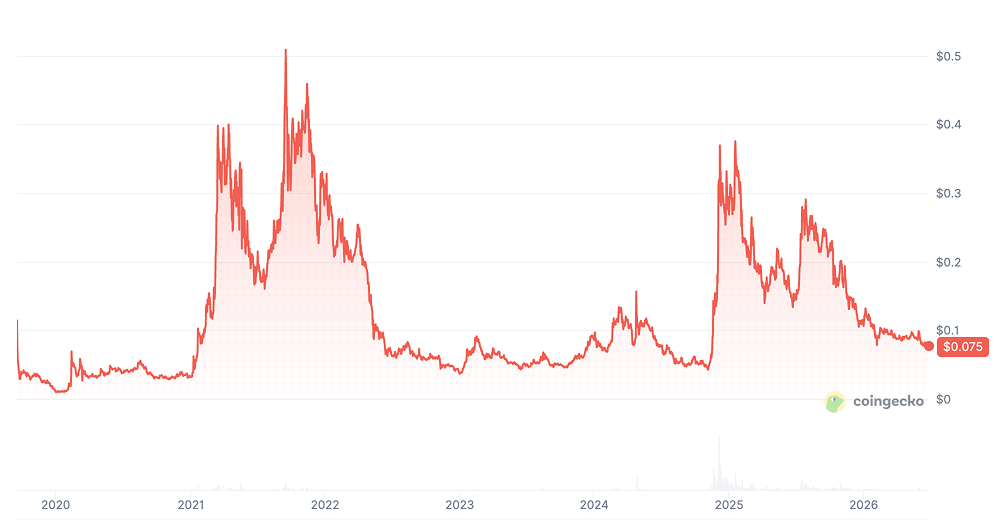
CoinGecko, June 24, 2026
In this Hedera HBAR price prediction guide, we explore potential price scenarios for 2026, 2027, and 2030. We examine both bullish and bearish outcomes, while also considering more balanced forecasts based on realistic market conditions. Although no prediction can guarantee future performance, analyzing possible scenarios can help investors make more informed decisions. Read on to discover the key factors that could influence HBAR’s long-term value and what analysts may expect from this ambitious blockchain alternative.
| Current HBAR Price | HBAR Price Prediction 2026 | HBAR Price Prediction 2030 |
| $0.075 | $0.18 | $0.31 |
Hedera (HBAR) is currently trading around $0.075 per token, with a market capitalization close to $3.3 billion and a daily trading volume ranging between $50 million and $100 million. These figures place HBAR among the top 30 cryptocurrencies by market value. The network has approximately 43.5 billion HBAR in circulation out of a fixed maximum supply of 50 billion tokens.
| Metric | Current Value |
| HBAR Price | ~$0.075 |
| Market Cap | ~$3.3B |
| 24H Volume | $50M-$100M |
| Circulating Supply | ~43,473,263,318 HBAR |
| Total Supply | 50,000,000,000 HBAR |
| Market Cap Rank | Top 25 |
Despite remaining far below its 2021 all-time high of $0.57, HBAR continues to attract attention because of its strong enterprise focus and growing ecosystem. Investors follow Hedera closely since its long-term success depends on real-world adoption by businesses, governments, and developers.
Hedera is a public distributed ledger network that uses a technology called Hashgraph instead of a traditional blockchain. While most cryptocurrencies process transactions by adding blocks to a chain, Hedera uses a different structure that allows the network to reach consensus faster and more efficiently.
One of Hedera’s key innovations is its asynchronous Byzantine Fault Tolerance (aBFT) security model. This mechanism helps the network remain secure even if some participants act maliciously or experience technical failures. As a result, Hedera delivers high performance while maintaining strong security standards.
The network can process more than 10,000 transactions per second (TPS) and usually reaches transaction finality in 3 to 5 seconds. These capabilities make it suitable for payments, tokenization, supply chain solutions, gaming, and enterprise applications.
HBAR serves several important functions within the ecosystem. Users pay transaction fees with HBAR, developers use it to power smart contracts, and token holders can stake their coins to help secure the network and earn rewards. Hedera is also governed by a council of major global organizations, which helps support network development and long-term stability.
Several factors can influence the HBAR price between 2026 and 2030. The most important one is real network adoption. Hedera already processes large transaction volumes, and recent public data shows more than 71 billion total transactions on the network. However, daily activity can change quickly, so investors should track real TPS, total transactions, DeFi volume, and active dApps instead of relying on old peak numbers.
Hedera’s roadmap also matters. Current development focuses on better EVM compatibility, sponsored fees, Hiero Hooks, TSS signatures, Block Nodes, state proofs, and Block Streams. These upgrades can make Hedera easier to use for developers, enterprises, and applications that need reliable audit trails. If these upgrades increase real usage, HBAR demand may improve over time.
Tokenomics also play a major role. HBAR has a fixed total supply of 50 billion tokens. Hedera’s treasury report shows that most tokens have already entered released supply, with the adjusted released supply forecasted at about 94.56% by Q2 2026. This means the supply overhang should become smaller after 2026, although future treasury releases can still affect market pressure.
Hedera also competes with major Layer 1 networks. Its main advantage is predictable fees, enterprise governance, and fast settlement. Its main weakness is smaller DeFi liquidity and fewer dApps compared with Ethereum and Solana.
| Network | Main Strength | Main Weakness |
| Hedera | Fast finality, low predictable fees, enterprise focus | Smaller retail and DeFi ecosystem |
| Ethereum | Largest developer and DeFi ecosystem | Higher fees on mainnet |
| Solana | Strong speed, liquidity, and retail traction | History of network reliability concerns |
| Cardano | Research-driven design and loyal community | Slower ecosystem growth |
Market cycles also matter. Like most altcoins, HBAR often follows Bitcoin during major risk-on and risk-off phases. When Bitcoin rises and liquidity returns to crypto, utility altcoins can attract more capital. However, when Bitcoin falls, HBAR can also drop sharply, even if Hedera’s fundamentals continue to improve.
| Year | Minimum Price | Maximum Price | Average Price | Price Change |
| 2026 | $0.0708 | $0.2964 | $0.1836 | +145% |
| 2027 | $0.0822 | $0.2095 | $0.1458 | +95% |
| 2030 | $0.0981 | $0.5249 | $0.3115 | +635% |
HBAR price predictions for 2026 show a wide gap between conservative and bullish models. According to DigitalCoinPrice, Hedera may trade in a relatively narrow range between $0.0711 and $0.0984 during the second half of 2026. This forecast suggests limited upside and a slow recovery pattern rather than a strong breakout.
PricePrediction.net gives a much more optimistic outlook. Its 2026 forecast places HBAR between $0.0708 and $0.2964, with the highest projected value appearing in December. This model assumes stronger market momentum, better investor sentiment, and higher demand for utility-focused altcoins.
| Source | 2026 Minimum Price | 2026 Maximum Price | General Outlook |
| DigitalCoinPrice | $0.0711 | $0.0984 | Conservative |
| PricePrediction.net | $0.0708 | $0.2964 | Bullish |
A balanced 2026 scenario sits between these two forecasts. If Hedera grows steadily but avoids a major speculative rally, HBAR could trade around the $0.1–$0.18 range. However, if the broader crypto market enters a strong bull phase, HBAR may attempt to move closer to the higher PricePrediction.net targets.
Forecasts for 2027 suggest that Hedera could enter a consolidation phase after any potential gains achieved in 2026. DigitalCoinPrice remains relatively conservative, projecting HBAR between $0.0866 and $0.10 throughout the year. This outlook implies stable network growth but limited speculative interest, keeping prices close to current levels.
PricePrediction.net presents a more optimistic scenario. Its projections place HBAR between $0.0822 and $0.2095 during 2027, with the strongest prices expected early in the year. While this model still anticipates periods of weakness, it suggests that Hedera could maintain significantly higher valuations if enterprise adoption and ecosystem activity continue to expand.
| Source | 2027 Minimum Price | 2027 Maximum Price | General Outlook |
| DigitalCoinPrice | $0.0866 | $0.1 | Conservative |
| PricePrediction.net | $0.0822 | $0.2095 | Moderate Bullish |
A realistic middle-ground scenario places HBAR between $0.09 and $0.15 for most of 2027. This range would reflect gradual adoption growth, increasing transaction activity, and a more mature crypto market environment. However, if institutional interest accelerates and Hedera secures additional enterprise partnerships, HBAR could challenge the upper PricePrediction.net targets near $0.2. Conversely, weaker market sentiment could keep the token trading closer to the conservative DigitalCoinPrice estimates.
The 2030 Hedera price prediction shows an even stronger difference between the two sources. DigitalCoinPrice remains cautious and expects HBAR to trade between $0.0981 and $0.12 in 2030. This forecast suggests that Hedera may grow slowly, even if the project continues to develop its enterprise ecosystem.
PricePrediction.net presents a far more bullish long-term view. Its 2030 forecast places HBAR between $0.2302 and $0.5249. The highest estimate appears in January 2030, while the forecast trends lower toward the end of the year. Even so, this model still suggests much higher upside than DigitalCoinPrice.
| Source | 2030 Minimum Price | 2030 Maximum Price | General Outlook |
| DigitalCoinPrice | $0.0981 | $0.12 | Conservative |
| PricePrediction.net | $0.2302 | $0.5249 | Bullish |
A realistic 2030 scenario may sit near the middle of these projections. If Hedera expands its enterprise use cases, keeps developer activity alive, and benefits from stronger crypto market cycles, HBAR could move toward $0.2–$0.35. However, if adoption remains slow or the altcoin market weakens, the price may stay closer to the DigitalCoinPrice range.
HBAR offers significant upside potential, but investors should understand the risks before investing. Like most cryptocurrencies, Hedera has experienced extreme volatility throughout its history. During previous crypto bear markets, many major altcoins, including HBAR, suffered 50% to 80% drawdowns from their cycle highs.
Although Hedera has maintained a strong security record, technology risks still exist. Software bugs, unexpected network issues, or vulnerabilities in smart contracts could affect user confidence and adoption. Regulatory uncertainty also remains a concern. Future SEC enforcement actions or a potential classification of certain crypto assets as securities could impact market sentiment and exchange availability.
Competition presents another challenge. If Ethereum scaling solutions continue improving and attracting developers, Hedera may struggle to expand its market share. For risk management, many investors limit HBAR exposure to roughly 5% to 15% of their total crypto portfolio, helping balance potential rewards with the risks associated with a single blockchain project.
HBAR is available on many major cryptocurrency exchanges, including Binance, Coinbase, Kraken, KuCoin, and Bitfinex. These platforms allow users to buy Hedera using bank transfers, debit cards, credit cards, or other cryptocurrencies. However, most centralized exchanges require account registration and identity verification before trading.
Another popular option is StealthEX. The platform allows users to exchange cryptocurrencies directly from one wallet to another without creating an account. StealthEX supports more than 2,000 digital assets, offers competitive exchange rates, and usually completes transactions within minutes.
Step 1: Visit StealthEX.io and select the cryptocurrency you want to exchange. Then choose HBAR as the coin you want to receive.
Step 2: Enter the amount you would like to swap.
Step 3: Provide your Hedera wallet address.
Step 4: Review the exchange details and click the confirmation button.
Step 5: Send the requested cryptocurrency to the deposit address generated by StealthEX and wait for the transaction to be processed to receive HBAR directly in your wallet.

Before purchasing HBAR, it is important to choose a secure crypto wallet. Popular Hedera wallets include HashPack and Blade Wallet, both of which offer full support for the Hedera ecosystem. Long-term investors often prefer hardware wallets such as Ledger, which provide an additional layer of security by storing private keys offline. Regardless of the wallet you choose, always back up your recovery phrase and never share it with anyone.
HBAR reaching $1 is possible, but it would require significantly higher adoption, stronger market conditions, and a much larger market capitalization. Most realistic forecasts place this target in a long-term bullish scenario rather than the near future.
A $5 HBAR price would imply a market capitalization of roughly $250 billion based on the fixed supply of 50 billion tokens. While not impossible, the probability appears very low for the current market cycle. A more realistic cycle peak could fall within the $0.5-$1.5 range.
HBAR at $10 would require a market capitalization of approximately $500 billion, placing it near the largest crypto assets in history. Such a valuation would require extraordinary adoption and market dominance, making it unlikely in the foreseeable future.
HBAR reaching $100 is not mathematically impossible, but it would require a market capitalization of around $5 trillion. This exceeds the size of most realistic crypto market forecasts and should not be considered a practical investment scenario.
A realistic long-term outlook depends on adoption and market conditions. Near-term targets may range from $0.15 to $0.4, while successful execution over several years could potentially support prices between $0.8 and $2.
If crypto market sentiment improves and capital flows back into utility-focused altcoins, HBAR could potentially trade between $0.4 and $1.2 during a strong bull market. However, results will depend heavily on Bitcoin and overall liquidity.
Long-term forecasts carry substantial uncertainty. If Hedera continues expanding its ecosystem and enterprise adoption, some speculative scenarios suggest a potential range of $1-$2.5 by 2035 and $3-$10 by 2040.
Predicting exact timing is impossible. Historically, major HBAR rallies have followed broader crypto bull markets, major enterprise partnerships, ecosystem growth, and increased investor interest across the altcoin sector.
HBAR may appeal to investors seeking exposure to enterprise blockchain technology. However, it remains a high-risk asset. Investors should conduct their own research and only allocate capital they can afford to lose.
Follow us on Medium, X, Telegram, YouTube, and Publish0x to stay updated about the latest news on StealthEX.io and the rest of the crypto world.
Don’t forget to do your own research before buying any crypto. The views and opinions expressed in this article are solely those of the author.
crypto price prediction HBAR Hedera Hashgraph price analysis price prediction




