For decades, bank branches were the backbone of financial services. They symbolized trust, stability, and accessibility, places where people deposited paychecks, applied for loans, and built relationships with bankers. But today, that model is quietly fading.
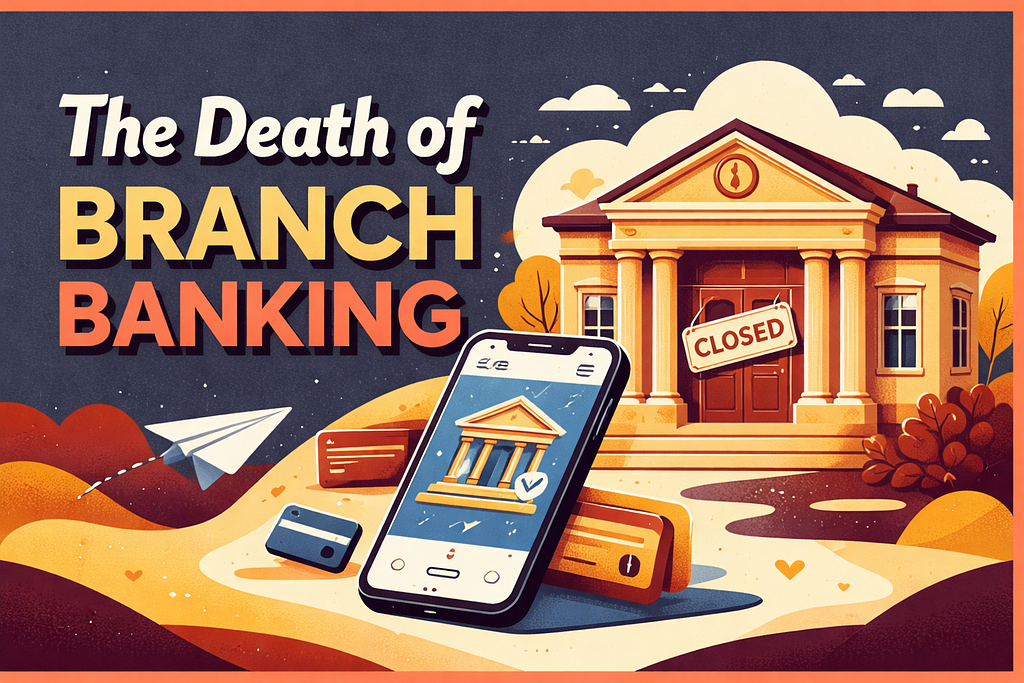
The decline of branch banking isn’t sudden, it’s structural. Driven by technology, changing consumer behavior, and cost pressures, physical branches are no longer the center of banking. Instead, they’re becoming optional.
We’re witnessing not just a decline, but a transformation.
There was a time when opening a bank account required standing in line, filling out forms, and interacting with a branch officer. Complex financial services, like mortgages or business loans, were entirely branch-dependent.
But over the last decade, three major shifts disrupted this model:
Branches didn’t become obsolete overnight but they stopped being necessary.
Modern consumers don’t hate bank branches, they just don’t need them anymore.
Today’s users prioritize speed, convenience, and control. Waiting in line or scheduling appointments feels outdated when everything else in life is instant.
Here’s what customers now expect:
The result? Branch visits are declining globally, especially among younger demographics.
Maintaining a physical branch network is expensive:
For banks, this creates a harsh reality: declining foot traffic but rising costs.
Digital channels, on the other hand, offer:
This cost imbalance is one of the biggest reasons banks are shutting down branches.
Fintech companies didn’t just compete with banks, they changed expectations.
Neobanks and digital-first platforms removed the need for physical presence entirely. They built systems where everything from onboarding to lending, happens digitally.
Key advantages of these players include:
Traditional banks, burdened by legacy systems, struggled to match this speed.
While the number of branches is declining, they’re not disappearing completely. Instead, their role is changing.
Branches are shifting from transaction centers to experience centers.
The new branch model focuses on:
In this sense, branches are becoming more like consulting hubs than service counters.
The decline of branch banking raises an important question: what happens to those who still rely on physical access?
Not everyone is ready for fully digital banking.
Challenges include:
For these segments, branches still play a critical role.
Banks and regulators must balance innovation with inclusion by:
The future cannot be digital-only, it must be digitally inclusive.
If branches are fading, what replaces them?
The answer is not a single technology but an ecosystem.
Modern banking infrastructure now includes:
These systems collectively perform the functions once handled by physical branches, only faster, cheaper, and at scale.
One of the most profound changes is psychological.
Traditionally, trust in banking came from physical presence, buildings, counters, and human interaction. Today, trust is built through:
Customers no longer need to “see” a bank to trust it.
This shift is subtle but powerful and it’s irreversible.
While the decline of branch banking was already underway, global events accelerated it dramatically.
During the pandemic:
What might have taken 5–10 years happened in under two.
And once customers experienced digital convenience, there was no going back.
The death of traditional branch banking doesn’t mean the death of banks but it does demand reinvention.
To stay relevant, banks must:
The winners will not be those with the most branches but those with the best experiences.
Even in a digital world, banking is ultimately about trust and trust is human.
Technology can handle transactions, but it cannot fully replace:
The challenge for banks is not to eliminate the human element, but to integrate it into digital experiences.
This could mean:
The future is not human vs machine, it’s human plus machine.
Looking ahead, the concept of a “branch” may become entirely abstract.
Instead of physical locations, banking will exist as:
You won’t “go to the bank.”
The bank will come to you, wherever you are.
The death of branch banking is not a collapse, it’s an evolution.
What’s disappearing is not banking itself, but an outdated delivery model.
In its place, we’re seeing:
But also new responsibilities:
The future of banking won’t be defined by buildings on street corners but by intelligent systems in our pockets.
And in that future, the “branch” isn’t a place.
It’s an experience.
The Death of Branch Banking was originally published in Coinmonks on Medium, where people are continuing the conversation by highlighting and responding to this story.





