Few subjects are started the wrong way as often as trading. The typical route looks like this: open an account with a broker, deposit three hundred euros, watch a handful of videos and begin. Two weeks later the money is gone, and the only lesson that sticks is frustration. That first stage can be completed at no cost at all, provided it is set up properly.
Nobody is short of knowledge. What leverage is, what a stop loss does, how a short position works: all of it is explained in five minutes and understood in ten. Most beginners still fail, and what defeats them is the execution.
Trading is less a body of knowledge than a craft. Defining a stop loss is trivial. Leaving it where it is while the price runs against your position and your mind hunts for reasons to move it down “just this once” is a different matter entirely. That ability comes from repetition alone, from hundreds of decisions taken under realistic conditions.
Then there is a factor no course conveys: how you personally handle losses. After three red trades in a row, hardly anyone still makes the decisions they made that morning. Positions grow larger to make up lost ground, rules get bent to fit the situation. Recognising that pattern in yourself is the precondition for working on it.
The sequence is what decides the outcome. Build the routine first, put capital at risk afterwards, and never the other way round.
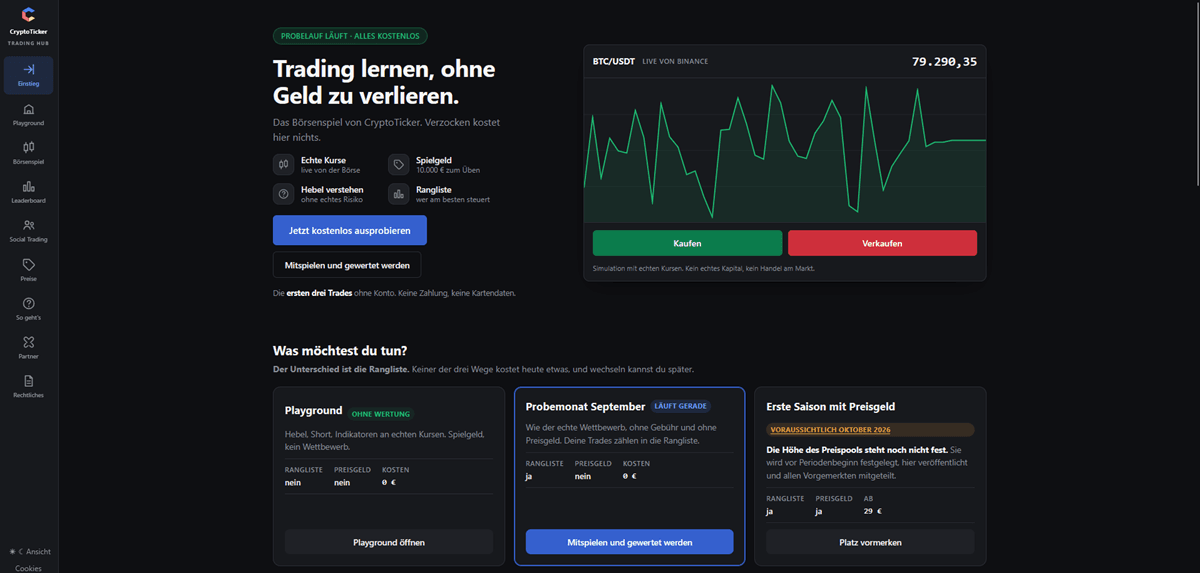
A practice account funded with virtual money solves the problem, as long as the market data behind it is genuine. Static sample charts achieve little, because they leave out the most uncomfortable part of the job: the movement that happens while you are sitting in the position.
The CryptoTicker Trading Hub is built for exactly that. You trade with virtual money, the prices come live from the exchange, and the cockpit matches what you will later find at a real broker, leverage, short positions and indicators included. Getting it wrong costs nothing beyond the insight. The first trades even work without an account, and no payment details are held on file.

The practical drawback of a demo account is the missing consequence. Without a stake there is no incentive to work cleanly; you click around, lose interest and stop.
A leaderboard supplies that incentive without exposing any capital. The Trading Hub is currently running its trial month: you can play in the Playground entirely unranked, or enter the leaderboard with scored trades. Both are free at the moment, and a competition with prize money has been announced for later seasons. Measuring yourself against others creates the seriousness that unstructured experimenting never produces.
Learning to trade online has little to do with putting real money to work as quickly as possible. It is about making the standard beginner mistakes where they cost nothing: leverage, position size and exit discipline. Practise consistently with live prices for a few weeks and you enter the real market with a routine instead of a hope.
(As of September 9, 2026. This article is not investment advice. Prices and fee structures change; check the terms with the provider before you buy.)





