Stablecoins are one of the most important building blocks in crypto, but most of them have a major limitation : they preserve value but do not generate earning on their own.
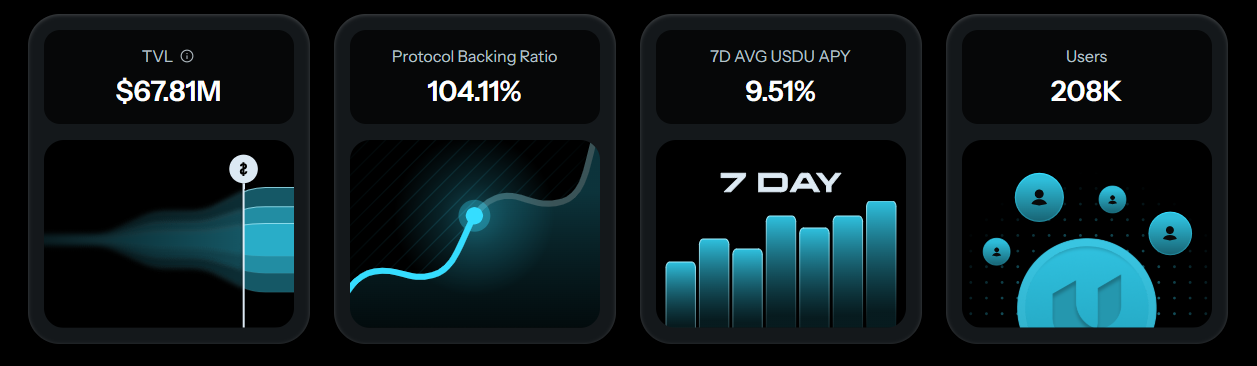
It is a yield infrastructure protocol that transforms stable digital dollars into productive capital through market-neutral strategies. At the center of the ecosystem are three core components:
USDu: a dollar-pegged stablecoin
sUSDu: a yield-bearing version of USDu
UP: the governance and ecosystem token
Instead of relying on price speculation, Unitas focuses on generating returns from structured, hedged, and market-neutral strategies.
Unitas operates by deploying capital into delta-neutral strategies, which are designed to minimize exposure to price movements while still capturing earning from market activity.
In simple terms, the protocol balances long and short positions so that price changes cancel each other out.
For example, if the protocol holds $10 million worth of an asset, it simultaneously opens a $10 million short position on a perpetual futures market. If the price goes up, the long position gains but the short loses. If the price goes down, the opposite happens. The result is a largely neutral exposure to price direction.
However, even when price risk is reduced, the system can still earn returns from other sources such as funding payments, trading activity, and liquidity incentives.
This is the foundation of Unitas’s earning model.
Unitas does not depend on a single income stream. Instead, it combines multiple market-based strategies to generate yield in different conditions.
1. Funding Rates
One of the primary sources of earning comes from perpetual futures funding rates. In many markets, traders holding long or short positions pay periodic funding fees to each other.
By maintaining a hedged position (spot + short perpetual), Unitas can capture these funding payments as part of a basis trade strategy.
2. Trading and Liquidity Fees
Another source of earning comes from providing liquidity in trading environments. When users trade, they pay fees, and liquidity providers earn a portion of those fees. These fees contribute to the overall yield generated by the protocol.
3. Lending Strategies
Unitas can also deploy capital into lending markets where assets are borrowed and interest is paid. This adds another layer of earning generation that is not directly tied to trading activity.
4. Equity Delta-Neutral Strategies
Beyond crypto markets, Unitas has expanded into equity-based delta-neutral strategies. These involve taking a long position in an equity asset while simultaneously shorting its perpetual contract.
The goal remains the same: reduce price exposure while capturing funding or structural market inefficiencies. This also helps diversify earning sources beyond crypto-native markets.
The core idea behind delta-neutral strategies is simple:
Long Spot + Short Perpetual = Reduced Price Exposure
This structure allows the protocol to remain relatively neutral to market direction.
If the price increases: the spot position gains while the short position loses
If the price decreases: the spot position loses while the short position gains
Because gains and losses offset each other, the strategy is not dependent on whether the market goes up or down.
Instead, returns come from funding rates, trading fees, and other structural inefficiencies in the market.
However, it is important to understand that delta-neutral does not mean risk-free. Risks still exist, including funding rate volatility, execution issues, liquidation risk, and counterparty dependencies.
USDu is the core stablecoin of the Unitas ecosystem.
It is designed to maintain a value close to $1 USD, making it suitable for trading, payments, DeFi usage, and liquidity provisioning.
Unlike traditional stablecoins that only store value, USDu is also integrated into the yield system of the protocol.
Users can hold USDu as a stable asset or stake it to access yield through sUSDu.
When users stake USDu, they receive sUSDu, which represents a yield-bearing version of the stablecoin.
Instead of receiving interest payments directly, the value of sUSDu increases over time relative to USDu as yield accumulates.
This means:
USDu → Stake → sUSDu → Value increases over time
The key idea is that yield is reflected in the exchange rate rather than distributed separately. As the protocol generates returns, sUSDu gradually becomes worth more USDu.
This makes it a simple “hold-to-earn” model for users who want exposure to yield without actively managing positions.
One of the most important concepts in Unitas is yield passthrough.
Yield generated from the entire collateral pool is distributed to users who have staked USDu into sUSDu.
This means the actual return depends on two main factors:
The performance of underlying strategies
The percentage of total USDu that is staked
If fewer users stake USDu, the same amount of yield is distributed across a smaller base, potentially increasing APY. If more users stake, earning is spread more broadly.
Because of this structure, returns are variable and dynamic, not fixed or guaranteed.
Although Unitas uses hedged strategies, it is not risk-free. Users should be aware of several key risks:
Funding rate risk: rates can change or turn negative
Liquidation risk: leveraged positions may require margin management
Smart contract risk: vulnerabilities in DeFi systems
Counterparty risk: reliance on exchanges or external platforms
Peg risk: USDu may temporarily deviate from $1
Strategy risk: performance of gain strategies may decline over time
Execution risk: slippage and rebalancing inefficiencies
Understanding these risks is essential before interacting with the protocol.
Unitas aims to make stable digital assets productive through delta-neutral gain strategies. With USDu, sUSDu, and UP serving stable value, yield, and governance roles, the protocol offers a different approach to onchain finance. However, returns are variable and risks remain, so users should understand the protocol before participating.
Disclaimer: This article is for informational purposes only and is not financial or investment advice. DeFi and digital assets involve risks, including market volatility, smart contract issues, liquidity risk, and potential loss of capital. Always DYOR before using any protocol or investing in digital assets.





