Hyperliquid news deployers will soon need to lock up 500,000 HYPE tokens just to launch a single prediction market. For anyone holding or trading HYPE, that kind of staking requirement could quietly reshape how much supply stays liquid. But the testnet rollout comes with penalty rules most coverage is glossing over — here's what's actually at stake.
HIP-4 Pushes Beyond Spot and Perpetuals
As per the official update and Onchain Analysis, Hyperliquid news today is preparing to expand past its existing spot and perpetual trading products with a new upgrade called HIP-4, built around what the exchange calls Outcome Markets. Instead of trading tokens or derivatives, users would trade on the results of real-world events.
The team has pointed out that the number of possible outcome-based events — economic data, sports results, political decisions, tech milestones — vastly outnumbers the total assets available across spot and perpetual contracts combined. That's the best driving this upgrade.
Testnet Comes Before Permissionless Deployment
The Hyperliquid HIP-4 testnet launch news will roll out first, before the feature opens up to permissionless, anyone-can-deploy markets on mainnet. The team says this mirrors how earlier upgrades like HIP-3 were handled — new deployment systems get validator-run testing first so the mechanics hold up before wider access is granted.
Once testnet validation wraps and documentation updates are complete, a separate announcement will confirm the mainnet timeline.
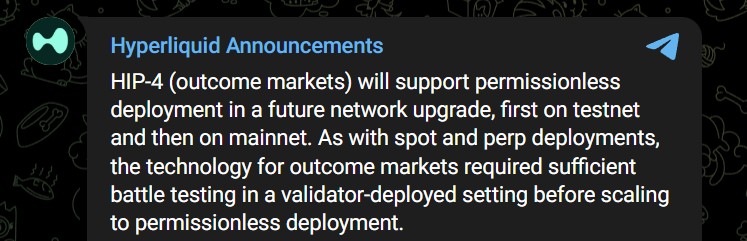
Source: Official Hyperliquid Telegram
Validators Set the Templates
Rather than letting anyone define a market from scratch, validators will vote on standardized outcome templates. These templates, enforced on-chain, will lock in the structure, settlement rules, and which outcomes qualify, aimed at keeping markets liquid and unambiguous.
Deployers Build On Approved Templates
Once a template passes the validator vote, any testnet deployer can use it to launch. Multiple deployers are allowed to instantiate the same template, and each one is individually responsible for defining and settling their own markets correctly. Validators may still deploy rare "canonical" events directly, but the Hyperliquid crypto market expects fewer than ten of those per year.
Locking HYPE to Launch a Market
Deployers must stake 500,000 HYPE tokens, locked for six months — the same lockup period used in HIP-3. To unstake early is not an option; every market the deployer opened must be fully settled first, which puts extra weight on how long-dated an outcome trade runs.
Penalties for Bad Markets
That stake isn't risk-free. Validators can vote to slash a deployer's stake if a market definition is unclear, if settlement doesn't match the template, or if a market sits unsettled for more than a week. This is the mechanism meant to keep quality high once permissionless deployment goes live.
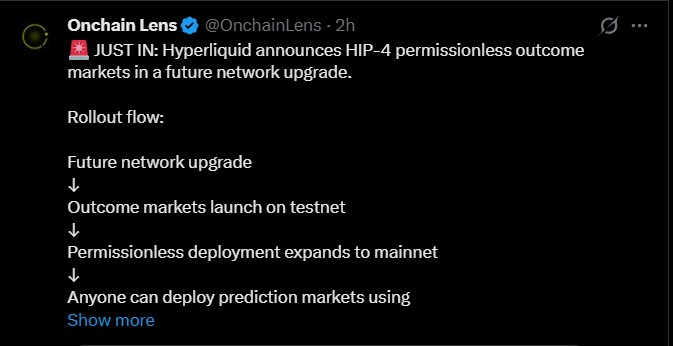
Source: Onchain Lens X
Deployers can currently claim up to 50% of the fee share generated by their markets, with fully configurable fee-sharing planned as a later feature. Each deployer starts with an allocation of 100 outcomes, equal to 200 outcome tokens; multi-outcome questions use up more of that allocation, which frees up again once an industry settles. Only AQAv2 quote tokens currently qualify for testnet.
| Feature | Spot Trading | Perpetual Contracts | HIP-4 Outcome Trading |
| Trading Asset | Tokens | Crypto derivatives | Real-world outcomes/events |
| Deployment | Existing system | Existing system | Template-based, permissionless |
| Creator Requirement | Validator approval | Validator approval | 500K HYPE stake |
| Settlement Risk | Price-based | Funding/liquidation-based | Outcome accuracy-based |
Official confirmation of the testnet launch date
The move from testnet to permissionless mainnet deployment
Which outcome templates do validators approve first?
Rollout of configurable fee-sharing
Any change in circulating HYPE supply as deployers lock stake
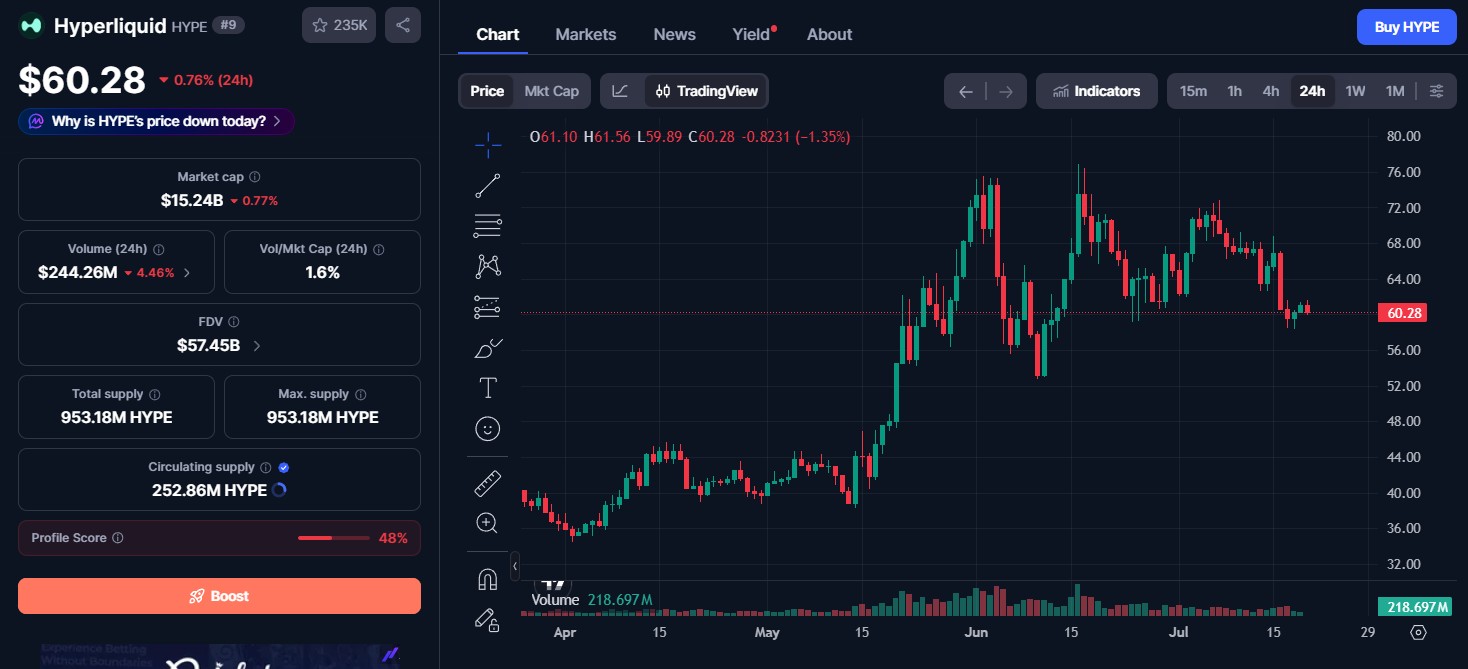
Source: CoinMarketCap Data
Poorly worded outcome definitions could trigger settlement disputes, and incorrect resolutions risk damaging user trust in the system. Prediction markets have also historically drawn extra regulatory attention in several jurisdictions, and how Hyperliquid latest update navigates that scrutiny could shape how fast outcome-based trading actually scales.
HIP-4 marks Hyperliquid prediction markets' move, starting with a testnet-first rollout ahead of permissionless deployment. Between validator-approved templates and the 500,000 HYPE staking requirement, the design leans heavily on quality control. If it works as intended, Outcome trading could become one of the bigger growth levers for the ecosystem going forward.
Disclaimer: This article is for informational purposes only and does not constitute financial, investment, or trading advice. Cryptocurrency markets are highly volatile and carry significant risk. CoinGabbar does not guarantee the accuracy of third-party statements referenced here. Readers should conduct their own research and consult a licensed financial advisor before making investment decisions.





