Hyperliquid news today isn't just about HYPE's price drop. One announcement could redefine future, while one wallet movement is dominating traders' attention today.
As Jeff Yan compares the protocol's ambitions to what AWS did for startups, millions of dollars worth of HYPE token are reportedly leaving a suspected a16z-linked wallet. Here's why these two developments may be more connected than they first appear.
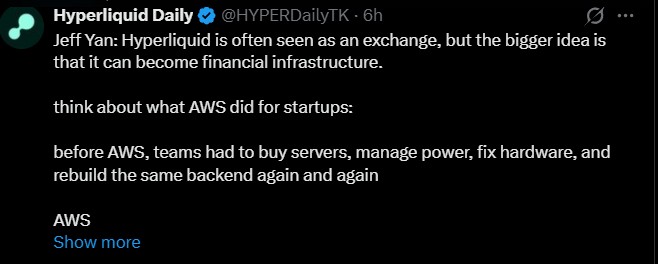
Hyperliquid founder Jeff Yan said the project should not be viewed as a single exchange. Instead, he framed Hyperliquid on-chain financial infrastructure meant to support an entire ecosystem of apps, not just perpetual futures trading.
The statement reframes how traders and builders should think about the platform. Rather than competing purely on trading volume, it is positioning itself as the base layer that other financial products plug into.
Source: Official Post
According to Yan, the strategy rests on offering shared liquidity, ledgers, deployment tools, perpetual markets, and real-world asset (RWA) tokenization as core building blocks for other applications.
Shared Liquidity Model: The idea is simple in theory: one liquidity layer that every connected wallet, app, and protocol draws from, instead of each product fragmenting its own order book.
Infrastructure for Developers: By handling deployments and ledger infrastructure, Hyperliquid wants smaller teams to build financial products without needing to construct their own backend from scratch.
RWA and Perpetual Markets: Perpetual markets remain the current core product, but RWA tokenization is positioned as the next expansion layer, extending Hyperliquid beyond crypto-native assets.
Yan's comparison to Amazon Web Services centers on one point: before AWS, startups had to buy servers and manage hardware themselves. AWS removed that burden so teams could focus purely on building products.
He argued theat protocol is attempting the same shift for finance — removing the need for every project to build liquidity, custody, and settlement systems independently.
Yan's core argument is that liquidity compounds. As more wallets, apps, and protocols connect to the same layer, the entire ecosystem benefits from deeper order books, tighter spreads, and stronger trade execution.
That network effect, if realized, could make Hyperliquid harder to displace over time — but it also depends entirely on adoption actually following the vision.
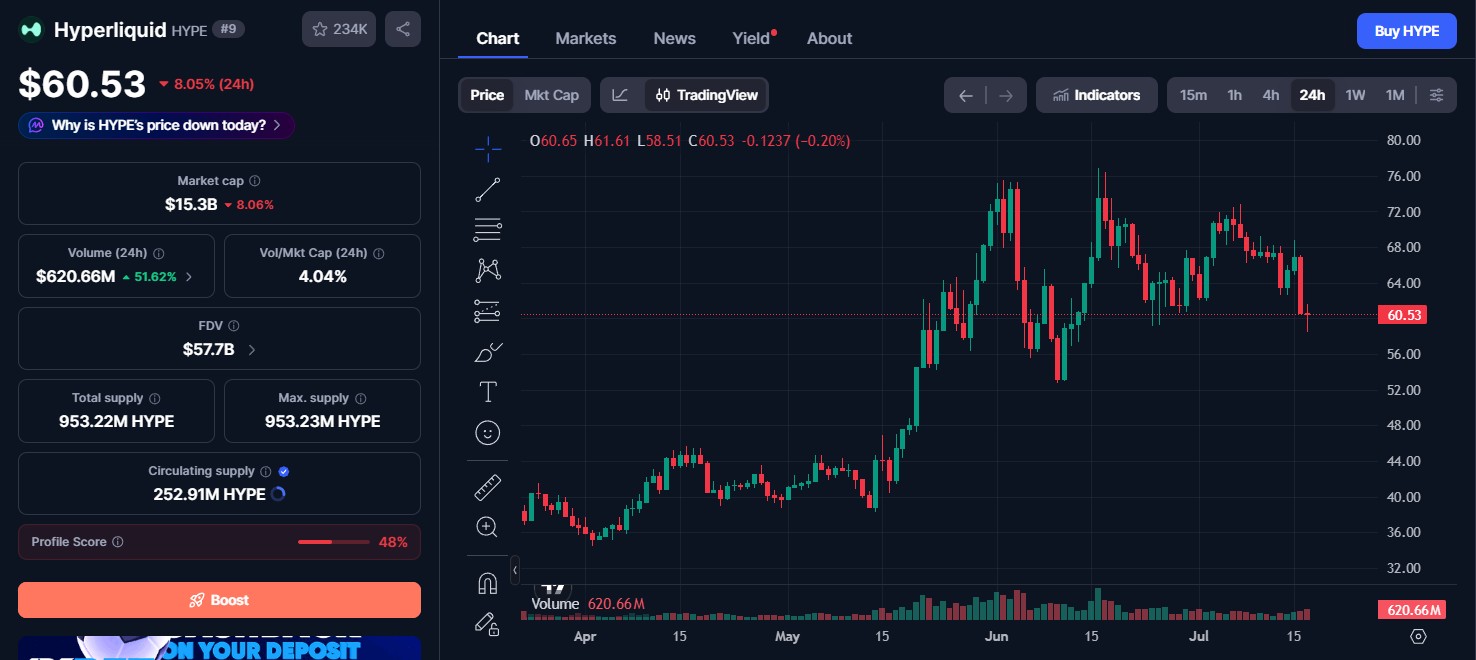
Despite the infrastructure narrative, it is not reacting positively in the short term. HYPE price today is currently trading near $60.53, down 8.05% over the past 24 hours.
The token's market cap sits at roughly $15.3 billion, while 24-hour trading volume has jumped 51.62% to about $620.66 million. Elevated volume alongside a sharp price drop typically signals heavy selling pressure rather than organic buying interest.
Source: CoinMarketCap Data
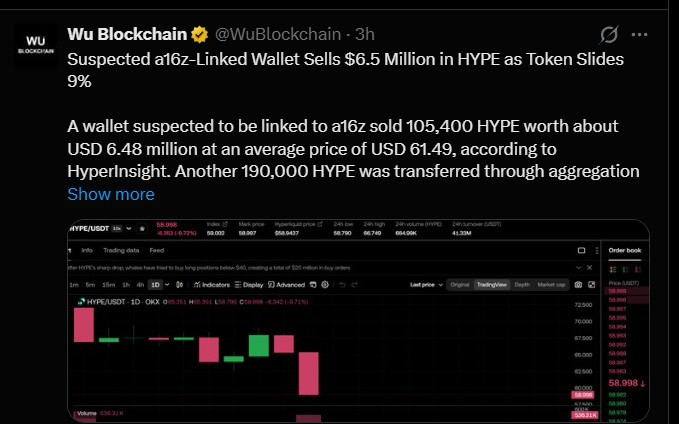
On-chain monitoring from HyperInsight flagged unusual activity from a wallet suspected to be linked to venture firm a16z. The address reportedly sold 105,400 HYPE tokens, worth approximately $6.48 million, at an average execution price of $61.49 per token.
Beyond that direct sale, the same wallet transferred an additional 190,000 HYPE through aggregation routes connected to centralized exchanges, including Bybit. It remains unconfirmed whether this second batch has been fully liquidated or is still being distributed across order books.
In total, the wallet moved 315,000 HYPE within a single day — a significant volume for one address. After these transfers, the wallet's remaining balance stood at roughly 45,100 HYPE, still held on HyperEVM.
The timing is notable: a16z has been one of the largest external accumulators of HYPE since 2025, building sizable positions at lower average costs. This apparent partial exit coincided directly with HYPE's sharp intraday decline, fueling speculation that large-holder selling contributed to the downward pressure.
Source: Wu Blockchain X
What Could This Mean?
If infrastructure pitch gains traction with builders, it could support a longer-term re-rating of HYPE beyond its role as a trading token. Institutional-style wallets accumulating and distributing large positions suggest sophisticated players are already positioning around that thesis.
For now, though, the token's price action reflects short-term profit-taking rather than confirmation of the longer strategy.
Jeff Yan's framing pushes the network toward a bigger long-term identity: shared financial infrastructure rather than a single trading venue. Whether that vision plays out depends on real adoption from wallets, apps, and protocols over time.
In the immediate term, markets are focused elsewhere — on HYPE's 8% daily drop and a suspected a16z wallet's multi-million-dollar token movement.
Disclaimer: This article is for informational purposes only and does not constitute financial, investment, or trading advice. Cryptocurrency markets are highly volatile and carry significant risk. Readers should conduct their own research and consult a licensed financial advisor before making any investment decisions. CoinGabbar is not responsible for any losses incurred based on this content.





