The Nigerian Startup Ecosystem Deep Dive: $4.17B | 293 Companies | 528 Deals

16-Feb-2026 Medium » Coinmonks

I spent one month tracking every Nigerian startup funding round from 2018 to 2025.

$4.17 billion. 293 companies. 528 deals.

The pattern that emerged shocked me

While founders chase Fintech (capturing 64% of all capital), the data reveals a hidden graveyard. Fintech has the WORST follow-on funding rate (40%) among all major sectors. Meanwhile, CleanTech startups — with just $228M raised — achieved 90% survival and 70% follow-on funding.

I analyzed every pivot, every acquisition, every shutdown. I mapped 72 subsectors across 8 years. I tracked which business models live and which struggle to survive.

Here’s what the numbers actually say.

The Survival Spectrum: Why Most Startups Fail

Across 72 subsectors and 293 companies, survival rates cluster into predictable tiers based on a simple formula: B2B + Essential Services + Recurring Revenue + Regulatory Tailwinds.

🟢 The 100% Survival Tier

The Pattern: Companies selling what businesses can’t operate without.

Examples:

  • HR & Payroll SaaS: SeamlessHR ($12.4M), PaidHR ($2.9M)
  • Tech Skills Bootcamps (ISA Model): Decagon, Semicolon, Bildup AI — ALL operating
  • Energy-as-a-Service (PAYG): Rensource ($44.5M), Watt ($29M) — ALL 5 operating
  • Digital Identity & RegTech: Seamfix, YouVerify, Prembly — 100% survival (CBN KYC mandate)
  • Pharma Supply Chain: Remedial ($17.4M), Field Intelligence, DrugStoc — ALL operating
  • B2B FMCG Distribution: TradeDepot ($123M), Omnibiz ($18M) — ALL 6 operating.

🟢 The 90–99% Survival Tier

Neobanks (Digital Banking): 92.9% survival — Moniepoint ($423M), OPay ($570M), Kuda ($91.6M)

But here’s the catch: 14 companies competing for the same market. Massive capital requirements. 67% follow-on rate (vs CleanTech’s 100% subsectors).

High survival, yes. But also high competition and capital intensity.

🟡 The 80–89% Survival Tier

The “pretty good but crowded” zone:

  • Payment Infrastructure/BaaS: 85.7% — Flutterwave ($465M), Interswitch
  • Agricultural Finance: 80% — Babban Gona ($27.7M), ThriveAgric ($65.6M)
  • Consumer Credit/BNPL: 80% — CredPal ($16.8M), Aella

🟠 The 50–69% Survival Tier: The Mixed Bag

  • Crypto/Web3: 53.8% — Canza, Busha, Yellow Card (7 of 13 operating)
  • B2B SaaS & Enterprise: 53.8% — Wakanow, JUDY (7 of 13 operating)
  • Logistics & Last-mile: 66.7% — Sendbox, Kwik, Renda (8 of 12 operating)
  • WealthTech: 63.6% — Bamboo ($16.6M), PiggyVest, Cowrywise (7 of 11 operating)

Some winners emerge. Many fail. The difference? Execution, not category.

🔴 The 0–32% Survival Tier: THE GRAVEYARD

This is where dreams die.

The Death Zone:

  • 54gene (Genomics): $44.8M raised → SHUTDOWN
  • Farmcrowdy (Ag Crowdfunding): $7.9M raised → SHUTDOWN (pivot failed)
  • EdTech Student Financing: 0% survival — ScholarX, Schoolable ALL failed
  • E-commerce Enablement/SaaS: 0% — Kitcart, Momma’s Bay ALL dormant
  • Loyalty/Rewards: 0% — ThankUCash ($5.3M) dormant
  • SME Lending: 33.3% — Lidya ($19.7M) shutdown
  • Consumer Marketplaces: 22.2% — Kippa ($3.2M) dormant

Why they fail:

  • Low willingness to pay
  • Capital-intensive operations without revenue
  • Long R&D cycles without product-market fit
  • Consumer financing without collections infrastructure
“You can’t build consumer lending in a market without collections infrastructure. The data proves it: 0–33% survival across ALL consumer credit subsectors without proper infrastructure.”

The graveyard is predictable.

The $200M Exit That Changed Everything

Let’s talk about acquisitions. Because they reveal which business models actually work.

🏆 The Big One

Stripe → Acquired Paystack (2020) — $200M

  • Subsector: Payment Gateways | Raised $8M
  • Result: Largest Nigerian exit. Stripe needed African market access, Paystack delivered.

🌍 Strategic Acquisitions (Big Companies Buying Startups)

Shell → Acquired Daystar Power (2021)

  • Subsector: Solar/Off-Grid C&I | Raised $68M
  • Result: Oil giant’s clean energy pivot. Shell bought Nigerian market access + installed solar capacity.

Risevest → Acquired Chaka (2023)

  • Subsector: WealthTech Investments | Raised $1.5M
  • Result: WealthTech consolidation. Buying competitor for user base + tech stack. Classic acqui-hire.

🔄 Ecosystem Consolidation (Winners Buy Losers)

Paystack → Acquired Brass (2024)

  • Subsector: Neobanking B2B | Raised $1.7M
  • Result: Payment winners buying banking losers. Paystack (now Stripe-owned) consolidating B2B banking.

C-One Ventures → Acquired Bankly (2025)

  • Subsector: Agency Banking/POS | Raised $2M

MFS Africa → Acquired Baxi (2021–2022)

  • Subsector: Agency Banking/POS | Raised $500K
  • Result: Pan-African payments consolidation. MFS Africa building regional footprint through acquisitions.

🚗 Other Notable Exits

  • Carbon/OneFi → Acquired Amplify (2019) — Payment Processing
  • Fixit45 → Acquired iFixng (2021) — Auto-Care Services
  • WhoGoHost → Acquired Sendchamp — Cloud Communications

💰 Meanwhile: The Acquirers

Three Nigerian startups became buyers themselves:

  • Chowdeck → Acquired Mira POS (2025) — Food delivery buying payments
  • LemFi → Acquired Pillar & Buttercrane — Cross-border consolidation
  • PiggyVest → Acquired PocketApp (2022) — Savings app consolidation

The Pattern:

  • Payment infrastructure attracts acquirers
  • Fintech dominates exits (75%)
  • Early-stage companies (<$10M raised) most likely to exit
  • Strategic buyers (Stripe, Shell) pay premiums for market access

The exits are predictable too.

28 Companies That Pivoted — And What Happened

Pivots reveal which strategic moves actually work. I tracked 28 companies that changed direction. Here’s what happened.

✅ The Successful Pivots

1. Payhippo → became Rivy: The Sector Escape

  • Original: SME Lending (Fintech)
  • Pivot: Clean Energy Financing (CleanTech)
  • Funding: $4M
  • Status: OPERATING

Result: Smart escape from a failing subsector (SME Lending 33% survival) to a thriving sector (CleanTech 90% survival). They kept the lending model, changed the customer base.

This is genius. They recognized the business model worked — but the sector didn’t.

2. Carbon/OneFi: The B2C → B2B Shift

  • Original: Consumer neobank
  • Pivot: AI-powered SME banking + BaaS infrastructure
  • Funding: $5M
  • Status: OPERATING

Result: Consumer banking is commoditized. B2B infrastructure has pricing power. Now they’re selling banking-as-a-service to other fintechs.

“B2C → B2B pivots work. Consumer apps are commoditized. Infrastructure has margins.”

3. OPay: The Focus Play

  • Original: Super-app (fintech + food delivery + ride-hailing)
  • Pivot: Fintech only
  • Funding: $570M
  • Status: OPERATING

Result: They killed food delivery and ride-hailing. Focused entirely on payments and agency banking. Strategic focus beats trying everything. Now valued at billions.

4. Zone (AppZone): The Infrastructure Pivot

  • Original: Cloud SaaS
  • Pivot: Decentralized payment switch (fiat + crypto)
  • Funding: $18.8M as Zone
  • Status: OPERATING

Result: Payment rails = better business than SaaS. Raised $8.5M after the pivot.

5. Nomba (KUDI.AI): The Product Expansion

  • Original: Agency Banking/POS
  • Pivot: Omni-channel Business Banking + POS Infrastructure
  • Funding: $5M+
  • Status: OPERATING

Result: Expanded from POS to full banking stack. Product expansion works when you own distribution.

Other Successful Pivots:

  • ThriveAgric: Retail crowdfunding → Institutional funding (OPERATING)
  • Vendease: B2B agro wholesale → Added BNPL/Credit (OPERATING, $33.3M raised)
  • Aella: Lending → Insurance + Payments + Investments (OPERATING)
  • Kora: Blockchain → Traditional payment infrastructure (OPERATING)
  • Lendsqr: Loan management → Full lending stack + APIs (OPERATING)
  • MAX: Ride-hailing → EV focus + financing (OPERATING, $39M raised)

❌ The Failed Pivots: A Cautionary Tale

Farmcrowdy: The Cautionary Tale

  • Original: Agricultural crowdfunding
  • Pivot: B2B agricultural tech + logistics (March 2021)
  • Funding: $7.9M
  • Status: SHUTDOWN

Result: The pivot didn’t save them. You can’t pivot WITHIN a fundamentally broken category. Ag Crowdfunding has 0% survival. They should’ve pivoted sectors entirely like Payhippo did.

BuyCoins → Helicarrier

  • Original: Crypto exchange
  • Pivot: Crypto remittance
  • Funding: $7.2M
  • Status: DORMANT

Result: Pivoting within a struggling crypto space didn’t help. Dormant after pivot.

“Pivoting WITHIN failing categories struggle. You need to change the game, not the tactics.”

The Pivot Lessons:

What Works:

  • B2C → B2B pivots
  • Sector pivots (Fintech → CleanTech)
  • Product expansion when you own distribution
  • Strategic focus over diversification

What Doesn’t:

  • Pivoting WITHIN failing categories
  • Rebranding without business model change
  • Diversifying when core business is broken

50 Rebrands: Growth Signals, Not Desperation

Rebrands reveal company maturity. I tracked 50 name changes. Here’s what they mean.

📈 Growth Rebrands: International Expansion

  • Plentywaka → Treepz: Expanding beyond Nigeria
  • Lemonade Finance → LemFi: Cross-border remittance focus ($86.9M raised)
  • Geegpay → Raenest: Full rebrand/unification ($14.5M raised)

🏦 Strategic Rebrands: Product Maturity

  • TeamApt → Moniepoint: Consumer neobank focus ($423M raised) — MASSIVE success
  • KUDI.AI → Nomba: Omni-channel banking ($5M+)
  • AppZone → Zone: Payment network pivot ($18.8M)
  • OneFi → Carbon: Consumer brand focus
  • Piggybank.ng → PiggyVest: Investment platform expansion

🔧 Tech Stack Rebrands

  • Wizter → Waza: B2B trade expansion ($8.5M)
  • Jand2Gidi → CargoPlug: Cross-border logistics focus
  • Pada HCM → PaidHR: Product maturity ($2.9M)

❌ Failed Rebrands (Rare)

Only 5 out of 50 rebrands failed:

  • ScholarX → Learnly: DORMANT (EdTech student financing)
  • ThankUCash → Store Smart: DORMANT (Loyalty/Rewards)
  • BuyCoins → Helicarrier: DORMANT (Crypto)
  • Schoolable → Allprotech: SHUTDOWN

The Rebrand Lesson: 90% success rate. Rebrands signal growth (international expansion, product maturity, strategic focus). Failed rebrands were in failing subsectors (student financing 0%, loyalty 0%, crypto 53%). Name changes don’t save bad business models.

The Numbers: 8 Years of Funding Data

I built 3 interactive Tableau dashboards with every funding round, company, and outcome. Here are the highlights.

📊 The Big Picture

The Numbers:

  • $4.17B total funding across 293 companies
  • 528 total deals (2018–2025)
  • 70% overall survival rate
  • 8 sectors, 72 subsectors analyzed

Top Companies by Funding:

  1. OPay: $570M (Neobanking)
  2. Flutterwave: $465M (Payments)
  3. Moniepoint: $423M (Neobanking)
  4. AFEX: $323M (AgriTech Commodity Trading)
  5. Interswitch: $110M (Payments)

Sector Breakdown:

  • Fintech: $2.66B (64% of all funding), 106 companies, 184 deals
  • AgriTech: $439M, 24 companies
  • Digital Commerce: $408M, 42 companies
  • CleanTech: $228M, 20 companies (90% survival!)
  • HealthTech: $180M, 27 companies (82% survival)

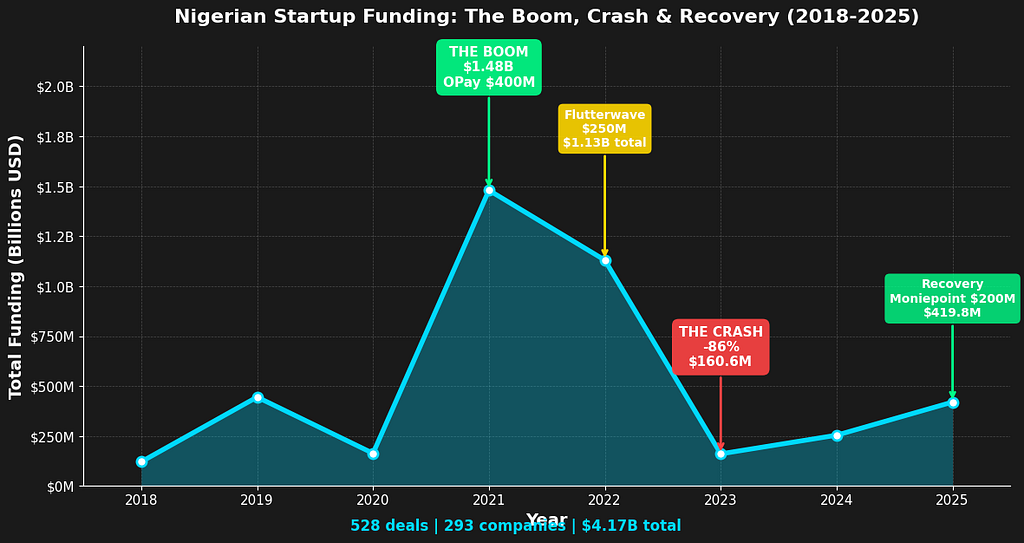
📈 Funding Evolution: The Boom, Crash, and Recovery

The year-by-year breakdown tells the real story.

2018: The Foundation (72 deals)

  • Total funding: $120.8M
  • Biggest deal: Wakanow ($40M) — Travel Tech (Enterprise)
  • Other notable deals: Kora ($12M), Paga ($10M), Flutterwave ($10M), Paystack ($8M)
  • Average deal: $1.7M
  • Key milestone: Ecosystem beginning. Travel Tech surprises with largest deal.

2019: Early Growth (93 deals)

  • Total funding: $444.9M
  • Biggest deal: OPay ($170M) — Neobanking mega-round
  • Other notable deals: Andela ($100M HRTech), PalmPay ($40M), Kobo360 ($30M), Rensource Energy ($20M)
  • Average deal: $4.8M (+182% from 2018)
  • Key milestone: First $100M+ deal in Nigerian startup history

2020: COVID Acceleration (75 deals)

  • Total funding: $163.3M
  • Biggest deal: Flutterwave ($35M) — Payment Infrastructure
  • Other notable deals: 54gene ($15M HealthTech), TradeDepot ($10M), KudaBank ($10M)
  • Average deal: $2.3M (-52% drop due to pandemic uncertainty)
  • Key milestone: More deals than 2018, but smaller sizes. Investors cautious.

2021: THE BOOM YEAR (125 deals) 🚀

  • Total funding: $1.48B
  • Biggest deal: OPay ($400M) — Neobanking Series C ← BIGGEST DEAL EVER
  • Other mega-deals: Flutterwave ($170M), AFEX ($115M AgriTech), TradeDepot ($110M), PalmPay ($100M)
  • Average deal: $12.9M (+461% from 2020!)
  • Key milestones:
  • First $1B+ year
  • 125 deals = PEAK DEAL COUNT
  • Global tech boom
  • Tiger Global aggressive in Africa

This was the peak. It wouldn’t last.

2022: Mega-Round Consolidation (50 deals)

  • Total funding: $1.13B
  • Biggest deal: Flutterwave ($250M) — Unicorn valuation ($3B)
  • Other mega-deals: Moove ($182M), AFEX ($175M), Interswitch ($110M), ThriveAgric ($56M)
  • Average deal: $23.1M (+79% from 2021) ← PEAK AVERAGE DEAL SIZE
  • Key milestone: Fewer deals but MUCH larger sizes = late-stage consolidation

2023: THE CRASH (40 deals) 💥

  • Total funding: $160.6M
  • Biggest deal: LemFi ($33M) — Cross-border payments
  • Other notable deals: Helium Health ($30M), FairMoney ($30M), Rensource Energy ($15M)
  • Average deal: $5.0M (-78% from 2022!)
  • Key milestones:
  • Deal count collapsed 68%
  • Funding dropped 86%
  • Global tech winter
  • SVB collapse
  • VC pullback

The crash was brutal.

2024: Bottoming Out (44 deals)

  • Total funding: $254.1M
  • Biggest deal: Moniepoint ($110M) — Neobanking dominance
  • Other notable deals: Yellow Card ($33M), Beacon Power Services ($30M CleanTech), Watt Renewable ($15M)
  • Average deal: $6.9M (+38% recovery from 2023)
  • Key milestone: Green shoots of recovery. Mega-rounds return.

2025: Recovery Begins (29 deals to date)

  • Total funding: $419.8M
  • Biggest deal: Moniepoint ($200M) — Another mega-round
  • Other notable deals: LemFi ($53M), Stitches Africa ($50M Fashion), Kredete ($22M), Gigmile ($21M)
  • Average deal: $14.5M (+110% from 2024)
  • Key milestone: Deal sizes approaching 2021–2022 levels, but deal count still low

The Pattern:

2018–2019: Foundation era (72–93 deals, $1.7–4.8M average)

2020: COVID pause (75 deals, $2.3M average)

2021: THE BOOM (125 deals, $12.9M average) — PEAK DEAL COUNT

2022: Mega-round consolidation (50 deals, $23.1M average) — PEAK DEAL SIZE

2023: THE CRASH (40 deals, $5.0M average) — 68% deal count drop, 86% funding drop

2024–2025: Recovery (29–44 deals, $6.9–14.5M average) — Deal sizes recovering faster than volume

“The future: Mega-rounds are back ($100M+), but only for proven winners. Deal count still 77% below peak.”

Total verified deals (2018–2025): 528 ✅

🎯 The Investment Matrix: Where Smart Money Goes

This is the most important chart.

I mapped every sector by Survival Rate (Y-axis) vs Follow-On Funding Rate (X-axis).

🟢 Top-Right Quadrant (GREEN — Best Bets):

  • CleanTech: 90% survival, 70% follow-on
  • HealthTech: 82% survival, 63% follow-on
  • HRTech: 80% survival, 60% follow-on

These are the capital-efficient winners.

🟠 Middle Quadrant (ORANGE — Moderate Risk):

  • Fintech: 73% survival, 40% follow-on (overcrowded, capital-intensive)
  • EdTech: 70% survival, 39% follow-on
  • Digital Commerce: 67% survival, 36% follow-on

🔴 Bottom-Left Quadrant (RED — High Risk):

  • AgriTech: 50% survival, 50% follow-on (WORST position)
  • B2B Enterprise SaaS: 63% survival, 22% follow-on (LOWEST follow-on rate)

The Fintech Paradox:

Fintech captured 64% of all funding but has the WORST follow-on rate (40%) among major sectors.

Why?

  • Overcrowding (106 companies)
  • Commoditization
  • High capital requirements
  • Investor fatigue

What This Means For You

After analyzing $4.17B across 293 companies, here’s what actually matters.

What Works (80–100% Survival):

  • B2B SaaS with regulatory tailwinds (HR, RegTech, School Management)
  • Essential infrastructure (Payments, Pharma Supply Chain, FMCG Distribution)
  • Recurring revenue models (Energy-as-a-Service, Subscriptions)
  • Capital-light tech plays (Coding Bootcamps with ISAs)

What Doesn’t (0–33% Survival):

  • Consumer lending without collections infrastructure
  • Agricultural crowdfunding platforms
  • Student financing products
  • Hardware with long R&D cycles (Genomics, Medical Devices)
  • Loyalty/rewards programs

Pivot Playbook:

  • B2C → B2B works
  • Sector pivots work (Fintech → CleanTech)
  • Product expansion works when you own distribution
  • Don’t pivot WITHIN failing categories

Infrastructure plays > Consumer apps consistently

Payment infrastructure = proven acquisition target (Paystack $200M)

key take away:

  1. Regulatory frameworks create or destroy subsectors (RegTech 100% due to CBN KYC)
  2. Fix collections infrastructure to enable lending (currently 0–58% survival)
  3. Strengthen CleanTech incentives (already 90% survival, can grow sector)
  4. Support B2B infrastructure over consumer apps for economic impact

Explore the Data Yourself

I built 3 interactive Tableau dashboards with:

  • Every funding round (528 deals)
  • Every company outcome (293 companies)
  • Survival rates by subsector (72 subsectors)
  • Year-over-year funding trends
  • Investment matrix by sector

Filter by sector, subsector, or funding stage. See which business models actually work.

https://public.tableau.com/views/NIGERIANSTARTUPECOSYSTEMANALYSIS20182025/HOME?:language=en-US&publish=yes&:sid=&:redirect=auth&:display_count=n&:origin=viz_share_link

The Bottom Line

Sector < Subsector < Business Model

The survivors aren’t lucky. They’re predictable.

They chose:

  • B2B over B2C
  • Essential over nice-to-have
  • Recurring over one-time
  • Infrastructure over consumer apps

The data doesn’t lie.


The Nigerian Startup Ecosystem Deep Dive: $4.17B | 293 Companies | 528 Deals was originally published in Coinmonks on Medium, where people are continuing the conversation by highlighting and responding to this story.
Also read: Barack Obama dit que les aliens sont “réels” mais qu’ils ne sont pas dans la Zone 51
WHAT'S YOUR OPINION?
Related News

