On October 27, 2025, something rare happened.
A rating agency — yes, the same alphabet-grading arbiters who once handed out triple-A scores to toxic subprime soup — decided to finally weigh in on the most radically crypto-exposed public company on Earth: MicroStrategy Inc.
But they didn’t call it MicroStrategy.
They called it Strategy Inc.
Which is like calling a high-wire act “Rope Business Inc.”
Nonetheless, the agency (S&P Global) issued a formal credit rating: B- with a stable outlook.
In credit land, that’s what we call “junk.” But make no mistake — it’s the kind of junk that glints.
Because this isn’t just a rating. This is the establishment finally acknowledging that a publicly traded company holding over $10 billion in Bitcoin — and not much else — is a real, functioning corporate organism. Risky? Sure. But legitimate enough to warrant a rating table entry.
And here’s the twist: instead of tanking on the news, the stock went up.
MicroStrategy shares (MSTR) rose to around $298 intraday, closing up +2.3% on the day. This wasn’t a euphoric surge, but it was a clear signal: the market didn’t flinch.
Why?
Because everyone already knew MicroStrategy was a high-voltage play. The S&P rating didn’t tell us anything new — it merely quantified what investors had priced in long ago. If anything, the issuance of a formal rating acted as validation.
Call it the “stamp of high-risk approval.”
And there was nuance to the “junk” label. The stable outlook implied that S&P saw no imminent default risk. It acknowledged that while Bitcoin is volatile, Strategy Inc. isn’t spiraling into chaos. The company can service its debt — for now — and has strategies to raise capital if needed.
Notably, the firm recently purchased more Bitcoin using preferred equity instead of common stock, avoiding shareholder dilution. It’s a subtle game of financial gymnastics — and Strategy has a decent form score.
TD Cowen analysts, ever the Bitcoin bulls, reaffirmed their Buy rating and held their lofty $620 price target, citing Strategy’s ability to translate Bitcoin enthusiasm into a functioning capital structure. Their thesis? As long as Bitcoin adoption grows, so does MSTR’s long-term value.
If this sounds like financial alchemy — turning digital gold into equity capital — that’s because it is. But the market, at least on this day, seemed fine with the sorcery.
What really earned Strategy Inc. its speculative rating wasn’t just debt.
It was Bitcoin.
Specifically, the massive concentration of BTC on its balance sheet, which S&P doesn’t treat as capital but rather as volatility risk. In their framework, Bitcoin doesn’t fortify the balance sheet — it punctures it.
Imagine a bank trying to assess the risk of a vault filled with dynamite. That’s how S&P views BTC: beautiful, explosive, and utterly unstable.
S&P’s methodology actually deducts Bitcoin from equity when calculating adjusted capital levels. That’s how you end up with negative capital — even when sitting on billions.
It’s a conservative view. Maybe outdated. But it’s the prevailing orthodoxy in rating land, and it frames how traditional institutions will see firms that follow MicroStrategy’s playbook.
You might think that Bitcoin itself would dance to this institutional acknowledgment.
It didn’t.
On the same day, BTC rose about 1–2%, climbing above $115,000. But this move aligned with broader crypto sentiment and coincided with Strategy’s purchase of another 390 BTC, not the credit rating announcement.
Translation: the Bitcoin market didn’t blink. It treated the rating as a Strategy-specific event, not a crypto-wide revelation.
That’s telling.
It reinforces the view that Bitcoin has matured into an asset whose price moves to macro winds — interest rates, ETF flows, global liquidity — rather than the corporate narratives of its loudest holder.
Still, the narrative power was there. Bitcoin Magazine and others framed the day’s rally as a response to Strategy’s purchase, keeping the mythos alive: that corporate accumulation moves the needle.
But under the hood? BTC remained cool, calm, and mostly indifferent.
One might expect Bitcoin-linked ETFs to surge or sink on such a headline. Especially funds that live and breathe MSTR.
But guess what?
They didn’t.
No meaningful net inflows or outflows were recorded in ETFs like MSTY, MSTX, or ULTY — the volatile triad that gives investors leveraged or income-wrapped exposure to MicroStrategy.
Here’s the data:
All three funds remained steady in asset terms. Their prices ticked up slightly — matching MSTR’s gain — but share counts were flat. No big creation or redemption events.
What does that tell us?
Institutions weren’t spooked. Nor were they suddenly inspired to pile in. The rating was treated as… neutral. Just another plot point in the ongoing MicroStrategy drama.
The Bitcoin community, predictably, turned this into a milestone.
Michael Saylor, who may or may not sleep in a vault made of cold storage wallets, called it the “first-ever rating of a Bitcoin Treasury Company.”
To him and others, the mere fact that S&P showed up to the table — even to scold Strategy with a B- — was a win. A sign that Bitcoin companies had matured into credit-worthy (albeit risky) entities.
In this light, the rating becomes a rite of passage.
Not everyone agreed. Some critics viewed it as confirmation that Bitcoin-heavy balance sheets would be punished in the eyes of traditional finance.
S&P’s refusal to count BTC as equity? “A joke,” said many Redditors.
And then came the flashbacks: “Remember when S&P gave AAA ratings to the CDOs that torched the world in 2008?” one forum post asked.
Fair point.
Others speculated that rival agencies (Moody’s, Fitch) might soften their stance over time, especially if demand for rating Bitcoin-rich companies increases. The credit world may eventually be dragged — slowly, and with great resistance — into accepting digital assets on their own terms.
But not yet.
For regulators, the rating carries nuance.
On one hand, it shows that a company can hold billions in BTC and still earn a rating — with a stable outlook, no less. That’s a breakthrough. It tells CFOs in other industries: “Yes, you can hold Bitcoin. You’ll get a junk rating, but you won’t be banished.”
On the other hand, the B- rating reinforces a longstanding concern: Bitcoin volatility is a credit risk. It’s not just price risk — it can limit your ability to borrow, issue debt, or be taken seriously in boardrooms.
So regulators may interpret the rating as a cautious green light — Bitcoin treasuries aren’t disqualified, but they’re still frowned upon.
Meanwhile, the IRS issued a favorable ruling on unrealized crypto gains around the same time — another nod toward clarity.
The times, they are a-marginally-less-confusing.
For investors navigating this brave new world of rated crypto companies, the implications are layered.
If you’re a trader, the playbook remains:
If you’re an allocator, your new world includes:
If you’re a policymaker, you’re watching a precedent unfold. The rating shows that traditional finance can assess a crypto-exposed company. But it also shows how much the framework still fears the orange coin.
Let’s put numbers on it.
Over the next 6–12 months, here’s how the council sees price probabilities:
This reflects a market tilted slightly bullish — but not wildly so. Tail risks remain. But so do tailwind catalysts.
If ETF flows remain positive and rates stay under control, upside convexity dominates. If yields spike and flows reverse, downside air pockets emerge.
So here we are.
A Bitcoin-heavy public company just earned a speculative-grade rating — and the world kept turning.
More than that, the stock went up.
This is the kind of moment historians will one day highlight: not as a thunderclap, but as a quiet turning point. When the world began building bridges between crypto-native strategies and traditional capital frameworks.
The B- rating was a mirror — reflecting not just MicroStrategy’s risk, but the growing sophistication of this entire asset class.
If you’re long Bitcoin, you didn’t need this to validate your thesis.
But now the world’s rating agencies are forced to speak your language.
And that, in this game of narrative gravity and capital flow, is a win worth noting.

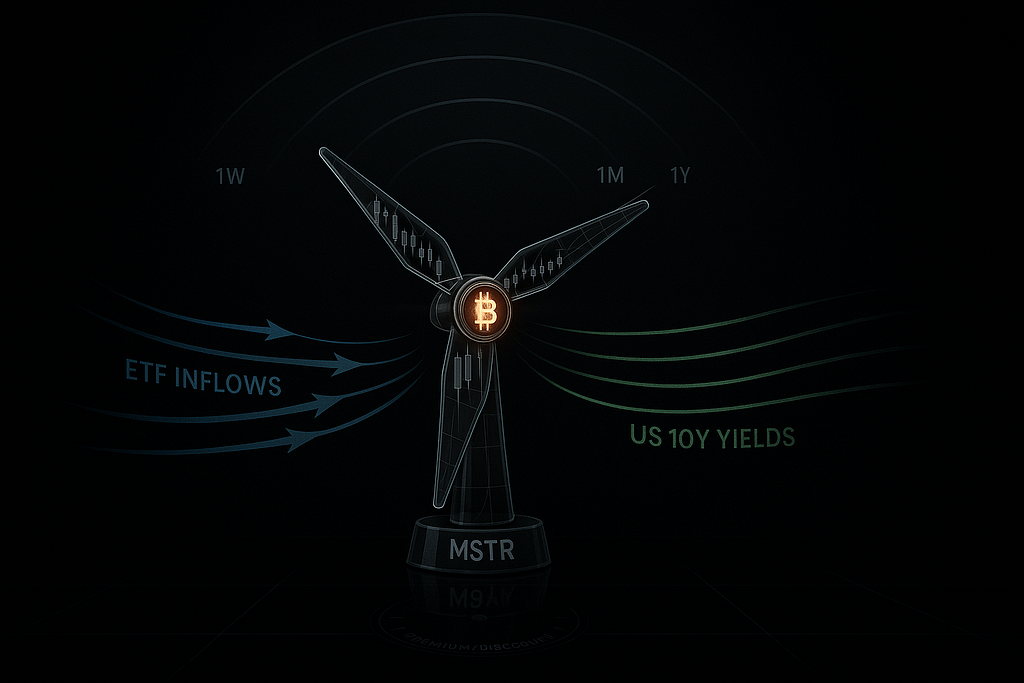
When yields exhale and flows breathe in, Bitcoin inhales altitude. MSTR? That’s your turbine.
The Day Wall Street Rated Bitcoin: MicroStrategy’s ‘B-’ and the Future We’re Now Living In was originally published in Coinmonks on Medium, where people are continuing the conversation by highlighting and responding to this story.





