
In deep reflection today, I came to realize that observing diverse human viewpoints uncovers a difference in how technological innovations are assessed. Most people take a short-term view, which invariably makes it difficult to fully comprehend the scope of a new technology’s impact and consequences. To transcend immediate reactions, an intellectual effort is necessary, an “unconventional” vision, to adopt the long-term perspective. Only this method allows for comprehending the technology’s actual trajectory and its persistent effect on society.
And following this, I decided to write about the Bitcoin evolution and how it came to a New Geopolitical Weapon?
The global financial system is undergoing a period of structural transformation due to the emergence of Blockchain technology. A change with impacts on the geopolitical system, which, in some countries, is being underestimated by less attentive leaders, focused only on the existing misinformation associated with this new technology, to the detriment of embracing the full strategic potential of it.
The current context and the emergence of blockchain technology challenge the faith question in the established trust in banking intermediaries and, consequently, in traditional fiat currencies and future Central Bank Digital Currencies (CBDCs). The transparency and immutability of Bitcoin’s decentralized ledger support its projection not only as a digital store of value but also as a potential benchmark that could, in the future, influence the perception of scarcity and the integrity of other forms of currency, including state-issued ones.
While various central banks prepare to launch their CBDCs, which promote centralized control and contrast with the desire for financial freedom, we simultaneously see an increase in interest in Decentralized Finance (DeFi) ecosystems. These ecosystems are financial applications that operate based on blockchain technology without the need for intermediaries, using smart contracts to self-regulate loans, payments, and asset exchanges. Transactions occur directly between users (P2P), which promotes autonomy, transparency, and worldwide access for everyone, regardless of their banking status or credit background.
And this is where Bitcoin emerges, the global, decentralized digital currency, considered a new form of money and a store of value. Its supply limit of 21 million units makes it a scarce asset, which enables secure and direct transfers. Confidence in Bitcoin is not tied to a single institution, but rather in its immutable public ledger, which is maintained by thousands of computers that validate transactions through mining, which guarantees censorship resistance. It is possible that, in the future, a coalition of nations will adopt Bitcoin as a strategic reserve. If this happens, Bitcoin would progressively substitute a portion of the gold and treasury securities currently held by these nations.
The enforcement of international sanctions is pushing several countries toward assets that cannot be blocked by Western nations. This trend is reinforced by the expansion of new custodial infrastructure, like Bitcoin ETFs (Exchange Traded Funds), which function as “parallel” financial systems operating fundamentally outside banking regulation. These allow institutional investors and the general public to gain exposure to the cryptocurrency’s price without having to directly manage its custody or technical security. After facing intense and long regulatory pressure, the approval of these instruments was a key marker, reflecting a strategic shift, not a regulatory surrender, by the American government. Instead of banning Bitcoin, regulators institutionalized it within their legal system. This strategy enables the US to maintain the dollar’s supremacy as a unit of account and trade, while simultaneously controlling the digital asset’s primary access point, Wall Street, thereby transforming it into a traceable and regulated instrument of financial power.
The analysis of potential failure points that Bitcoin might face is closely linked to the persistent doubts that have remained over time, enduring since its creation. External scenarios that could lead to a decline in value or the outright collapse of this ecosystem may arise from the following factors. Bitcoin’s strategic risks fundamentally involve a blend of technical, economic, and geopolitical vulnerabilities. On the technological front, the main concerns lie with the network’s limited scalability, which presents a transactions per second limit considerably lower than that of traditional systems, and the effectiveness of mitigating solutions, such as the Lightning Network, remains uncertain. Network security faces the risk of a 51% attack, where control of the majority of mining power could lead to the manipulation of transactions, undermining confidence in the system. Additionally, there is the threat that the protocol may be unable to update to post-quantum cryptography, compromising its longevity. Economically, the network’s sustainability could be compromised in the long term by a breakdown in miner incentives resulting from diminishing block rewards. Finally, the most significant external risk is government regulation, given that Bitcoin’s decentralized nature is viewed with suspicion by many states, and the imposition of restrictive legislation or prohibitions could significantly impact its adoption and value.
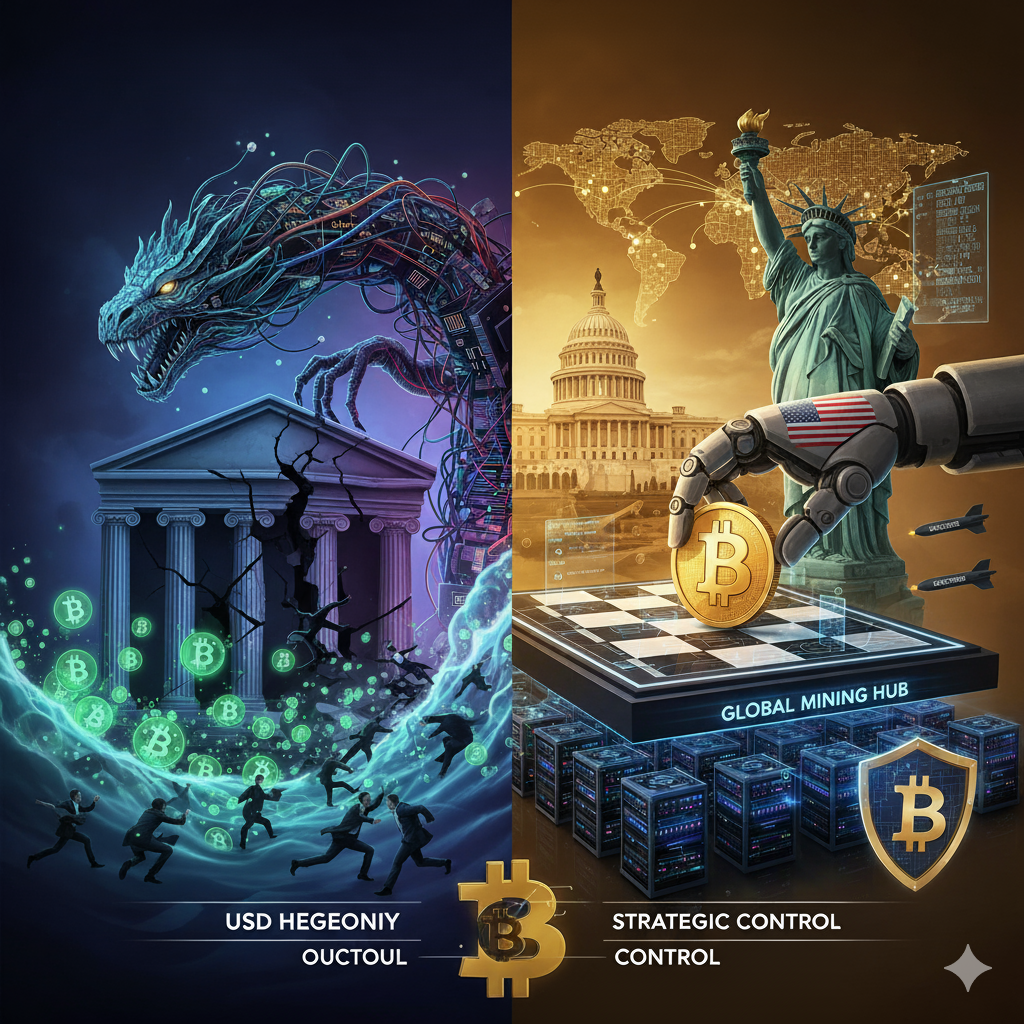
I consider the US posture regarding Bitcoin to be schizophrenic in nature. While the traditional American banking system perceives it as a real threat, the political establishment tends to view it as a tool for strategic use.
The American approach seeks, on one hand, to preserve the dollar’s hegemony and, on the other, to institutionalize Bitcoin. The approval of Bitcoin ETFs and the involvement of major institutions (such as BlackRock and Fidelity) ended up integrating the cryptocurrency into the regulated financial system. This allows the government to track, tax, and influence its price and custody, converting Bitcoin into a Wall Street commodity and thus, into a tool of American financial power. The dollar’s hegemony as a unit of account is, in this way, ultimately maintained.
Following China’s ban on Bitcoin mining in 2021, the United States ascended to become the global leader in mining capacity. This outcome has, provisionally, given the US control over the physical security of the network, as allied jurisdictions now validate most blocks. This provides the US and its allies with a resilient “cryptographic mining defense” and significantly minimizes the threat of potential 51% attacks by rival nations.
Bitcoin is strategically being deployed as a “weapon” against competing powers. DeFi furnishes citizens and businesses with an avenue for wealth escape, serving as a countermeasure to the financial coercion employed by authoritarian states, notably China, which seeks to dominate its capital flows via the Digital Yuan (CBDC). The technology is thereby transforming into an unspoken tool for currency war. Its adoption by allied nations (like El Salvador) may be interpreted as a trial of how far the dollar’s sphere of influence can be penetrated. The American strategy involves the strategic control of Bitcoin and an attempt to capture its potential for its Western sphere of influence. However, the decentralized nature of Bitcoin is a long-term limiting factor in achieving total control by any state. But the war for mining has already begun, with several state-subsidized companies emerging in various parts of the globe.
Bitcoin has moved past its technological origin and consolidated itself as a tool of monetary policy and national security. Its rise challenges the current fiat structure, offering a decentralized alternative that is sought after by nations in search of autonomy and financial freedom. Despite the existing risks, the institutionalization movement led by the US suggests an attempt at strategic control. It is in this way that the freedom and integrity that Blockchain technologies promise are beginning to shape the future of state sovereignty.
Bitcoin: The New US Geopolitical Weapon was originally published in Coinmonks on Medium, where people are continuing the conversation by highlighting and responding to this story.