In the world of high finance, the most powerful players often operate in the shadows. While names like Goldman Sachs and Bank of America dominate headlines, a quantitative trading firm called Jane Street has quietly grown into a behemoth, becoming one of the most influential — and controversial — forces in global markets.
To understand its power, consider this: last year, Jane Street generated more revenue from trading than Goldman Sachs, Citigroup, and Bank of America. It’s estimated to be the hidden hand behind more than 10% of all stock trades in the United States. But it’s the firm’s alleged influence over the one asset class built to escape traditional finance — Bitcoin — that has the crypto world buzzing with a mix of fear and fascination.
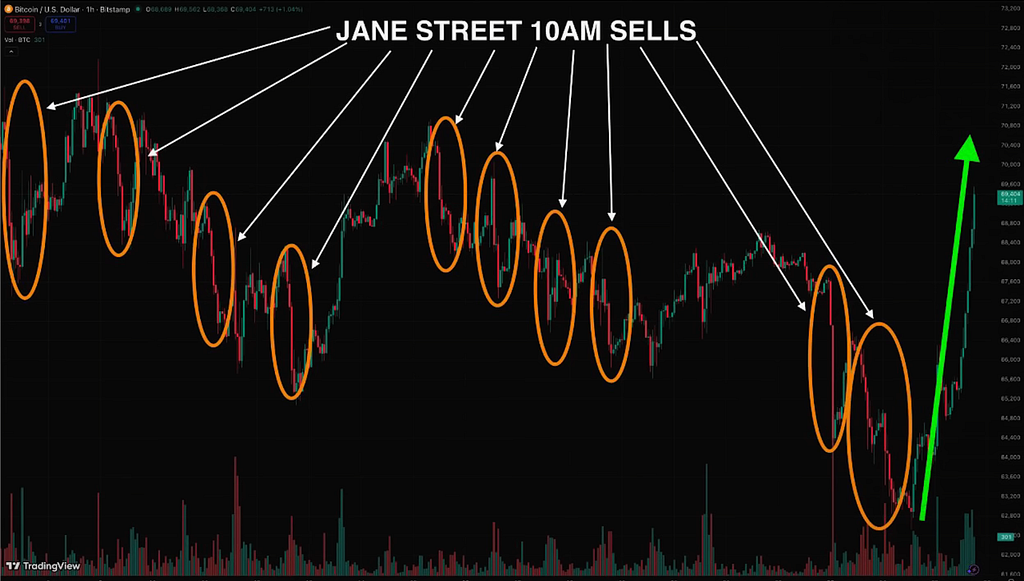
For months, a bizarre pattern emerged in the Bitcoin market. Every single trading day, around 10:00 a.m. Eastern Time — the moment the stock market opens — Bitcoin would predictably drop by 2% to 3%. It happened with such mechanical precision that analysts and retail investors began to suspect it wasn’t a coincidence, but a design.
The theory gaining traction points directly at Jane Street. As one of only four “Authorized Participants” (APs) for BlackRock’s IBIT Bitcoin ETF — the largest in the world — Jane Street holds a unique set of superpowers that most investors don’t even know exist.
Here’s how it works: When you buy IBIT, you aren’t buying Bitcoin; you’re buying a share in a fund that holds Bitcoin. Jane Street sits in the middle, ensuring the ETF’s price stays aligned with the actual spot price of Bitcoin. But this role comes with privileges. Due to regulations like Reg SHO, APs have exemptions regarding short-selling rules, allowing them to create and sell shares with fewer restrictions.
More importantly, when Jane Street files disclosures showing they hold hundreds of millions in IBIT, they only have to report the “long” positions (the shares they own). They do not have to disclose if those positions are hedged with short positions, options, or futures. They could theoretically own the tickets to the Pikachu card while simultaneously betting billions that the card’s value will plummet — and the public would never see it.
The alleged manipulation strategy is a classic “pump and dump” meets “short squeeze.” A bad actor could buy spot Bitcoin, open massive short positions on a separate exchange, and then sell a huge amount of Bitcoin during a low-liquidity window (like 10:00 a.m.). This triggers liquidations, creating a cascade of selling. While they lose money on the spot Bitcoin they sold, the profit from the short position dwarfs the loss. Then, they buy back the Bitcoin at a discount, creating buying pressure, sparking FOMO, and setting the stage to do it all over again.
Skeptics argue that the 10:00 a.m. dip is simply a “repricing” when the U.S. market opens, or a standard “delta-neutral” strategy. But for those accusing Jane Street, the evidence extends far beyond Bitcoin charts.
In July 2025, India’s securities regulator, SEBI, investigated Jane Street and found them guilty of manipulating the local stock market using a strategy described as “morning pump, afternoon dump.” The firm allegedly pushed prices up in the morning, only to reverse the positions in the afternoon to profit from the drop. As a result, SEBI froze $566 million of Jane Street’s assets and banned the firm from trading in the country.
This wasn’t an isolated incident. China has also reportedly caught Jane Street accounts manipulating silver prices through ETFs. The playbook, it seems, is consistent: use a dominant market position to create predictable price movements and then profit from them.
The most explosive allegation, however, comes from a lawsuit filed in February 2025 regarding the $40 billion collapse of the Terra ecosystem in 2022.
The lawsuit claims that a former intern at Terraform Labs, who later joined Jane Street, brought confidential information about the project’s vulnerabilities with him. Allegedly armed with this insider knowledge, Jane Street positioned itself to profit from Terra’s eventual collapse.
According to the suit, on May 7, 2022, a coordinated $85 million dump of the UST stablecoin on the Curve exchange broke its dollar peg, triggering a death spiral that wiped out $40 billion in wealth, destroyed the savings of millions, and set off a chain reaction that eventually took down FTX.
Jane Street has yet to formally respond to these allegations, but the implication is damning: that they didn’t just witness the collapse, they may have had a hand in causing it.
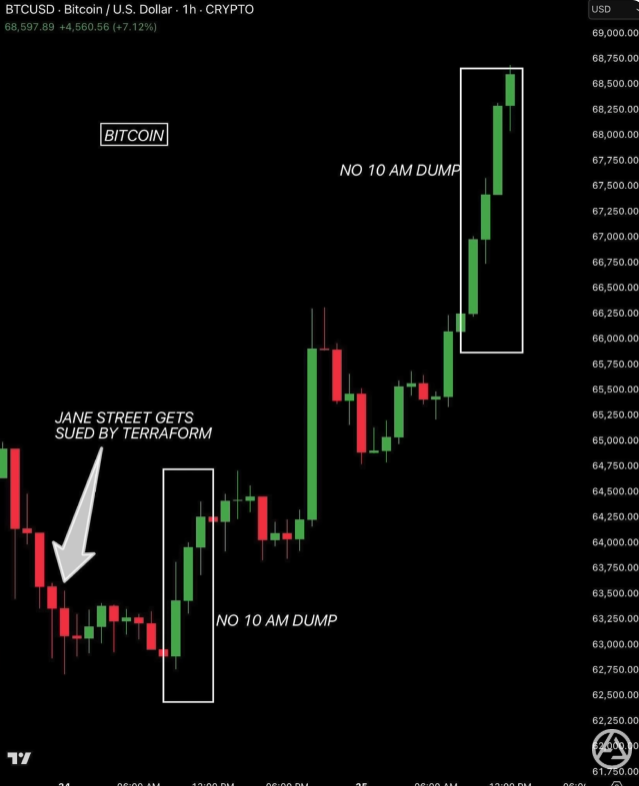
The most compelling piece of evidence for the conspiracy theorists? Timing.
The moment the lawsuit against Jane Street became public, the 10:00 a.m. Bitcoin dumps stopped completely. In the 48 hours following the news, Bitcoin surged 10%, adding $200 billion to the crypto market. Short liquidations hit $213 million, and BlackRock’s IBIT saw a $250 million inflow in a single day, breaking weeks of outflows.
To many, this felt like a smoking gun: as soon as the spotlight hit Jane Street, the mysterious market manipulation vanished.
If the financial allegations weren’t enough to raise eyebrows, the human element adds a layer of intrigue that borders on the absurd. One of Jane Street’s co-founders, named in the Terra lawsuit, reportedly wired $7 million that was used to purchase AK-47s, Stinger missiles, and grenades for a failed coup attempt in South Sudan — a fact verified by the Department of Justice.
Furthermore, Sam Bankman-Fried, the disgraced founder of FTX, was a Jane Street alum, along with several of his future colleagues at Alameda Research.
For Bitcoin purists, the Jane Street saga is a cautionary tale. Bitcoin was created to be outside the financial system, a trustless, decentralized asset. But the moment it was securitized into an ETF, it was re-intermediated. It gained a middleman with special privileges who can create and destroy shares, hedge in secret, and potentially move the price during low-liquidity windows.
The story of Jane Street isn’t just about one firm’s alleged misdeeds; it’s about the structure of the financial industrial complex. If these allegations are true, it suggests that the price of Bitcoin, when accessed through traditional vehicles, can be swayed by the same forces it was designed to evade.
The ultimate lesson for investors is not to abandon Bitcoin, but to be mindful of how they hold it. Buying an ETF means trusting the very system Satoshi Nakamoto aimed to replace. Holding your own keys means none of this manipulation can touch your actual coins. The price may fluctuate, but no one can liquidate you, and no one can take your Bitcoin from a self-custodial wallet.
As the lawsuit against Jane Street unfolds, the evidence will either confirm the suspicions of a generation of crypto skeptics or reveal a remarkably long string of coincidences. Until then, the mantra remains: Don’t trust, verify.
The Ghost in the Machine: How an Unknown Trading Firm Is Accused of Manipulating Bitcoin was originally published in Coinmonks on Medium, where people are continuing the conversation by highlighting and responding to this story.