In this article, we compare two big names in the blockchain space: Avalanche (AVAX) and Solana (SOL). We’ll take a close look at the battle between AVAX and Solana, breaking down what each offers. You’ll find out which platform might be better for you, whether you’re investing, building, or just curious. We cover everything from how fast they are to how many people use them. In the AVAX vs SOL showdown, we aim to make your decision easier. Get ready to see how Solana and Avalanche stack up against each other. By the end of this, you’ll have a clearer picture of the Avalanche vs Solana debate.
Avalanche (AVAX) is a blockchain platform known for its speed and efficiency. It’s like a super highway for blockchain transactions, making things faster and more reliable. At the heart of Avalanche is its unique consensus mechanism. This mechanism lets it process thousands of transactions per second. That’s lightning fast compared to some other blockchains. What makes Avalanche special is its ability to handle many tasks at once. It can do this without slowing down or becoming less secure.
Avalanche is also very flexible. Developers love it because they can create all sorts of applications on it. These can be anything from simple payment systems to complex financial products. The platform supports multiple blockchains running at the same time. This feature is like having multiple specialized tools instead of just one. Another big plus is that Avalanche is eco-friendly. It uses less energy compared to many blockchain networks. This is great for our planet.
AVAX is the native token of Avalanche. People use AVAX for various things on the platform. They pay transaction fees with it or use it to secure the network. AVAX also plays a role in governance. Holders of AVAX can vote on decisions about the network’s future. This makes AVAX not just a currency, but also a tool for community involvement.
Solana (SOL) is a rising star in the blockchain world. It’s known for its incredible speed and low transaction costs. These features make it a favorite among developers and users. Solana’s secret sauce is its hybrid consensus model. This model combines proof-of-history (PoH) with proof-of-stake (PoS). The result? A network that can handle tens of thousands of transactions per second. It’s like a speedboat racing through the waves of digital transactions.
Solana is not just fast, it’s also scalable. This means it can grow and manage more users and transactions without a hitch. Developers find Solana attractive for building all sorts of apps. These apps range from decentralized finance (DeFi) to non-fungible tokens (NFTs). Solana’s ecosystem is vibrant and growing. New projects keep popping up, showing the platform’s versatility.
The native cryptocurrency of Solana is SOL. People use SOL for transaction fees and staking. Staking helps keep the network secure. SOL also has a role in governance on the Solana platform. By holding SOL, you can have a say in its future direction. This makes SOL more than just a digital currency. It’s a key to participating in a fast-growing blockchain ecosystem.
Avalanche (AVAX) and Solana (SOL) are two very popular blockchains. While they share some similarities, their key differences set them apart. Let’s explore these differences in a clear and concise manner:
Choose StealthEX for Exchange and Buy Crypto
Earn from Each Exchange by Joining StealthEX Affiliate Program.
Become a partner right now and use affiliate tools:
Despite differences, AVAX and SOL also share several key similarities. Here’s a concise comparison using bullet points:
| Aspect | Avalanche (AVAX) | Solana (SOL) | Similarities |
| Architecture | Multi-chain (three interconnected blockchains) | Single-layer blockchain with Proof of History | – |
| Transaction Speed | ~4,500 TPS | Up to 65,000 TPS | – |
| Consensus Mechanism | Avalanche Consensus | Proof of History combined with Proof of Stake | – |
| Smart Contracts | Ethereum EVM compatibility | High-performance environment for dApps | Both support smart contracts |
| Network Participation | Complex multi-chain validation structure | PoS model allowing token holders to validate | Both enable broad network participation |
| Energy Efficiency | – | Marketed as energy-efficient | – |
| Decentralization | – | – | Principle of decentralization |
| Scalability Focus | – | – | High focus on scalability |
| Token Utility | Transaction fees, governance, staking | Transaction fees, governance, staking | Similar roles for native tokens (AVAX and SOL) |
| Developer Ecosystem | Growing developer community and tools | Growing developer community and tools | Rich developer ecosystems and resources |
| Interoperability Goals | Working towards interoperability | Working towards interoperability | Aim for seamless interaction with other networks |
| Market Position | Leading blockchain platform | Leading blockchain platform | Recognized as innovators in blockchain space |
Cross-chain exchange can often be intricate and cumbersome process. However, StealthEX simplifies it remarkably. Here’s a step-by-step guide to using StealthEX for this purpose:
Step1: Choose Cryptocurrencies – On StealthEX, select the blockchains and the specific crypto pair for exchange, such as AVAX to SOL.
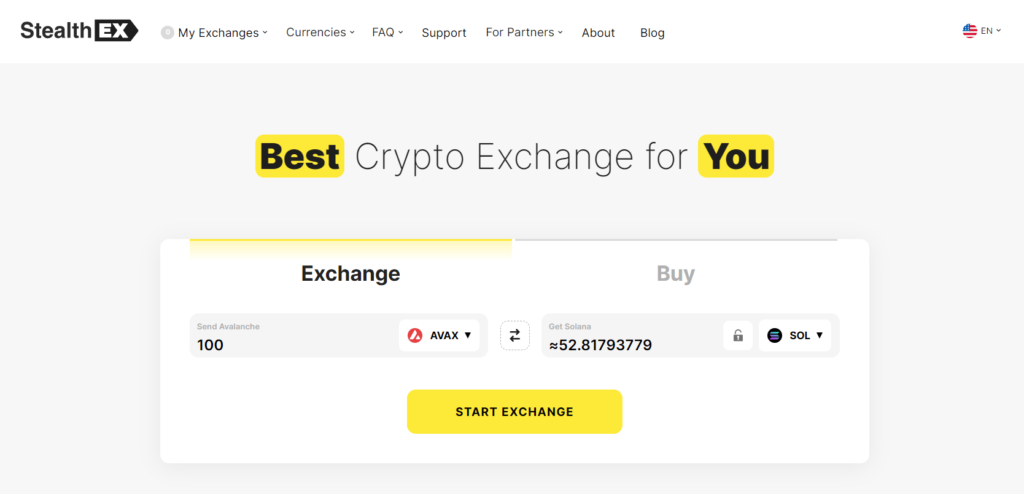
Step 2: Start the Exchange – Click the “Start Exchange” button.
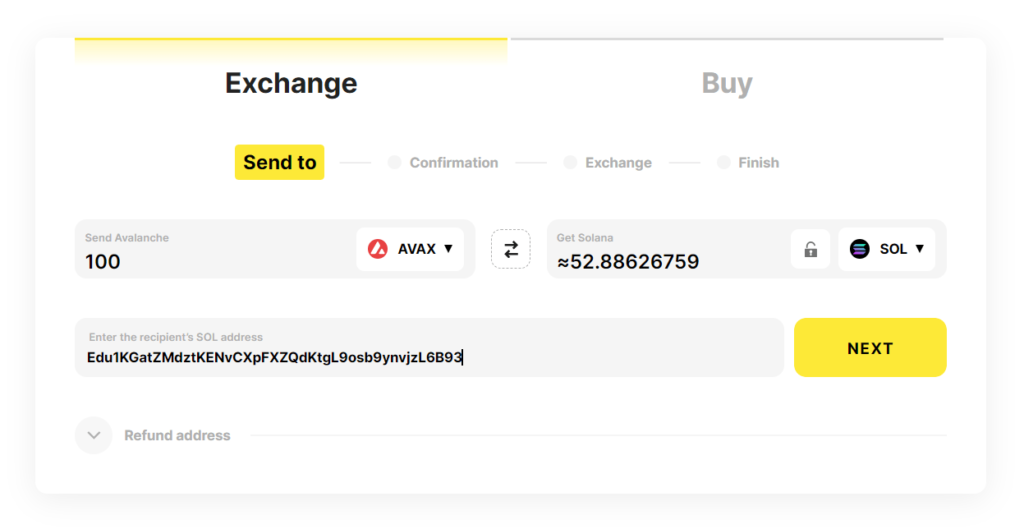
Step 3: Provide Recipient Address – Enter the address where you want to receive your SOL crypto.
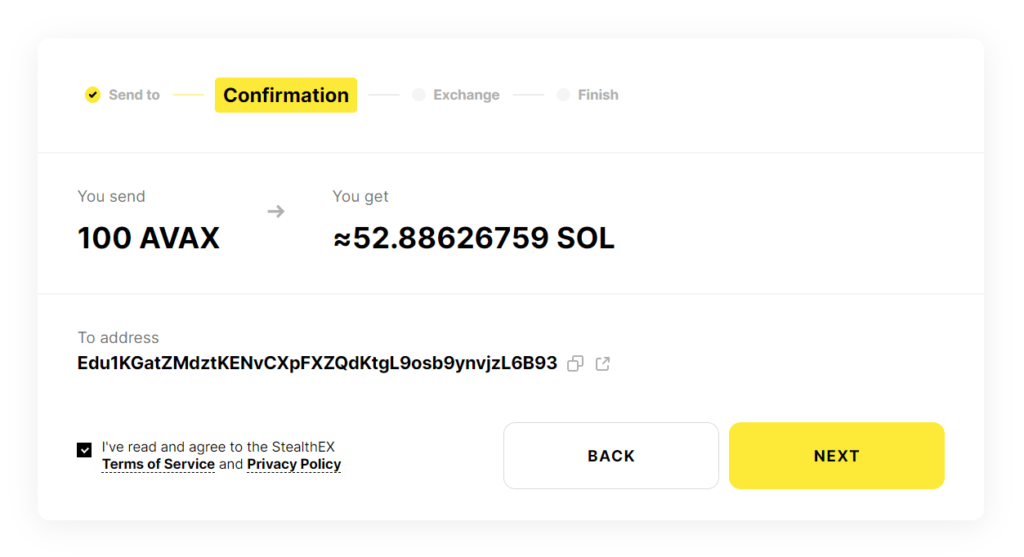
Step 4: Process the Transaction – Follow the instructions to complete the transaction.
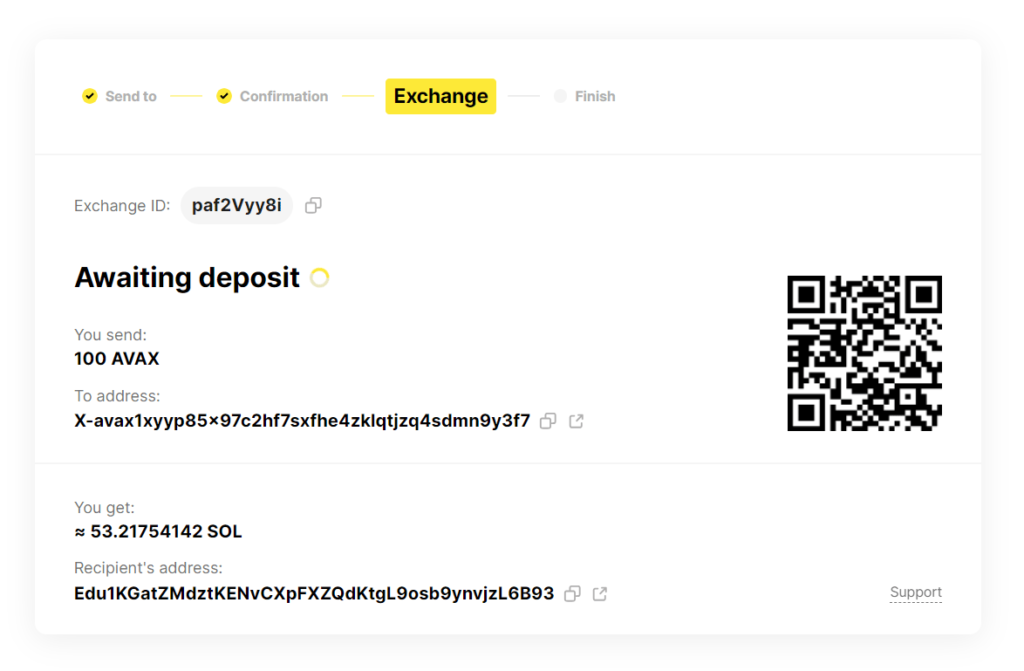
Step 5: Receive Cryptocurrency – Once the process is complete, you’ll receive your SOL coins.
The advantages of using StealthEX are numerous. It’s a platform where users don’t need to register or undergo extensive checks and verifications to exchange crypto. The process is peer-to-peer, meaning no third party is involved, enhancing privacy and efficiency. StealthEX ensures competitive rates by considering various factors such as pricing structure, gas fees, and slippage. Furthermore, they charge instant swapping fees, which include network transaction fees and other fees charged by their partners, varying depending on the chosen coin.
StealthEX stands out by allowing seamless cross-chain exchanges without the need for external bridges or intermediaries. This is achieved through a network of liquidity providers, including major centralized and decentralized exchanges. Such an approach not only offers convenience but also ensures competitive rates for users.
Of course you can use also AVAX to SOL bridges like Allbridge. However, platforms like StealthEX offer an even simpler solution for users who might not be familiar with the technical aspects of cross-chain bridges.
In the debate of Avalanche vs Solana, choosing between AVAX and SOL depends on individual preferences and needs. Solana’s high transaction speed and single-layer blockchain, as seen in the SOL vs AVAX comparison, cater to users prioritizing efficiency and throughput. Conversely, Avalanche’s multi-chain architecture and Ethereum compatibility make AVAX a versatile choice in the AVAX vs Solana discussion. For those considering AVAX to SOL transfers, using a reliable AVAX to SOL bridge is essential for seamless asset movement. Ultimately, whether it’s Avalanche or Solana, both platforms offer unique advantages, making the choice of AVAX or SOL a matter of specific use-case requirements.
The choice between Solana and Avalanche depends on your specific needs. Solana excels in transaction speed and efficiency, while Avalanche offers a unique multi-chain architecture and Ethereum compatibility, making it a versatile platform.
While Solana is highly regarded for its speed and scalability, whether it’s the ‘best’ crypto depends on individual investment goals and technological preferences. It’s one of the top contenders in terms of transaction efficiency and blockchain innovation.
Yes, Avalanche is a robust blockchain platform known for its unique architecture that allows high throughput, flexibility, and Ethereum compatibility. It’s well-suited for diverse decentralized applications and DeFi projects.
Avalanche offers benefits like a multi-chain structure and EVM compatibility, while Solana is known for its exceptional speed and efficiency. The term ‘better’ varies based on the user’s requirements and application needs.
The decision to buy AVAX or SOL should be based on thorough research and consideration of your investment strategy, risk appetite, and the specific attributes of each token.
AVAX, as the native token of the Avalanche platform, has potential due to its underlying technology’s adaptability, speed, and growing ecosystem. Its future prospects are promising, especially as the platform continues to evolve and gain adoption.
Yes, Solana is faster than AVAX in terms of transaction processing speed. Solana can handle up to 65,000 transactions per second, compared to Avalanche’s 4,500 TPS.
The AVAX to SOL bridge allows users to transfer assets between the Avalanche and Solana blockchains. It operates by locking tokens on one network and issuing equivalent tokens on the other, ensuring a seamless transfer process.
Generally, Solana offers lower transaction fees compared to Avalanche, attributed to its efficient single-layer blockchain and Proof of History mechanism, which optimizes processing and costs.
Follow us on Medium, X, Telegram, YouTube, and Publish0x to stay updated about the latest news on StealthEX.io and the rest of the crypto world.
This article is not supposed to provide financial advice. Digital assets are risky. Be sure to do your own research and consult your financial advisor before investing.
Avalanche AVAX Ethereum SOL Solana