India Crypto News: CBDCs Enter the Same Race as Stablecoin Rails
Cross-border money transfers could get cheaper for Indian families sending remittances home, and that's the biggest thread in India crypto news this week.
Source: X Official (@CryptooIndia)
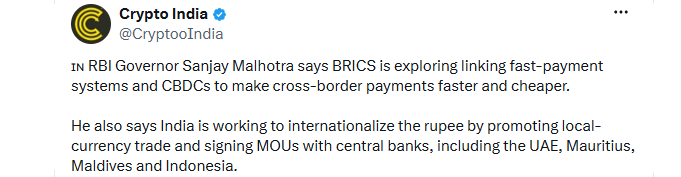
Reserve Bank of India Governor Sanjay Malhotra confirmed at a Mumbai banking conference that BRICS nations are discussing linking their fast payment systems and central bank digital currencies to cut transfer costs and speed up settlement.
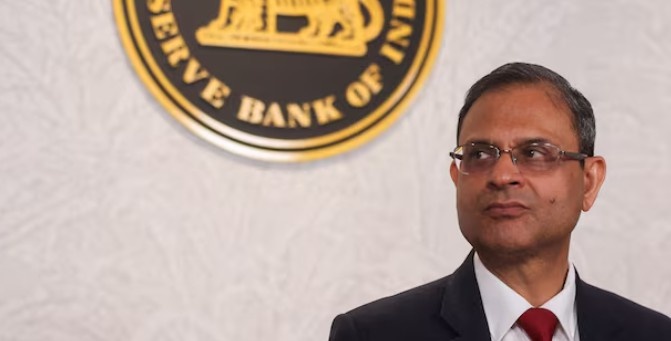
Speaking at the Ficci-IBA Annual Banking Conference, known as FIBAC 2026, Malhotra laid out where things stand.
Source: Reuters Official
He said BRICS has a dedicated task force studying payment options. These discussions include connecting national systems like India's UPI with digital currencies issued by central banks. He used UPI as a reference point, asking why foreign remittances should take hours or days when domestic transfers happen instantly.
Nothing has been finalized yet. Malhotra was clear that every option remains on the table, and no decision has moved past the discussion stage.
Key points from his speech:
BRICS has a dedicated payments task force studying cross-border options
Discussions include CBDC linkages and connecting national fast payment systems, such as India's UPI
Everything remains at the discussion stage — no launch date, no finalized architecture
Cross-border transfers today usually pass through several correspondent banks. Each stop adds fees and delays. For BRICS economies, that adds up to real money lost on trade and remittances.
With India holding the BRICS presidency in 2026, cutting these costs has become a priority. Malhotra also pointed to rupee internationalization efforts already underway. He shared these details:
India has signed local-currency trade MOUs with central banks in four countries: UAE, Mauritius, Maldives, and Indonesia
He acknowledged trade volumes under these arrangements are still small
Additional MOUs are in progress, though no specific countries or dates were named
Separately, RBI's own digital rupee pilot has grown to roughly seven million users, according to Deputy Governor T Rabi Sankar's recent comments, a scale point worth watching as CBDC talks progress
In India crypto news today, BRICS is exploring a model similar to what stablecoins already offer in the crypto market – faster and cheaper cross-border transfers. However, they are different from CBDC.
A CBDC is issued directly by a central bank, carries legal tender status, and is fully backed by sovereign authority.
A stablecoin is usually issued by a private company and pegged to an asset like the US dollar, with no government backing behind it.
The BRICS CBDC conversation Malhotra described is government-to-government infrastructure. It has nothing to do with privately issued blockchain tokens, even though the end goal, faster, cheaper transfers, overlaps with what stablecoin networks already do.
That distinction matters for how this India crypto news should be read.
Settlement networks built for cross-border payments already operate at meaningful scale, which makes the BRICS payment systems discussion worth comparing against real numbers:
Ripple's On-Demand Liquidity network uses XRP as a bridge currency across corridors including USD-MXN through Bitso and Japan-to-Southeast Asia routes via SBI Remit
Ripple counts over 300 enterprise partners, though independent trackers estimate fewer than 20 actually move meaningful XRP volume through ODL
On the stablecoin side, Stellar's partnership with MoneyGram has moved from a 2021 pilot to a full retail product — MoneyGram launched its own dollar-backed stablecoin, MGUSD, on Stellar in June 2026, built for its network of roughly 60 million customers and close to 500,000 retail locations across 200-plus countries
That Stellar-MoneyGram rail already runs live in Colombia and El Salvador, with more Latin American markets planned
If BRICS sovereign rails get built out, they would compete for some of the same remittance and trade-settlement volume these private networks currently serve, rather than growing the space for both side by side.
As India pushes rupee internationalization, questions about INR stablecoins are likely to resurface.
A rupee-backed digital token could theoretically support the same local-currency trade goals Malhotra described.
However, India's crypto regulation stance on private crypto assets remains cautious. India crypto adoption at the retail level still operates under tight compliance rules.
Any INR stablecoin discussion would need to fit within RBI's existing digital rupee framework rather than exist alongside it.
BRICS isn't moving toward Bitcoin or other decentralized cryptocurrencies with this proposal. Instead, the bloc is building sovereign digital-payment infrastructure that could compete with some of the same cross-border use cases currently served by stablecoins and blockchain payment networks.
The digital rupee remains a state-controlled project, separate from any idea of a common BRICS currency, which Malhotra did not endorse.
For anyone tracking India crypto news today, this story reflects a broader Asia crypto stance: governments want the speed and cost benefits blockchain technology offers, without handing control to decentralized networks.
As BRICS payment talks progress through 2026, the real story to watch is whether sovereign systems and private crypto rails end up competing, or eventually finding ways to work side by side.
Disclaimer: This article is for informational purposes only and does not constitute financial or investment advice. Crypto markets carry significant risk. Always do your own research before making any investment decisions.





