Inside a packed Senate hearing room on May 14, the air was heavy with the tension of a high-stakes jurisdictional brawl on the CLARITY Act.
What was intended to be a routine legislative markup became a grueling “tick-tock” of procedural maneuvering, personal barbs, and a desperate search for a bipartisan middle ground.
Ultimately, the bill cleared the Senate Banking Committee in a 15-9 vote after a gauntlet of last-minute objections.
However, the path to that victory was defined by a series of sharp clashes between pro-crypto Republicans and a Democratic wing led by Senator Elizabeth Warren, who challenged the hearing’s “good governance” framing within the first hour.
The morning began with Chairman Tim Scott attempting to set a tone of orderly progress.
Opening the hearing, Scott framed the CLARITY Act as a common-sense modernization of “outdated rules” that would prevent American innovation from fleeing to overseas markets.
Scott said:
“Safeguarding our national security means closing the doors that criminals, terrorists and hostile regimes have tried to exploit. This bill strengthens anti-money laundering and sanctions rules and gives law enforcement better tools to go after bad actions. None of this happened overnight.”
Scott’s strategy was clear: position the bill as a shield for the American Dream. He even invoked his personal history, mentioning his mother’s struggle as a single parent to argue that financial innovation should be within reach for every family.
By the time he concluded that “this is what good governance looks like today,” the Republican side of the dais seemed confident that the year of “good-faith negotiations” would lead to a smooth afternoon.
However, that confidence was short-lived as Ranking Member Warren took the floor and immediately pivoted from Scott’s talk of innovation to the economic anxieties of the kitchen table.
In her opening statement, she criticized the prioritization of a “pro-industry crypto bill” while American families struggled with rising grocery, health care, and utility costs.
Warrent said:
“Right now, American families across this country are struggling. We could be working right now on changes in the law that would help bring down prices and help unrig our economy… Instead of that, we’re spending our time working on a bill written by the crypto industry for the crypto industry.”
Warren cited a CoinDesk survey suggesting that just 1% of voters ranked cryptocurrency as their top concern. She also accused the Republican majority of ignoring a “crypto grift” involving the highest levels of government.
Warren specifically highlighted that President Donald Trump and his family have reportedly amassed $1.4 billion in gains from crypto deals since taking office last year.
“No President—and no one in Congress—should be allowed to profit from crypto at the same time that they are enforcing rules to regulate it,” Warren declared, setting the stage for a day of rejected ethics amendments.
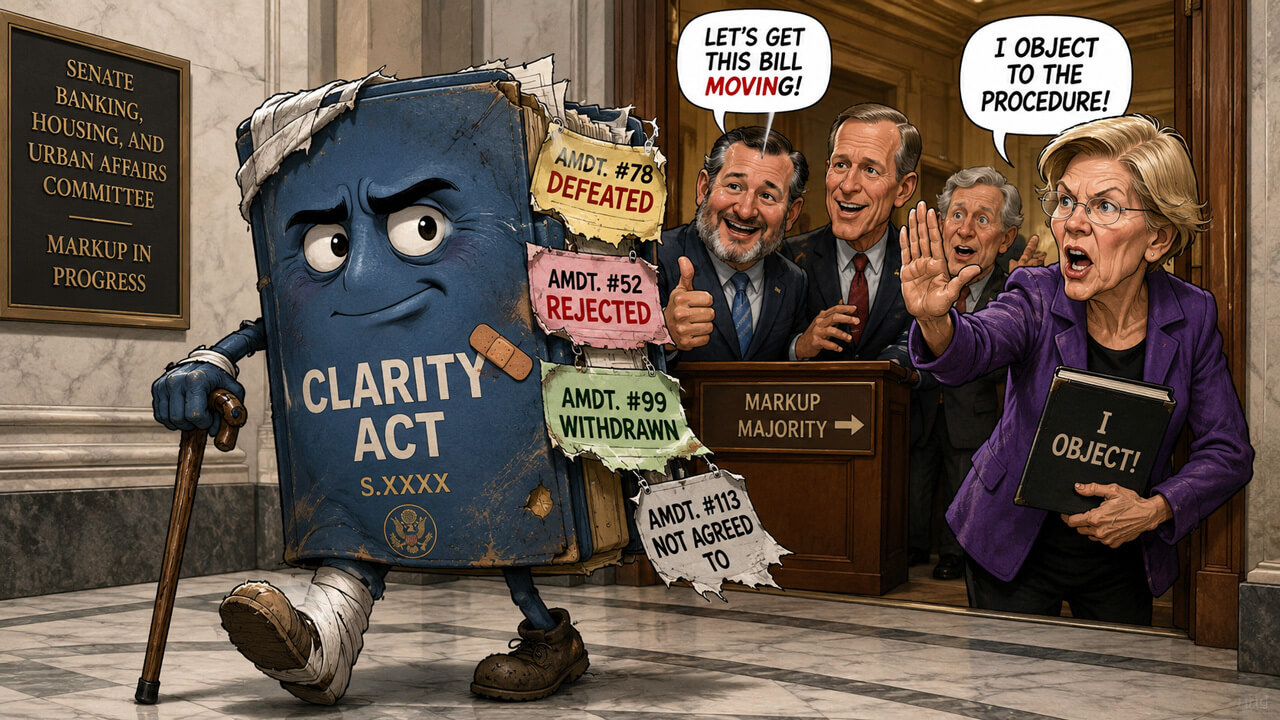
As the hearing moved into the “markup” phase, the atmosphere turned clinical and contentious.
Chairman Scott utilized his procedural authority to rule several Democratic amendments out of order, citing “procedural requirements.”
This move incensed the minority. Senator Jack Reed countered that the very “definition of working together at a markup is allowing amendments to be called up and voted upon.”
The room watched as a series of Democratic amendment priorities were systematically dismantled:
The recurring 11-13 tally became the heartbeat of the hearing, serving as a constant reminder of the razor-thin partisan divide.
While the political fireworks dominated the headlines, a more technical and perhaps more dangerous threat to the bill’s survival emerged from the traditional financial sector.
A coalition of the nation’s most powerful banking groups, including the American Bankers Association and the Bank Policy Institute, issued a joint statement after the markup, warning of “significant flaws” in the current draft.
The banking lobby’s concern centered on “yield.” They argued that without tighter prohibitions on interest-like rewards for holding stablecoins, digital assets would cannibalize traditional bank deposits. This, they warned, would starve community banks of the capital needed for local lending.
The groups stated:
“Without the necessary guardrails, stablecoin offerings are expected to draw away bank deposits and threaten local lending and economic activity across the country.”
Notably, Senators Reed and Smith had attempted to introduce a bank-supported amendment to restrict these yields.
However, Chairman Scott refused to hold a vote on the provision. Market observers suggested the refusal was a tactical move to avoid a “political liability” for Republicans who did not want to be seen as siding with big banks over crypto innovators.
Despite the procedural wreckage and the banking industry’s warnings, Republicans managed to execute a tactical “peel-off” of Democratic votes. Senators Ruben Gallego and Angela Alsobrooks joined all 13 committee Republicans to advance the bill.
The victory, however, came with a heavy dose of skepticism.
Gallego made it clear that his “yes” vote was meant to keep the CLARITY Act process alive and not an endorsement of the final product.
He stated that he reserved the right to flip his vote on the Senate floor if the final ethics agreement regarding the President’s crypto holdings was not strengthened.
The “crypto-champion” of the committee, Senator Cynthia Lummis, spent much of the afternoon playing the role of the diplomat. She praised the “expertise” of Democrats like Cortez Masto and the “hard work” of Senator Mark Warner.
Lummis framed the CLARITY Act as a tool for humanitarian good, arguing that Bitcoin allows vulnerable people, such as those in abusive marriages or escaping oppressive regimes, to carry their wealth “in their head” via memorized seed phrases.
The 15-9 vote successfully moves the Digital Asset Market Clarity Act to the Senate floor, but the “tick-tock” of the day suggests a rocky future.
Senator Mark Warner, who described the last few months as “crypto hell,” notably declined to vote for the bill's advancement despite his extensive work on the text.
His absence from the “yes” column signals that the 60-vote threshold required to overcome a filibuster in the full Senate remains a monumental hurdle.
As the hearing adjourned, the partisan lines were more deeply etched than when it began.
For the crypto industry, the day was a victory of survival; for the critics, it was a demonstration of how far the bill remains from a consensus that can satisfy both the GOP's “crypto capital” ambitions and the Democratic caucus's consumer-protection demands.
The post How CLARITY Act survived a chaotic Senate markup after Warren, Banks and Democrats tried to slow it down appeared first on CryptoSlate.





