Checkout pages have long been optimized for fewer clicks in order to reduce the likelihood of a customer abandoning their cart. Real-time payment checkout, however, takes things a step further. It focuses on the value proposition of instant money transfer for both the customer and the business in order to increase customer confidence, reduce time spent on checkout, and create faster settlement.
Here’s why real-time payment checkout is the next big thing and how it can benefit your bottom line.
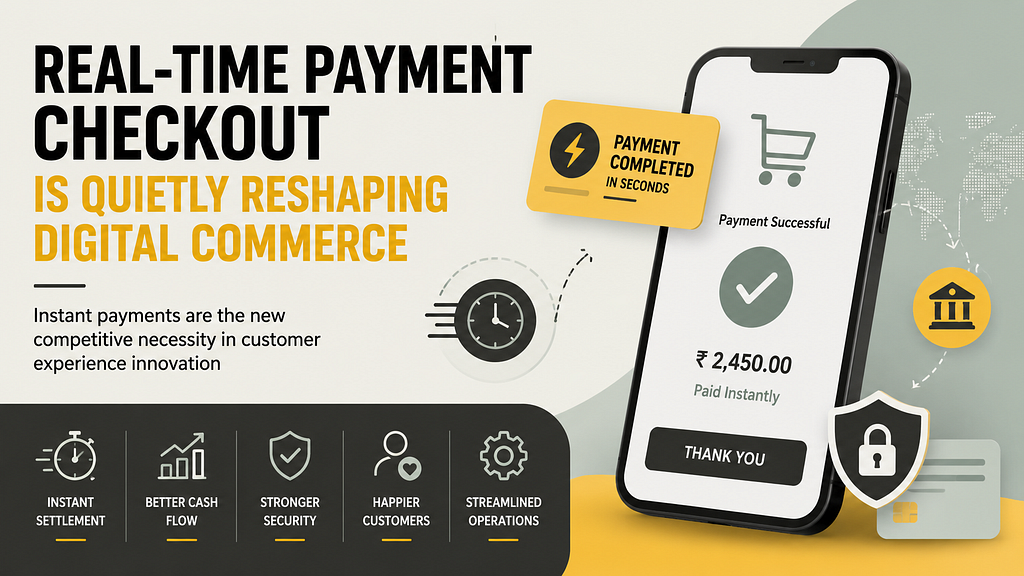
Traditional checkout processes have prioritized streamlined interfaces to reduce drop-off. While effective, this places the onus of optimization on the customer
Modern expectations demand immediacy from financial transactions. Settlement periods cause issues for both parties in an exchange, resulting in:
With digital transactions becoming the default choice for customers, the friction of payment processing is becoming more apparent. The immediacy of non-financial transactions (messaging, transportation, etc.) have raised customer expectations. Real-time payment checkout addresses this by enabling instantaneous movement of funds.
Real-time payment checkout refers to a system where money moves between accounts within seconds. Unlike instant customer feedback, this process involves a back-end optimization which reduces processing delays and provides confirmation right after customer approval.
A modern instant checkout experience should involve:
From a consumer perspective, it’s all very simple. However, this requires powerful payment messaging systems and reliable banking infrastructure to function.
Customers don’t care about the payment infrastructure, only the speed of the checkout experience. An instant confirmation of payment provides them with peace of mind. Their order has been processed and both the merchant and customer support don’t have to spend time double-checking if the money has arrived.
Minor UX improvements during checkout create major improvements across the business, including:
As customer expectations shift towards instant experiences, speed becomes a critical component of the product itself.
While applicable to most digital transactions, some industries stand to benefit from instant payment settlement more than others.
E-commerce
Merchants will see faster checkout and easier order fulfillment for both physical and digital goods.
Subscriptions, apps, games, and streaming services can grant access to their products immediately after payment confirmation.
Any platform connecting buyers and sellers stands to benefit from faster payouts as well as improved escrow services in the case of dispute resolution.
Booking services and related platforms can reduce uncertainty around payments.
Banks and fintech companies can provide faster account funding as well as settlement services to their business clients.
As competition intensifies across industries, payment speed goes from a nice-to-have to an absolute necessity.
A common concern raised against instant payments is the potential risk and fraud. In reality, many security measures are being implemented to ensure that faster payments aren’t compromised.
Modern real-time payment systems utilize:
Since money moves immediately, fraud prevention measures have to be taken in real-time as well. Instant payment systems are actually driving fintech security innovation.
Real-time checkout payments provide financial transparency as they settle immediately after confirmation. Instead of reconciling daily or weekly, businesses have access to precise financial data right away. This informs better business decisions around:
As such, instant checkout payments improve not only the financial health of a business but its overall operations.
There are several underlying technologies which make real-time payment checkout possible. Most involve optimizing the speed and reliability of money movement. Some of these include:
As financial institutions improve their own technologies, businesses can use these innovations to improve their own financial operations. What used to be only available to fintech giants is now accessible to small businesses as well.
The future of payments seems to be pointing towards instant fund transfers. However, it’s unlikely to exist as a standalone process. Rather, real-time payments will be used as enablers for richer digital experiences where the user isn’t actively aware of a financial transaction taking place.
Artificial intelligence will assist in fraud detection and optimization of payment transfers. Open banking will fuel account-to-account payments while embedded finance will provide financial services as a lubricant for industry-specific transactions. In the future, faster checkout payments can become an invisible expectation for the consumer.
Checkout has always served as the end-user culmination of a business’s operations. In many ways, it’s the first impression of the company. Real-time payment checkout is set to redefine customer expectations in a way that has lasting benefits for both sides of the transaction. It builds confidence, improves cash flow, streamlines operations, and enhances the overall digital experience.
As commerce trends towards immediacy, real-time payments will play a central role in delivering on those expectations. The companies best poised to succeed in this environment will be the ones that embrace faster checkout options and evolve with shifting customer sentiments.
While the next evolution of digital commerce takes shape, businesses would be wise to consider real-time payment checkout as a competitive differentiator.
Real-Time Payment Checkout Is Quietly Reshaping Digital Commerce was originally published in Coinmonks on Medium, where people are continuing the conversation by highlighting and responding to this story.





