Institutional crypto allocation stalls on due diligence, not conviction. Here is the checklist, with answers you can verify while you read.
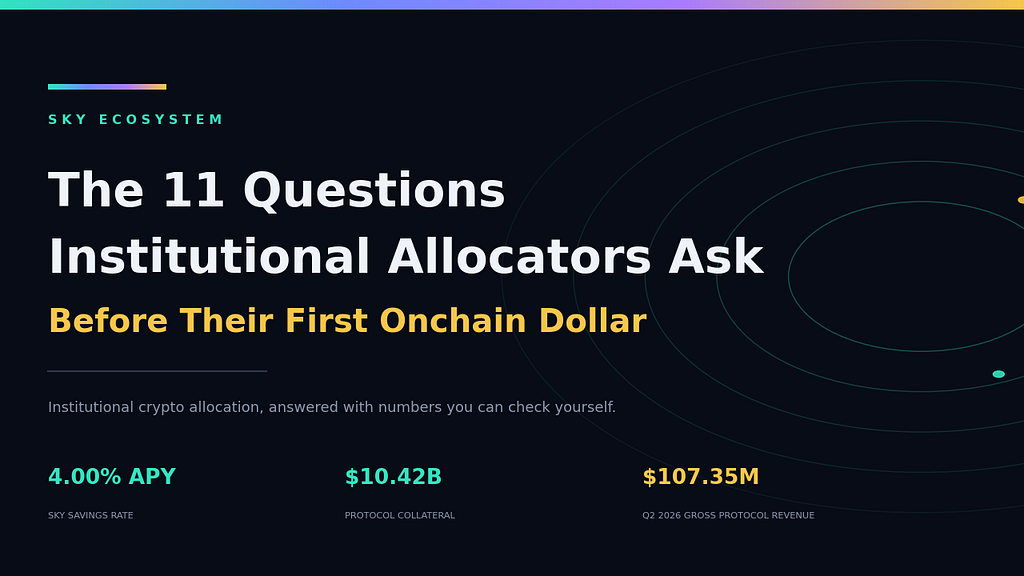
Institutions have made peace with stablecoins. They have not made peace with putting them to work.
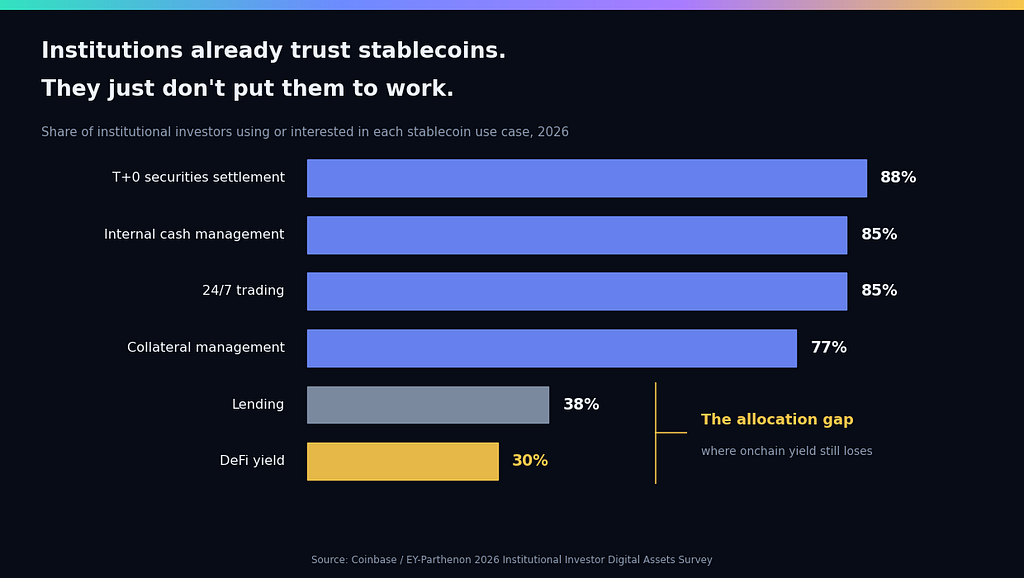
In the Coinbase and EY-Parthenon 2026 institutional survey, 85% of respondents said they use or want stablecoins for internal cash management. 88% flagged T+0 securities settlement. Then the same people were asked about DeFi yield.
30%.
That single gap explains most of what is happening in institutional crypto allocation right now. The dollar is already onchain. It is just sitting there.
Roughly 80% of stablecoin supply earns nothing at all. In any treasury department, idle cash at that scale would trigger a very short and very unpleasant meeting.
So the blocker is not conviction. It is an unfinished due-diligence list. Below is that list, in the order it actually gets asked.
Idle stablecoins are not a rounding error. Sky Frontier Foundation sized the addressable pool at more than $300 billion when it introduced Laniakea, its institutional capital deployment framework, in April 2026.
Meanwhile, allocation intent keeps climbing:
Read those together and the picture is obvious. Nobody is waiting for permission. They are waiting for answers.
What changed is not appetite. It is that the reporting finally caught up. Two years ago, an allocator asking for per-counterparty exposure on an onchain strategy got a blog post and a shrug. Today they get a live figure with a settlement date attached to it.
Four clusters, eleven questions. In practice a mandate dies at whichever one gets a vague answer, so treat vagueness itself as the signal.
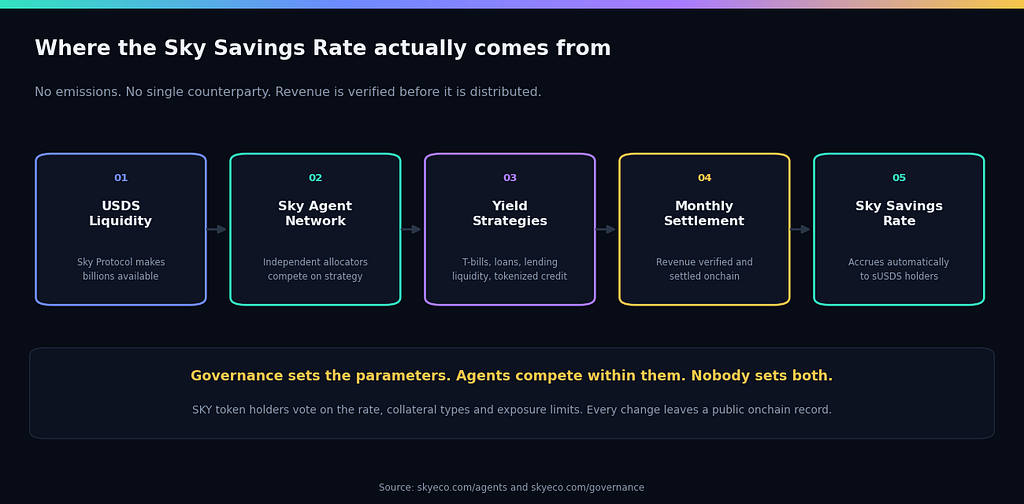
The Sky Savings Rate is not a token emission or a growth subsidy. It is funded by the Sky Agent Network: independent capital allocators that borrow USDS from Sky Protocol and deploy it into yield strategies.
These are firms with balance sheets and disclosure obligations, not anonymous vaults.
Every month, agent revenue is calculated independently by two parties, reconciled by governance operations, opened to a five-day dispute window, then settled onchain. The rate is paid from verified revenue, not projected revenue.
That is the Monthly Settlement Cycle. It is also the reason the number is boring, which is the highest compliment a rate can receive.
By design, not much. Sky Agents are separate businesses running separate books across:
No single counterparty, market or strategy carries the rate. That is the practical difference between diversification on a pitch deck and diversification on a balance sheet.
A yield funded by one counterparty is a credit exposure wearing a yield costume.
SKY token holders, by onchain vote. Not a desk. Not a discretionary committee. Every parameter change carries a public record of who voted, what changed, and when.
Yes, and any answer that says otherwise should end the meeting. The Sky Savings Rate is variable and currently 4.00% APY.
Earlier in 2026, governance cut it from 4.75% to 3.60% to prioritise reserve building over attracting supply. That is a governance body choosing solvency over marketing, which is behaviour you want to observe before you allocate rather than after.
Allocators who need duration certainty should say so early. Fixed Yield positions widened through Morpho integrations in July 2026.
Nobody. sUSDS is non-custodial. You supply USDS, receive sUSDS, and retain control throughout. There is no account to freeze and no balance sheet it sits on.
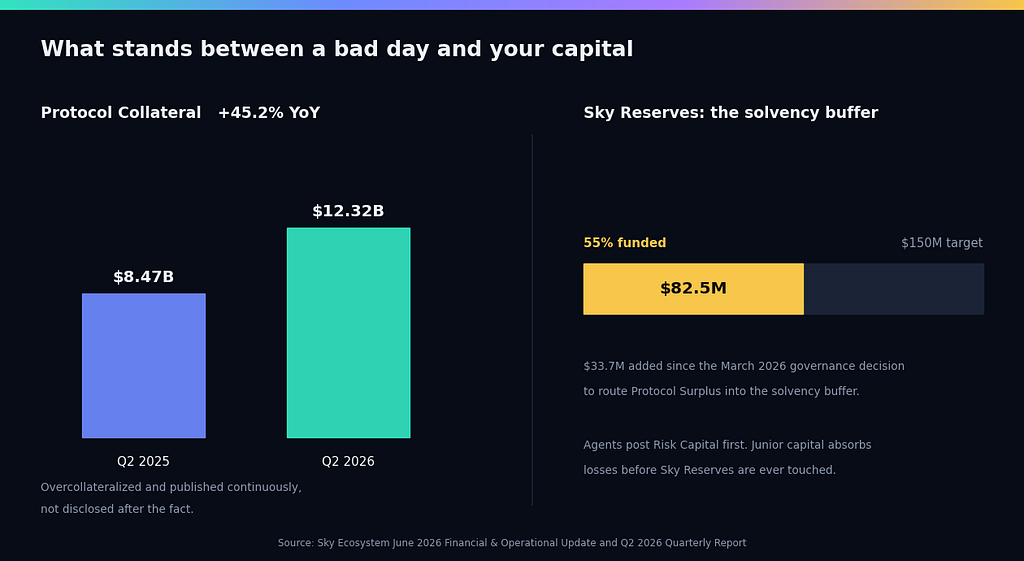
Protocol Collateral, held above a one-to-one ratio and published continuously. It closed Q2 2026 at $12.32B against $8.47B a year earlier, growth of 45.2%.
Overcollateralisation is the boring part, and plenty of protocols can claim it. The part worth checking is the publishing cadence. You can inspect the composition before you commit, not in a letter three months later.
Two layers sit ahead of you:
Sky Protocol has run for close to a decade under continuous third-party review, including ChainSecurity, Cantina and ABDK, with the security program expanded to Sherlock in July 2026. The audit list is public, so you can check who signed what rather than taking the claim at face value.
A public Safe Harbor agreement also pre-authorises whitehats to rescue funds mid-exploit, with a 72-hour return window and a capped bounty. Agreeing legal cover before a crisis is unusual. It is also the entire point.
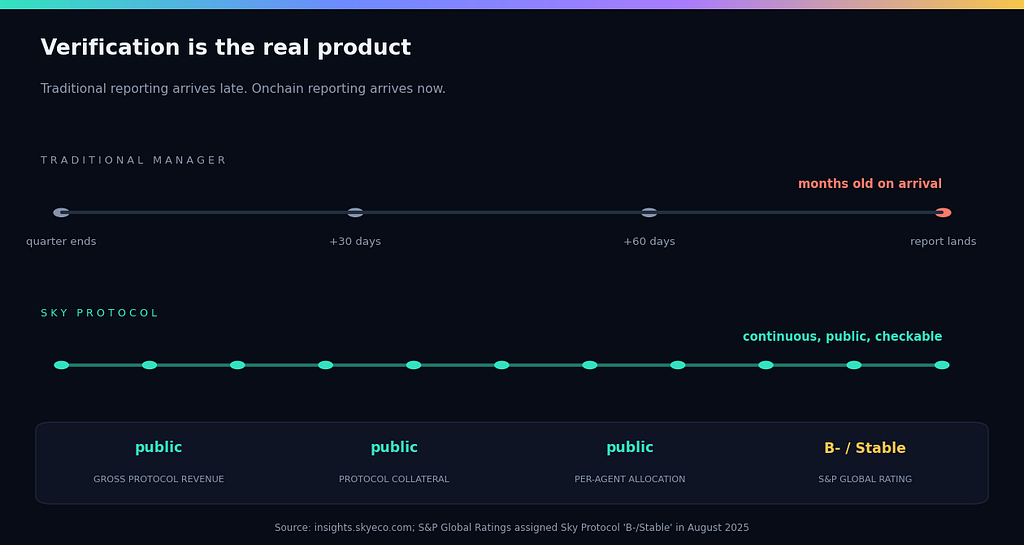
This is where onchain capital allocation quietly wins. A traditional manager reports quarterly, and by the time the report lands the data is months old. Sky Protocol publishes continuously:
It is also the first DeFi protocol ever rated by S&P Global Ratings, at B- with a stable outlook. The accompanying peg-stability assessment is public too, constraints included. Read both. A protocol that publishes its rating and its limitations is a different proposition from one that publishes neither.
That is precisely what Laniakea standardises, across four dimensions:
Bespoke integrations do not scale. Templates do.
Nobody allocates because of a headline rate. They allocate because eleven questions got answered without a pitch in between.
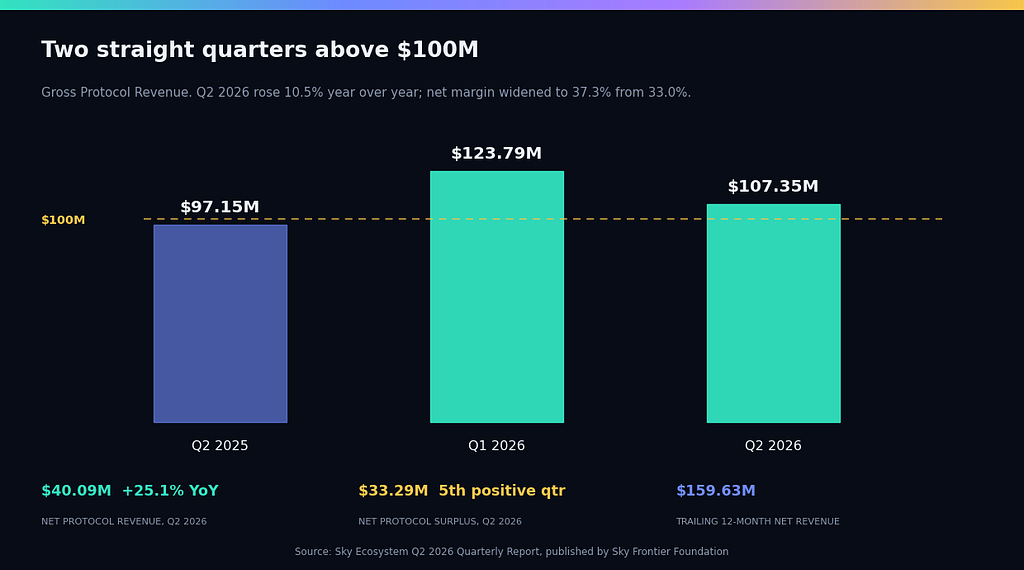
What is different here is not the yield number. It is that every answer above is checkable while you are still reading this sentence. Gross Protocol Revenue, Protocol Collateral, per-agent allocation, governance votes, audit history. All public. All current.
That is a strange thing to say about crypto. It is a stranger thing to say about traditional finance, where the same figures arrive on a quarterly lag and you take them largely on trust.
USDS supply reached $10.04B in June, up 41% year over year. sUSDS closed Q2 2026 at $5.52B, up 149%. The capital is arriving. The difference now is that the questions get asked first, which is how it should have worked all along.
So: which of the eleven is the one actually blocking your committee?
Drop the number in the comments, 1 through 11. I will answer what I can and tell you honestly where the answer is still being built. If it is a twelfth question I missed, that is more useful still.
Where to verify everything above:
Sky Agent Network: skyeco.com/agents | Protocol and audits: skyeco.com/protocol | Governance: skyeco.com/governance
USDS and sUSDS: skyeco.com/products | Reports and financials: insights.skyeco.com | Laniakea thread: forum.skyeco.com
Nothing here is financial, legal or tax advice. The Sky Savings Rate is variable and set by SKY token holder governance.
The 11 Questions Institutional Allocators Ask Before Their First Onchain Dollar was originally published in Coinmonks on Medium, where people are continuing the conversation by highlighting and responding to this story.





