Intelligence does not have to be artificial.
The goal of this field was always to reproduce what a brain does. Somewhere along the way “artificial” stopped meaning inspired by the real thing and started meaning nothing like it — enormous, power-hungry, and opaque.
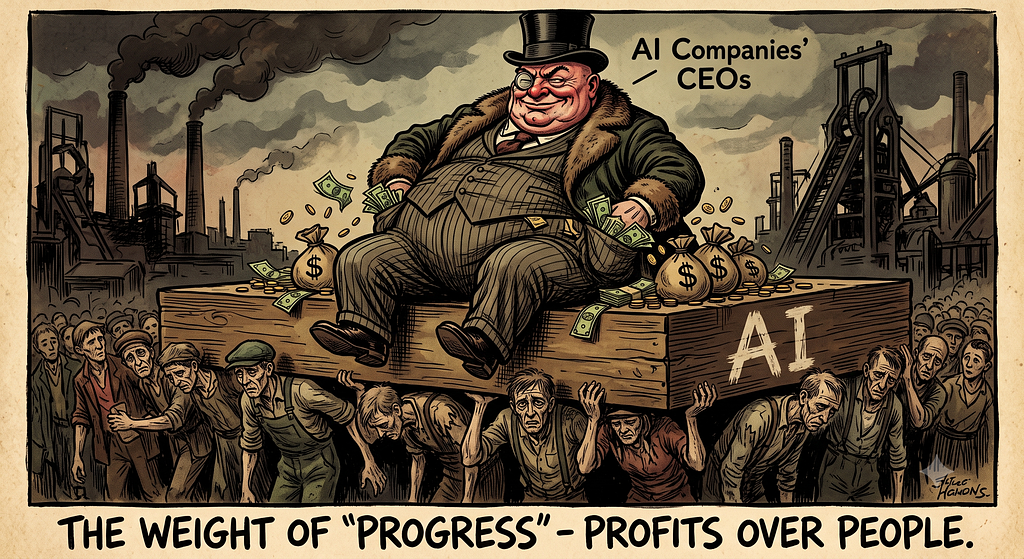
You’re tired of AI launches and IPOs? So am I. Every week there’s a bigger model, a longer context window, another benchmark nobody outside the lab can reproduce — and underneath it, the same machine doing the same thing a little faster and a lot more expensively. I mean, just looking at my emails these days is making me nauseous. I do not even check my social media anymore, and even less the stock market.
But, instead of complaining and be satisfied with the status quo, I decided to look at the problem from a different angle.
The main problems everybody knows without knowing it…
The cost problem isn’t separate from the design. It falls out of four choices that the field made early and never really revisited.
1- It reasons in the dark. Which makes hallucination or fake generation very hard to catch, yet to fix. Hidden states are well, hidden.
2- Scale is not intelligence. The reflex has been to make the model bigger and hope understanding shows up (it never will, the bigger the model, the more “links” it can do between concept and give the illusion of understanding). Scale = $$$$$$$$$$$$$$$.
3- Biology as the last of their concern. The brain runs on about twenty watts, and that number is a challenge, not a footnote. While we cannot make an AI that works on 20watts we can definately reduce the amount of energy consumption.
4- The root of it is profit. Not science. Even OpenAI leader is confirming it by saying that AI will eventually be sold like electricity and water — by companies like OpenAI. Article link: https://www.businessinsider.com/sam-altman-ai-utility-electricity-water-openai-2026-3
The goal of this field was always to reproduce what a brain does. Somewhere along the way “artificial” stopped meaning inspired by the real thing and started meaning nothing like it — enormous, power-hungry, and opaque.
I think we need to take the biology seriously instead of metaphorically: real neural mechanisms, a memory that consolidates the way a hippocampus does, a neurochemistry that actually modulates behaviour, learning that happens as the system runs rather than only in an offline training run. Those are design constraints, not decoration. And will lead to the “second generation” of AI.
a very convenient one if what you need is a reason to keep raising money.
While I have been plain, here’s where I don’t stand: AGI. The industry’s favourite three letters do a lot of quiet work — a general, human-beating machine, forever a few years and a few hundred billion away. It’s a wonderful story — or a frightening one, depending on where you stand — and a very convenient one if what you need is a reason to keep raising money. It’s a poor description of what these systems actually are, and a worse goal to organise a field around.
It’s a poor description of what these systems actually are, and a worse goal to organise a field around.
And the way today’s models are built won’t get there — not for lack of ambition, but for reasons you can put numbers on. Large language models improve along a scaling curve, and that curve has a shape: the returns diminish. Each new increment of capability takes not a little more compute but multiples more; the graph everyone cites bends the wrong way, flattening as the bill climbs. Every training run costs more than the last and buys less than the last one did. That isn’t a detail better engineering erases. It’s the shape of the method itself.
Every training run costs more than the last and buys less than the last one did. That isn’t a detail better engineering erases. It’s the shape of the method itself.
Now set that against a hard limit: power is finite. You can’t answer a curve of exponentially rising cost with an infinite supply of energy, because there isn’t one. A method whose only real lever is “make it bigger” runs into a wall that isn’t philosophical — it’s thermodynamic. Somewhere on that curve the next run stops being affordable, then stops being physically possible, long before it stops being merely better at text.
You don’t get a different kind of thing by making the same thing bigger
And that’s the deeper point: what scales here is fluency, not understanding. A model trained to predict the next word learns the statistics of language extraordinarily well. It doesn’t thereby acquire a grounded model of the world, a cause it can reason about, or a memory it can update — and no amount of the same training conjures those out of more of the same text. You don’t get a different kind of thing by making the same thing bigger. You get a costlier version of the same thing. A transformer is, underneath, a very good text generator; scale it and you get a better text generator — not a mind that understands, and not consciousness quietly emerging from the weights. Fluency is not comprehension, and no quantity of the first ever becomes the second. Something like general intelligence, if it’s reachable at all, will come from a different design — grounded, able to reason step by step, able to learn as it runs.
The point of this work was never to conjure a god
The point of this work was never to conjure a god. It was to build something genuinely useful — that reasons, remembers, and helps — and to run it on hardware people can actually afford. Intelligence doesn’t have to be general to be worth having, and it certainly doesn’t have to be a superbeing to earn its keep. Chasing AGI is how you end up with the bill on the other pages. Building something useful, efficient, and yours is how you don’t.
What a discovery is for, and how it gets used, stays a human call — the machine widens what we can see; the judgment is still ours.
None of this means the tools are useless — the opposite. An AI can read across billions of documents and surface a link between two of them in seconds, connections no person would ever stumble on alone. That is a genuinely powerful research instrument, and we build with it every day. But it won’t know what to do with what it finds unless someone told it beforehand what to look for and why. Finding is not deciding. What a discovery is for, and how it gets used, stays a human call — the machine widens what we can see; the judgment is still ours.
If one ever goes autonomous and causes genuine harm, it will be because a person somewhere pointed it that way —
Some people will tell you AI is the real long-term danger. We’d put it the other way around: the danger is us. A model does what it is built and instructed to do. If one ever goes autonomous and causes genuine harm, it will be because a person somewhere pointed it that way — wrote the objective, wired it to something it should never have touched, or pulled out the guardrails that other people had put there in the first place. Even the runaway story needs a human at the start of it: someone to build it, aim it, and take it off the leash. Even if it escapes, a human had to set it loose or dare it to.
That isn’t a reason to be careless — it’s the opposite. It means the responsibility is ours and stays ours, which is exactly why we should keep the reasoning legible and the controls somewhere a person can see them. A tool you can read is a tool you can hold to account. That matters far more than pretending the machine has a will of its own.
Now time for a little shameless self-promotion ;) I built Grillcheese Research Laboratory exactly to study, learn and solve those problems and share how to do it with as much people as possible. I invite you to check the link to our website if you are curious. https://grillcheeseai.com
Let me know in the comment what you think and if you have more ideas / different views / links.
Thanks for reading and have a wonderful day!
Yours, Nick
Beyond A.I. was originally published in Coinmonks on Medium, where people are continuing the conversation by highlighting and responding to this story.





